Showing posts with label colonialism. Show all posts

Saturday, February 20, 2016

The 100, Season Three, Episode Five: Hakeldama


So much happened this episode, I hardly know where to begin.  Last week, Pike's first move as Chancellor was to pardon himself and prepare to go to war with the Indra's forces.  It was clearly a decision born of the attacks his people suffered at the hands of the Ice Nation, but was short sighted in that he didn't for a moment consider that there are different nations for a reason.  This week we watched him go off to war with Bellamy in tow and when his forces returned, they had slaughtered the entirety of the army save Indra whose life Bellamy begged for.  Bellamy suggested that Indra remain a live in order for her to be able to tell her people that Skaikru was claiming the land for themselves and promised death to any Grounder who violated their new territory. Pike didn't suffer a single loss because of the fact that they had guns and the Grounders did not.

I think in many ways, The 100, have constructed Skaikru to be European conquerors and  the Grounders to be Indigenous people.  This is a troubling juxtapostion in that Grounders are always presented as backward and Skaikru as forward thinking.  I think making this story about colonization is great but for this to really work they need to make the Grounders far more sympathetic. We need to learn more about the culture and their language.  The 100 needs to make sure that the audience sees the Grounders as people who in their own way are being wronged.  This is particularly true with Pike declaring war.

Pike at this point is really a despicable character and though I can understand that he is acting out of fear and anger, it doesn't even come close to justifying his actions.  It's  particularly appalling given that on the station, Pike was a teacher, meaning that he better than most should have had some idea about colonialism which is what the theft of the grounder land is. Furthermore imprisoning people is beyond problematic.  Pike pulled people out of sickbay claiming that they didn't have enough medical supplies to share.  Lincoln was thrown in with the Grounders when he was deemed disruptive.  As a teacher, Pike must have learned about minorities being locked up, he must have known about internment camps and he still went ahead and threw them in prison.  For the life me, I don't understand why beyond, Abby, Marcus, Octavia and Clarke that no one else can see the harm which will come of this.  In earth's history, might is right has always lead to war and oppression. Having the person responsible for the atrocities be a man of colour also flies in the face of exactly who in earth's history has been responsible for things like slavery, internment camps, genocide etc,.

Marcus continues to show us how much he has changed.  He's not willing to openly challenge Pike, because Pike won the election fairly.  Well, plenty of harmful dictators were originally elected with a mandate that turned out to be destructive. It's a testament to how far his character has grown that I find myself rooting for Marcus of all people.

From the moment Bellamy decided to side with Pike, I very much felt that this decision was out of character for him.  As much as Bellamy has been actively involved in the decision making for Skaikru since receiving his pardon, he has very much been in a secondary role, happy to follow the orders of others or even more specifically Clarke.  Siding with Pike very much feels like he simply substituted Clarke with the first strong person to come along and to deal with his grief at the loss of girlfriend. I really do think that we need more of an explanation for Bellamy's decision to partner with Pike.

Tuesday, January 12, 2016

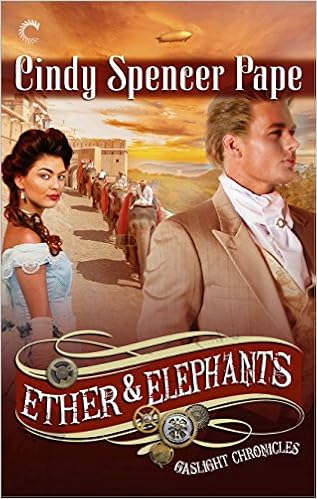
Ether & Elephants (Gaslight Chronicles #8) by Cindy Spencer Pape


After many years, Nell has finally forgiven Tom for his indiscretion and has determined to get on with her life.  Nell has decided to become a teacher and though it's not nearly as exciting as the life her siblings have created, for the most part, Nell is content. When her student Charlie goes missing, Nell is determined that she must find him.  Upon some investigation, it come to light that  Charlie may be Tom's son and while that knowledge stings a little bit it does not dull Nell's determination. It's not long before Nell finds herself in close quarters with Tom on a mission to save Charlie and though she has forgiven Tom, it's been a long time since they have been close.

Though this is the eighth book in this series, one need not have read the other seven to be able to follow what is going on.  Those familiar with the Gaslight Chronicles series however will enjoy the brief appearance of several characters who have had their own books.  We learn that they are all happy in their marriages and some have gone onto have children.

Obviously the purpose of this novel is to bring together Tom and Nell for their HEA.  The mystery itself was quickly resolved.  As with any romance, Pape introduced a stumbling block to forestall the HEA and in this case, it is Nell's reticence because Tom slept with someone before they were properly engaged and then married as a result of believing that he had gotten the young woman pregnant.  As much as Pape tried to stress Nell's desire for independence and a career, I could not help but find her to be a twit.  Nell wallowed for eight years before deciding to start leading her own life. Who the hell wallows for eight years?  Then there's the issue that at the time Tom slept with Polly, they had not even mentioned their feelings for each other.  How exactly did Tom break Nell's trust?  When Tom finally is free of his entanglements, Nell holds onto her stubbornness but suddenly without explanation, at the end of the book, Nell changes her mind and decides to marry Tom.  Then there's the little matter of Roger, the man Nell promises to marry who suddenly breaks off the relationship when he learns that Nell can control people with her voice.  Roger's speedy exit left room for Tom to sneak in and Roger was a useless unnecessary distraction.

I must admit that I dreaded reading this story.  From almost the beginning of the Gaslight Chronicles, Pape has made a big deal about the colour of Nell's skin.  I understand that attitudes about race in Victorian England would not have been as evolved as they are today but the constant exotification of Nell is beyond tiresome to say the least.  It made me want to scream, "I get it, Nell is half Indian get the hell over it."  Pape never missed a chance to point out Nell's skin colour or the fact that she is biracial. Nell, for all intents and purposes is the "other" in the Gaslight Chronicles.  It is then compounded by the fact that Pape decided to make Nell a princess.  I rolled my eyes so hard and fast that I nearly hurt myself when I read that.  Nell was well aware of the fact that she is of colour and does not shy away from it which is good but the way in which Pape handled race beyond that is problematic to say the least.
"Maybe he is my Micah, as you seem to suggest.  But more than anyone else here, you know what it's like to be different, to be darker-skinned than society expects, to be eyed with suspicion. Micah gave you refuse from that. A chance to live an ordinary life. That's no small thing."

The problem of course is that everything brown or Indian was backward, dirty, wrong and even worth less.  Nell even says that her biological mother described her father as "handsome, despite the hue of his skin."  Nell's father even preferred steak and tea and biscuits to curry.  Pape could have made some comment about internalized racism but instead continued on with her story as though the preference of a culture outside of one's own happens in a vacuum without the damage of colonialism. To be clear, there was nothing about British colonialism that did not have deleterious effect on Indian people. In fact, the harm continues to this day.

Thursday, May 23, 2013

Hammer of Witches by Shana Mlawski

Baltasar Infante is a story teller in Spain at a time when Spain has finally united and actively seeking to purge it's borders of anyone who has not converted to Christianity.  Being a Jew puts him and his family in a precarious position but when his father, the legendary Moor sorcerer pays him a visit one night, it brings Baltasar and his aunt and uncle to the attention of the Malleus Maleficarum.  Baltasar is forced to flee the only home he has ever known and when he gets a prophecy from the Baba Yaga that a great force is traveling west to end the world as we know it, Baltasar knows what he must do - kill the great Amir al-Katib.

As much as this story is about folklore, magic and religious persecution, it's also very much about colonialisation.  Much of this story takes place on Columbus's famous voyage west in 1492.  When the Baba Yaga speaks of a force moving west to destroy the world, what she is talking about is how colonialisation will destroy indigenous cultures and wipe language and history completely off the map.  Even if a single battle had never been waged, the diseases the Europeans brought with them alone would have been enough to start the genocide which did eventually occur.  Being Spanish, Baltasar could not conceive of the fact that it was the Spanish who were the threat.  This is framed as is part of his optimistic nature rather than his Eurocentric view of the world.  

Mlawski drew on a lot of folklore to write this book and it is evident.  There were golems, unicorns, and many other fantastical creatures from a host of mythologies.  It helped to make the world Mlawski created not only diverse but absolutely engaging.  To use his magic, Balthasar had to rely on his ability to synthesize folklore and take elements from it. The magic was also different according to race and gender. The Ayiti having a different belief system than Balthasar showed that even though their culture was different and perhaps not at technologically advanced that they were powerful in their own right. Then there is Catilina who uses the Joan D'arc spell to present as male because there are thousands of stories in which women must become men or appear to be men to gain a modicum of respect.