Showing posts with label alternate history. Show all posts

Wednesday, August 10, 2016

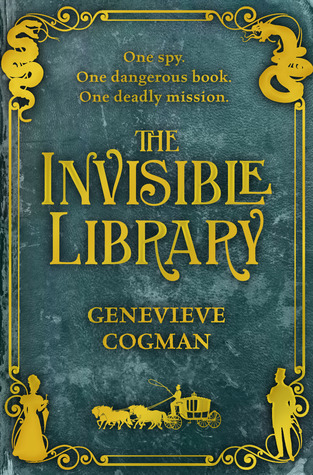
The Invisible Library (The Invisible Library #1) by Genevieve Cogman

Irene is a Librarian, and her task is to acquire rare books and take them back to the Library.  This means travelling to different dimensions.  Though having just completed a long mission, Irene is immediately sent out when she returns.  She's even saddled with a new apprentice, who hasn't left the library in five years.  Irene cannot fathom what is so special about this version of Grimm fairy tales that means she has to be sent into a chaos dimension inhabited by fae, vampires and werewolves to snatch this book. Librarians however do not question, they only do and Irene gathers her courage and takes a leap that will ultimately lead to her meeting the Library's arch nemesis.

There were times when I almost gave up on this book.  It began very quickly and then just as quickly ground to what felt like an absolute stand still.  A major part of the problem with The Invisible Library, is that it is hopelessly overwritten and tries to desperately to be too many things. I understand that in order to affect the world around her, Irene had to speak in a special kind of language however the explanation of this skill seemed to go on forever.  I also quickly became tired of reading about the tattoo on her back. I think that Tolkien relies on Elvish less than Cogman relies on the language as a writers device.

The Invisible Library has a strong steampunk element to it.  Cogman story includes dirigibles and things like mechanical centipedes attacking on the streets of London.  Cogman takes great care to repeatedly remind the readers exactly how dirty this London is.  She talks about the smog hanging in the air, the scarves people strap around their mouths and noses, as well as the effect it has on statues. Yes, London during the industrial revolution with its towering smoke stacks was filthy and extremely polluted.  Anyone with the slightest sense of history is well aware of this which led me to wonder why it is that Cogman kept repeating these mundane facts to the reader? It felt like an effort to increase word count rather than to make The Invisible Library a more vivid read.

This novel also felt very piecemeal as though Cogman was simply throwing things against the wall to see what would stick.  Irene reads as a self insert as she talks about how much likes detective stories. It feels like Cogman's way of explaining why she has inserted a very Sherlock Holmes like character into The Invisible Library.  The concept of Librarians hunting down books and storing them away feels directly lifted from the television show The Librarians; however, Cogman doesn't infuse her story with even half of the humour. Then there are the vampires, fae, and werewolves just thrown in for what feels like shits and giggles, though Cogman explains their presence by claiming they are because of the chaos infused world. This concept should have been a readers paradise but the execution absolutely let it down.

Thursday, January 14, 2016

Better Off Undead (The Bloodhound Files #4) by D.D. Barant

Despite the fact that everyone has told her to give up on Doctor Pete, Jace is determined to kill Tair and bring back her friend.  To that end, without securing back up, Jace attempts a magical rescue mission of sorts, only to end up scratched by Tair and no closer to Doctor Pete.  Now Jace has to deal with the potential of turning into a werewolf - that is if her boss cannot cure her with vampirism.  If that weren't enough to deal with, Jace now finds herself chasing down a mob boss gone rogue, as she follows Tair's trail.  With so much at stake, Jace is desperate to hold onto her humanity; however, even if Jace is cured, someone might still have to die.

As mentioned in the description, a lot of the plot revolves around Jace's quest to stay human; however, as a reader I never believed that Jace would lose her humanity. Other than being from another dimension, Jace's humanity is a lot of what makes her super special in this world and if she were to lose that, she wouldn't be the same character.  The minute that Cassius became involved, it became evident that not only would Jace remain human but that this would be used to advance the romance between the two of them.  At no point did I ever really feel that either  Jace or Cassius were in actual jeopardy. Let's be honest, the two have plot immunity up the ying yang.

I still very much enjoy this alternate dimension world with its slightly twisted versions of what we have today.  Gally the weredog continues to be one of my favourites, along with Charlie the golem. At this point, Jace is pretty much acclimated to this world and is quite comfortable with the fact that she doesn't really fit in anywhere.  Jace knows that remaining human means that she won't quite fit in  but is confident that without her humanity, she won't be her authentic self.  Even though the end goal is to return to her home, Jace seems less and less fixated on this as this series goes on.

As a protagonist, I still find Jace somewhat irritating because she tends to just barge forward without much forethought. When Jace frees a group of vampire sex slaves for instance, she sends them to a hotel with a bag of money and that is pretty much the last we see of them.  How exactly is this solving the problem that these now free women find themselves in? Jace is simply content to pat herself on the back for a good deed done and move on.  As much as the acclimation with this new world is good, Jace as a character really needs to have some growth.  At this point, she feels absolutely stagnant.

In terms of isms, Better Off Undead is absolutely loaded with problematic elements.  Reading this book very much feels like wading through muck to get to the good parts. None of the problematic elements in Better Off Undead are necessary to the plot whatsoever, particularly given that Thiropirelem is an alternate universe.  This means that Barant made very specific choices about what to include and what to exclude.  The history of Thiropirelem didn't have to unfold the way that it did.

Thursday, May 23, 2013

Hammer of Witches by Shana Mlawski

Baltasar Infante is a story teller in Spain at a time when Spain has finally united and actively seeking to purge it's borders of anyone who has not converted to Christianity.  Being a Jew puts him and his family in a precarious position but when his father, the legendary Moor sorcerer pays him a visit one night, it brings Baltasar and his aunt and uncle to the attention of the Malleus Maleficarum.  Baltasar is forced to flee the only home he has ever known and when he gets a prophecy from the Baba Yaga that a great force is traveling west to end the world as we know it, Baltasar knows what he must do - kill the great Amir al-Katib.

As much as this story is about folklore, magic and religious persecution, it's also very much about colonialisation.  Much of this story takes place on Columbus's famous voyage west in 1492.  When the Baba Yaga speaks of a force moving west to destroy the world, what she is talking about is how colonialisation will destroy indigenous cultures and wipe language and history completely off the map.  Even if a single battle had never been waged, the diseases the Europeans brought with them alone would have been enough to start the genocide which did eventually occur.  Being Spanish, Baltasar could not conceive of the fact that it was the Spanish who were the threat.  This is framed as is part of his optimistic nature rather than his Eurocentric view of the world.  

Mlawski drew on a lot of folklore to write this book and it is evident.  There were golems, unicorns, and many other fantastical creatures from a host of mythologies.  It helped to make the world Mlawski created not only diverse but absolutely engaging.  To use his magic, Balthasar had to rely on his ability to synthesize folklore and take elements from it. The magic was also different according to race and gender. The Ayiti having a different belief system than Balthasar showed that even though their culture was different and perhaps not at technologically advanced that they were powerful in their own right. Then there is Catilina who uses the Joan D'arc spell to present as male because there are thousands of stories in which women must become men or appear to be men to gain a modicum of respect.

Wednesday, October 10, 2012

Review All Timelines Lead to Rome by Dale Cozort

When the police are called in to investigate the murder of a woman, the journey doesn't just take them across middle America but into an alternate earth. This secondary earth is a world where no industrial revolution has happened, and Romans still rule Europe. To get the menial tasks done, the Romans have enslaved a group of pixies, which are humanoid creatures bred specifically to please there master in whatever fashion is needed. No colonization has occurred and this means that Indigenous people still control all of the land in North America.  This is a world out of time essentially. This is a world where none of the natural resources have been tapped and untold treasures are still to be discovered.  Ancient artifacts are easily available for the taking.

Someone has been accessing the alternate earth and this means the possibility of them wiping out the  Indigenous population with diseases that we have long ago built immunity to, or introducing advanced weaponry and starting the project of colonization again. It also puts our current earth at danger of small pox, should someone infected with the disease return. There is also the danger that interacting with the Romans or indigenous peoples will change their culture and path of development. Do we have the will to allow these people to develop naturally without our intervention?

I think this book walks the line between sci-fi and alternate history and manages to pull it off well.  When it does move to the alternate world, Cozort adds little details like being able to drink directly from streams and a lack of things like satellites and motorized vehicles to provide convenience. This alternate world quickly becomes real to the reader and one can almost smell the pollution free air.

Though the title of the book is All Timelines Lead to Rome, the book is really all about the exploitation of North American Native people. I can see that Cozort took some time investigating the various tribes and how they lived, the problem is that the book read very much like a White saviour complex.  Much of the motivations behind the characters was to save the Indigenous people from colonisation  and of course exploitation. Scott, the professor, was highly aware of how the introduction of Europeans to North America not only brought diseases which the Indigenous had no immunity to but advanced weaponry.  Obviously, what happened in our timeline was a genocide and it makes sense that the characters would want to avoid this, the problem is that those truly concerned where all White, making the book read like Rudyard Kipling's White Man's Burden.  Jeni sought to give the Indigenous a chance by introducing them to advanced weapons in an effort to speed up their development because she believed that it was only a matter of time until our timeline began  exploiting them.  This approach of course does not factor in potential harm from disease. This entire book seemed to reify the ridiculous binary that Native tribes are backward and need saving.  It makes absolutely no sense to me why Indigenous people from our timeline would not be concerned about their people on the other side.  All we got were the opinions of White people on the issue.