Showing posts with label steampunk. Show all posts

Thursday, March 8, 2018

The Bride Wore Constant White (Mysterious Devices #1) by Shelley Adina


After Daisy’s mother died after her father disappeared, Daisy became the responsibility of her aunt and uncle. And they would very much like to marry her off and get her out of their hair

Daisy is not thrilled with the chinless future planned for… and instead is more determined to find her missing father; in the Texican Territories, a continent away

Her sister joins her on the voyage - but when there’s a murder on her journey and an innocent man seems likely to hang for it, she cannot justy move on; not until she tries for justice, especially since no-one else seems willing


This is a continuation of Shelley Adina’s Magnificent Devices series - being set in the same world and with many excellent call outs and connections to the characters within that series. But those connections are small, none of the main characters are particularly intimate or involved with those characters, those characters have not adventured with these characters and have no real draw upon them. And I think this is important. Claire and all her friends and family and flock are awesome characters but their stories have all progressed to a whole new level. Between them they have vast resources, extremely powerful, loyal friends and connections at the highest possible level of society. They are not the plucky underdogs standing firm against the vast world. They are integral to that vast world. That doesn’t mean Claire & co can’t have plenty of stories yet - but the scale and scope of them, by necessity, need to be much grander. We already saw this in the last few books - defeating invasions of England, stopping a war between the Californios and the Texican territory. The Story of Claire, Gloria, Alice, the Mopsies et al has, by necessity, become far grander and far more epic than how it started

So when returning somewhat to the root of the story, while keeping the connection and call outs to the old books for excellent recognition and confirmation that this is the same world, we also have a protagonist who will not be able to send up the batsignal and expect all the arsenal of Claire’s flock to rain down. Similarly, while you can pick up any of the books in the Magnificent Devices series and not need to have read the previous books: but this

Also there’s Mr. Featherstonehaugh who is sadly lacking in the chin department and so very suitable. Alas this poor man, may he one day actually find a bride.

So we have Daisy - and she’s a wonderful character - different again from all the previous protagonists we’ve seen before: yet still strong, capable, determined, brave and intelligent. It’s one of the gems of this greater world and series that we all of these women who are so very very different from each other yet still have their own strengths

In Daisy’s case, she’s probably much more conservative than most of her fellow protagonists. She doesn’t exactly rail against the mores of society exactly, and even her sister finds her unnecessarily proper. I actually like this, especially next to the other series, because it shows competent and capable women not just those exceptions who move against society as competent: a common theme in the series. But she does object to her uncle and aunt trying to pawn her off on any suitable, albeit dull and chinless, men they can find, at least in part to remove their duty to support her.

Thursday, December 14, 2017

The Queen of England: Coronation (The Queen of England #2) by Courtney Brandt


Queen Victoria is dead, killed along with her whole family in a terrible terrorist attack that shook the empire and led to Juliette, young, inexperienced and far from the throne as the next queen

The New World Order has claimed responsibility for the deaths and threatens not just Juliette’s reign but the world itself; Juliette must try to expose this conspiracy while securing her nascent throne, some inconvenient romances and the hunt for Excalibur itself.

Fantastical Steampunk is one of my favourite genres - I do like the whole aesthetic and plot of running around in dirigibles with mechanical arms and steam powered gadgets - but to throw magic, unicorns (unicorns!!!) and arthurian legend in as well and I am sold. We’re taking those elements - magic and machines - and engaged in deadly attempt to take down a shadowy conspiracy that would plunge the whole world into chaos by any means necessary, with battles, shadowy plans and lots of hidden agendas and looking behind every corner for who the enemy is.

If anything I wish this book had explored this more because the world we have laid out here is really excellent. The existence of magic, Excalibur and air ships it all tantalises so much - but that’s kind of the theme of this book: tantalises. We have Excalibur with apparently lots of powers and perhaps its own agenda but we don’t really explore that.

We have a fascinating female crime boss with a shadowy but apparently legitimate past running around doing swashbuckling things… but we don’t really focus on her except as a provider of resources.

We have the American heiress to a major technological corporation pursuing an illicit love affair and ready to offer friendship - but we don’t really explore her

We have a street urchin turned footman with a mechanical arm and lots of streetwise contacts

We have a society of magic users who apparently follow the legacy of Merlin and have done so for generations - but they’re only mentioned.

A county whose principle resource is unicorns, is in much demand by European nations and appears to be African (it’s not explicitly stated but North Africa was implied), but we only get their prince visiting?

It’s like this whole book throws out a million fascinating storylines, characters, world building etc and we don’t actually spend much time on examining any of these amazing things instead focusing on Juliette

Who is a decent fun character but kind of overshadowed by the vast potential of everyone around her. Not because she’s bad, but because everyone else around her, everything else around her, could be so amazing

Tuesday, June 6, 2017

The Adventure of the Incognita Countess by Cynthia Ward


Lucy is an agent for the crown charged to ensure important plans being delivered to the American government actually arrive and don’t fall into the hands of a hostile foreign power: especially as tensions rise and Britain’s new Martian technology is in high demand.

As a dhampire, a half-vampire, she is uniquely qualified for this role – and for vampire slaying. Which is complicated when a vampire joins her on the HMS Titanic – and a vampire that conflicts so strongly with what she has been taught and tempts her away from both her duty and her mission.


This is one of those books that frustrates me immensely – because it’s only a book. Worse, it’s only a short story. Because, by all that is awesome, why is this not a book series? Why is it not a book series covering many many many books?

Bisexual female dhampire secret agent working for the government in a Steampunk setting that has the feel of both The League of Extraordinary Gentleman and Penny Dreadful pulling in all those Victoriana stories from Martian invasions to vampires and men raised in the wilderness – and so much more. All of it mixed in with real world politics of the time adding some nice intrigue to the story of the supernatural secret agent. All of this world building is nicely hinted at, included briefly but not overwhelming the actual plot and development of this short story.

Of course the bitterness of that is there’s so much of this world building which we could so play with! I want to see it all, the martial technology, the supernaturals incorporated into the world and government agencies and Lucy’s own personal situation and development and growth as a dhampire.

With this world we have a nice plot that does an excellent balance between action and development and world building that really just left me wanting more because there’s so much potential. Lucy’s story and development, lots of intrigue and lots of action which is really well written along with lots of emotional; development and world building all perfectly balanced.

Thursday, May 4, 2017

Fields of Gold (Magnificent Devices #12) by Shelley Adina


Gloria is ready to do anything to try and stop the war and convince the Viceroy of Spain and the Californias to stand his army down – and to stop his devastating dam

But is she willing to marry a man she just met – again – and give up her chance at love?

And how does one say no to a prince when surrounded by his army?

It’s a dangerous, difficult political game Gloria has to play – and the entire country may be irrevocably changed by it


It’s hard not to sound like a broken record when talking about a series that continues to do the same thing right every time – but I have to say it again: I love how these women work together. I love how we can have several capable, intelligent, skilled women who are happy to work together without competing, without hating each other, without unnecessary dislike or conflict, without jealousy, without rivalry but with genuine friendship and respect. We have Gloria and Alice of course, but we have the Brujahs and we have Honoria and we have Isabella

I think it’s Isabella that stands out to me, not because she’s specially stand out character – but because there was no narrative push to have another strong female character from the Spanish aristocracy. But she’s there – she’s there to show the strength and intelligence of women from every corner of this world

And I love the rose rebellion, the power of women who aren’t just going to be silent in a land that oppresses them so completely; the power of women in a place that tries to deny them all power – and how being oppressed doesn’t mean they have no capability and intelligence. It’s a wonderful element to add

Oh and there’s a moment that had me fall to my knees in praise. Two of Gloria’s good friends unfortunately, through sharing too much information, put her in a difficult position. It is a betrayal. And Gloria is hurt… and then gets over with it. I mean, she’s angry and upset but there’s no big dramatic tantrum, there’s no refusal to talk to them about it, there’s absolutely no holding a grudge for the entire book. It didn’t downplay what happened but at the same time everyone had much more important things to concern them than this. It’s also very natural and real – yes her friends made a mistake which hurt her, but they’re still her friends, she still values them and she’s not going to dramatically throw away their relationship because of it. I wish I could see this more often when we have so many protagonists who take chapter on chapter to get over an offence like this.

Tuesday, October 18, 2016

Toru The Wayferer Returns (Sakura Steam #1) by Stephanie R. Sorensen


Japan isolated themselves from most of the world under the policy of sakoku, limiting its contact with foreign nations to preserve the Japanese way of life – until Americans forced the opening of Japanese ports with “gunboat diplomacy”

But the Japan of Toru the Wayfarer is different – this is a Japan where Toru, a traveller, returned to Japan from the west with a warning – and guides to technology that may save Japan and keep her independent: able to say no to the inevitable arrival of foreigners


While this book was advertised as a steam punk, I think it is much better termed an alternate history since, beyond a few dirigibles and dubious submarines, there’s little steampunk element

This book looks at what would have happened if Japan had managed to industrialise and arm itself with modern weaponry before Commodore Perry forced the opening of Japan to trade and the end of the Sakoku isolationist policy that Japan

The book contains a lot of historical references and research drawing on actual events of the time as well as actual daimyos who were present and involved in Japan at the time. It includes a lot of history of Sakoku and policies around it.

We follow the story of how Toru, returning to Japan after visiting America – back when it was illegal to do so and returning from abroad carries the death penalty under the isolationist policy. He brings with him lots of information from the west including a whole lot of guidance on technology and weapons – and the warning that the Americans are coming. There is a lot of references to the Unequal Treaties and stark warnings using China as an example of how a mighty, ancient and great nation in the world can be utterly abused by predatory treaties forced on them by gunboat diplomacy.

While Toru is certainly bringing in western technology and knowledge to help “save” Japan, there is a definite emphasis on the Japanese working together, working to keep themselves independent and free from brutal unequal treaties. This is not a white saviour narrative, every character in this book – except the late arriving western threat – are all Japanese and there’s even an attempt to at least make the names of the technology they’re adopting to fit Japanese pronunciation and word structure. There’s also a major point that the technology would be adapted to Japanese ways – for example, introducing sewing machines doesn’t mean that they’re going to produce western clothing – they will make yukata and hakama. To quote:

Thursday, October 6, 2016

The Masked City (The Invisible Library #2) by Genevieve Cogman

Things take a turn for the worse when Kai, Irene's dragon assistant is kidnapped. Irene must now risk travel into a world filled with chaos to save him and somehow in the process avert a war.  With no allies to count on and a very real fear of breaking her vows to the Library, Irene sets off on her rescue mission.  Successfully rescuing Kai could just mean her banishment but failing to succeed could very well be the start of the war that the fae were hoping to provoke when they kidnapped Kai. No matter which way Irene turns, the only thing that is certain is that her options aren't good.

I was very hesitant to pick up The Masked City given my dislike of The Invisible Library, the first book in this series.  I'm happy to report that I enjoyed this second offering much more. With the world well established in the first book, Cogman could simply get down to telling the story and this time, she did so without repeatedly telling us about the setting itself.  This allowed me to get caught up with the story and get to know the characters at long last.

As a protagonist Irene is always willing to consider all of her options, even when no good one presents itself.  Even when things seem at their darkest she doesn't ever give up.  It's her tenacity that wins the day and a facet of her character I found myself liking a lot.  Irene even questions herself, which allows her to stop from falling under the control of the fae, whose glamour and power are quite capable of taking over her will.

In The Invisible Library, Cogman's continual reference to the language, really bothered me. It was a concept that didn't make sense and felt like a writers device.  I think this changed for the positive in The Masked City.  As a reader, I came to see the language as a powerful tool at Irene's disposal and because Cogman created clear boundaries when it could and could not be used, it didn't feel like a device she employed to get out of each and every scrape.  I very much enjoy the idea that one must be careful because words have meaning.

As great as Irene is, she is yet another protagonist who is isolated. She has no female contemporaries and all of her companions and a large percentage of her enemies are male.  It's almost as though no other woman can be great or even equal in Irene's presence.  The relative isolation of women really does come down to a trope in this genre and I hope in succeeding novels to see Irene interacting more with women or even gaining a female friend.

Because Kai spent most of this novel in captivity, we didn't really see a lot of him.  That being said, we did learn that Kai is Asian and so his family.  This isn't something that really wasn't confirmed in the first book and so it greatly increases representation in terms of POC in this series.  I do however wish that there had been more obvious clues as to Kai's racial make up or references to his culture beyond his identity as a dragon.  There's also Atrox Ferox, who is an Asian Fae.  His role in the story is not large and quite like Kai, beyond being told that he's Asian, there are no markers in the story regarding his culture. It's as though being magical in some way blocked out connections between language, and cultural practices.  What remained were the driven supernatural personas.

There were two characters who may or may not be LGBT.  Li Ming is referred to using both male and female pronouns.  Irene is quite open about not knowing what gender Li Ming is and actually speculates.  Li Ming could be gender non conforming or gender queer. Li Ming could actually be a lot of things but because Cogman has written hir so ambiguously and Irene has not thought to simply ask Li Ming what pronoun ze prefers it's a mystery for now.  At this point however, I don't know how much presence Li Ming will have going forward since ze works for the dragons.  Zayanna is also a fae and as part of her story (read:power) she wants the opportunity to seduce a hero.  It's clear that Zayanna has no preference on the gender of said hero and so this leads me to believe that she is a bisexual character.  Cogman was very brief with this part of the story so don't get excited about real inclusion folks.

Friday, September 30, 2016

The League of Extraordinary Gentleman Vol 1


The big glaring issue of this volume - it’s set in Victorian England AND it’s based on 19th century adventure stories. Which means the authors have taken a carte blanche to engage in some pretty epic level racism, misogyny and a dash of homophobia.

Look, yes, when using past settings there should be prejudices depicted - because that was how it was (and how it very much is). But there are correct ways of doing this - naming, showing prejudiced PEOPLE and then showing them as wrong. Depicting prejudice and then challenging it.

This volume doesn't come close to it; the prejudice is revelled in and elevated at every turn. We don’t just see prejudiced people, the marginalised people fit those prejudiced stereotypes; prejudice is reinforced as ACCURATE at every turn in this book - from how the characters act to how they are drawn. Bigotry is not only reasonable, but it is accurate and even a sensible response to the situation

Mina Murray is the so-called leader of the league.  She is hired by Mr. Bond, an agent of the British government to gather up a “menagerie” of people to help protect the empire. To that end, she rounds up Captain Nemo, Dr. Jekyll, Allan Quatermain, and Hawley Griffin (The Invisible Man). Mina is now divorced from her husband after supposedly being “ravished by an Easterner,” and the League is her chance to make her own way in this world.  This premise sounds good right? A woman in charge of all of these notorious men, on a mission to save the empire.  What could be more glorious?

Unfortunately, from the very beginning it’s clear that Mina is a liability.  When she goes to retrieve Quartermain, Mina finds him high out of his mind on opium.  She tries to rouse him several different ways but it is not until she is set upon by a group of Egyptians intent on raping her that Quartermain jumps out of bed and comes to Mina’s rescue.  Throughout this volume, Quartermain saves Mina several times and Mina is only able to return the favour once.

Mina seems to be in charge because she plans the missions and even hands out the assignments, but it is Nemo who has the intelligence to have Bond investigated.  When Mina rightly gets upset that she was not consulted on the investigation of Bond, Nemo actually commiserates with Quartermain about western women not obeying their men and dressing like whores.  At no time does either man acknowledge that she managed to get them this far with her careful planning.  No, they are being oppressed by having a woman who does not know her place.

When it is discovered that Bond is indeed a problem, instead of focusing on the issue at hand, Mina actually blames her failure to investigate Bond on her female naivete.  To be fair, Quartermain does acknowledge that he was also naive but he never blames it on his gender.  This failure of leadership is solely because of her gender.

Wednesday, August 10, 2016

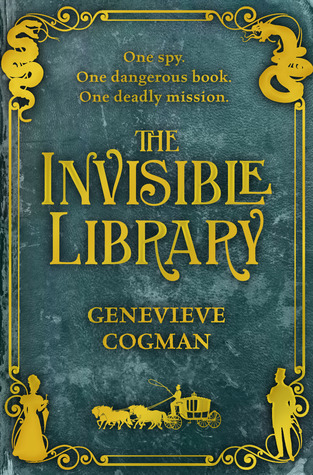
The Invisible Library (The Invisible Library #1) by Genevieve Cogman

Irene is a Librarian, and her task is to acquire rare books and take them back to the Library.  This means travelling to different dimensions.  Though having just completed a long mission, Irene is immediately sent out when she returns.  She's even saddled with a new apprentice, who hasn't left the library in five years.  Irene cannot fathom what is so special about this version of Grimm fairy tales that means she has to be sent into a chaos dimension inhabited by fae, vampires and werewolves to snatch this book. Librarians however do not question, they only do and Irene gathers her courage and takes a leap that will ultimately lead to her meeting the Library's arch nemesis.

There were times when I almost gave up on this book.  It began very quickly and then just as quickly ground to what felt like an absolute stand still.  A major part of the problem with The Invisible Library, is that it is hopelessly overwritten and tries to desperately to be too many things. I understand that in order to affect the world around her, Irene had to speak in a special kind of language however the explanation of this skill seemed to go on forever.  I also quickly became tired of reading about the tattoo on her back. I think that Tolkien relies on Elvish less than Cogman relies on the language as a writers device.

The Invisible Library has a strong steampunk element to it.  Cogman story includes dirigibles and things like mechanical centipedes attacking on the streets of London.  Cogman takes great care to repeatedly remind the readers exactly how dirty this London is.  She talks about the smog hanging in the air, the scarves people strap around their mouths and noses, as well as the effect it has on statues. Yes, London during the industrial revolution with its towering smoke stacks was filthy and extremely polluted.  Anyone with the slightest sense of history is well aware of this which led me to wonder why it is that Cogman kept repeating these mundane facts to the reader? It felt like an effort to increase word count rather than to make The Invisible Library a more vivid read.

This novel also felt very piecemeal as though Cogman was simply throwing things against the wall to see what would stick.  Irene reads as a self insert as she talks about how much likes detective stories. It feels like Cogman's way of explaining why she has inserted a very Sherlock Holmes like character into The Invisible Library.  The concept of Librarians hunting down books and storing them away feels directly lifted from the television show The Librarians; however, Cogman doesn't infuse her story with even half of the humour. Then there are the vampires, fae, and werewolves just thrown in for what feels like shits and giggles, though Cogman explains their presence by claiming they are because of the chaos infused world. This concept should have been a readers paradise but the execution absolutely let it down.

Tuesday, July 12, 2016

Paper and Fire (Great Library #2) by Rachel Caine


Jess, Khalila, Glain and Dario are now working for the Library – but working knowing that their lives hang by a thread and the Archivist is just looking for an excuse. While the last members of their group – Morgan and Thomas – are imprisoned. Morgan fights for freedom – and Thomas may be already dead.

Together they need to free their friends and somehow escape the Library’s incredible power and reach


I am just going to repeat all my endless praise for the world building of this book that I said during the first book review of Ink and Bone. Because it’s still awesome

I do love how the characters look on their battles with the library. Because they don’t want to destroy it, they don’t want to bring it down. They want, desperately, passionately, for the Library to be what it should be – the excellent, shining force for good. It should be this place which can protect knowledge, spread knowledge and advance the whole world. We have wonderful looks back into the past where the Library stood against all kinds of discrimination (as I’ll come to, the cast is wonderfully diverse), where the Library passionately resisted control of nations for the sake of knowledge for its own sake.

But despite all that they have come a long way from those original routes. As the Library became more and more about power. Defending Library independence from national control has changed to them outright taking over, destroying and controlling nations in the name of Library Power. We find whole stashes of books they are not only hording, but actively suppressing (we learn that the printing press has pretty much been invented dozens of times over centuries and each time has been viciously suppressed by the Library – Thomas and Wolfe are not the only ones by a long way. After all, the press is a relatively simple invention).

Through this, in some ways, even the enemies they fight are not entirely demonised. They horde those books even though they’d ban them and not read them – because even then destroying them is an anathema to everything they stand for. They legitimately think they’re a force for good even as their actions in the name of that good go ever darker. Which is why the whole struggle of the gang not WANTING to burn it all down – but desperately wanting to make it better.

Monday, February 22, 2016

Fields of Air (Magnificent Devices #10) by Shelley Adina


Gloria Meredith-Astor has inherited an extremely wealth and successful munitions company, one that is set to make a vast profit off a potential future war

And she doesn’t want it – not the munitions and certainly not the war. She is determined to turn her guns into ploughshares and she adamantly will not allow a war to be fought because of the weapons her company created, no matter what erstwhile family members wish.

If she has to hare off across the continent and ambush a train to stop it – then so be it.


This is one of those series that always makes me smile when there’s another book out – and this book is no exception

The series has a semi-shifting protagonist and this time it’s Gloria Merriweather-Astor. Now, I can’t say she’s one of my favourite protagonists, but I’ve always liked the idea of her, as I’ve said before. I like the idea of her because it would have been so easy, so very very very easy, in any other series to make her the villain. I probably wouldn’t have even criticised it if she were because there are so many other excellent and awesome female characters in this series, that having a single vapid/immoral/damn fool cardboard cutout villain would not have ruffled the waters

But that is not this series, that is not what this series does. So, I loved Gloria for that – for turning out to be brave and dedicated and awesome and full of morality and integrity even in the face of extreme pressure when she could just as easily have been a villain. But I am also interested in her because she is very different from the others. To a degree all the other protagonists have been misfits. They’ve not fit in the world they’ve been in – whether it’s Claire’s ambition and sudden poverty or the Mopsies rising from poverty to high society or Alice living among the raiders – they’ve all followed a different path because they haven’t had much choice in the matter. But Gloria has everything going for her – she’s the heiress to a rich, doting father who fully intends her to take over his company (despite him being evil and despite her being female). She has wealth, power, prestige, influence and she is also quite capable of realising any ambition she may have without every doing anything other than what is expected of her. She’s not like any of the other protagonist who must fight for what they want, their career, the life they choose, the family they value – Gloria doesn’t have any hard choices she HAS to make

Wednesday, January 20, 2016

Manners & Mutiny (Finishing School #4) by Gail Carriger


Sophronia continues her education in espionage at Mademoiselle Geraldine’s floating school – all the while fully aware that nefarious plots are afoot. The anti-supernatural Picklemen are still plotting to overthrow the established order and their schemes are well hidden.

As if that weren’t sufficient distraction for Sophronia, there’s also Soap. Now a werewolf, the former Sooty sees much more hope between him and Sophronia than there ever was in the past – but how far from social convention is she willing to deviate?

It all makes it very hard to focus on her lessons. Especially when all her training is finally put to the ultimate test


Sophronia I predictably awesome this book. As ever she is skilled, intelligent, capable, dangerous and fun. But she also has some nice growth and moral questions – including asking just what she has become with her intelligencer training. Has every interaction become just another mission for her? Has she become cold? Has she become completely incapable of trusting? As is asked on numerous occasions, has she become hard and cold?

From that we also have some nice questions about exactly what Sophronia wants when she finishes school and challenging some of the roles that have been clearly expected of her

One thing I really like in this book is not just Sophronia being, predictably, awesome and amazing – but her companions being almost as awesome as well. Agatha, Dimity – both far too often her sidekicks (not weak by any means, but certainly lesser in comparison to the awesomeness of Sophronia) who’s weaknesses are far far more clear than their actual strengths. They are defined more by their frailties than their strengths

And in this book we see their skills excellently portrayed. We see there are many ways to be an intelligencer. This series has always done an excellent job of taking the trappings of traditional Victorian femininity and making them strengths (which I think is sorely needed because so many books with “strong female characters” are strong because they eschew all things feminine. We have scene after scene of women who disdain clothes and make up and anything deemed female which is why they are strong. It’s unusual and powerful to have the feminine be strengths). This book goes a step further to make a lot of different forms of feminine strengths. Whether it’s Dimity’s gossip and social butterfly flitting or, equally, Agatha’s quiet, hidden wallflower nature. Always on the outside – but always seeing everything. (And I really love how, along with Sophronia, Agatha has found a way to forge her own future, free from the expectations and demands of society and her family. Agatha has courageously chosen her own path even as everyone acknowledges the risk she’s taken doing that).

Wednesday, November 18, 2015

Devices Shining Brightly (Magnificent Devices #9) by Shelley Adina


It is time for the event of the season – the Dunsmuirs are holding a party to celebrate Claire and Andrew’s marriage and everyone who is everyone will be invited to take part.

Of course that includes Claire’s best friend Alice and her fiancé Ian. And Alice is beginning to realise what it means to be marriage to a British noble – and while she loves him, she’s having second thoughts about everything that comes with him

Gloria Meriwether-Astor’s cousins also arrive and, of course, get an invite – but in the process the tensions in the family and in Gloria’s family business come to light


This is a short story, and pretty much an ideal example of one for me.

The plot is fun and works so well with the rest of the world. I don’t think you will need to read this book to transition from the last book to Gloria’s adventures in the next novel. But by reading this it nicely will fill in a lot of gaps and really set up the next chapter. We’ve been introduced to the new principle characters and the details of the conflict. It’s a truly excellent prologue that really tells us why all the characters are there and what they are doing and their goals.

The next book can launch right into the story because everything has been excellently established without the need to make it essential. For me this is exactly what a short story needs to do – add richness to the world and characters without making them an essential component.

It also does this through a fun little story. It’s not super-dramatic and it’s certainly not action packed. But that’s a good thing – Claire et al seem to spend so much of their life in peril and action that this is an excellent change of pace. Why not just have a party? Let’s see these characters living together, dealing with something relatively mundane together – it’s lighter and fun because of it.

It also has some very nice challenges and examination of sexism of the era. There’s the obvious – all of the women are planning their own lives. Even better, they’re all planning different lives, different paths – because there’s more than one way for a woman to live and be strong and express her agency.

There are some excellent call outs – Alice fighting fiercely and courageously against the idea that she cannot captain her own airship. This is the kind of thing I’d expect on most female led steampunks at this point.

Monday, October 26, 2015

Da Vinci's Demons, Season 3, Episode 1: Semper Infidelis


Da Vinci’s Demons is back for a last and final season to see if it can possibly redeem even a little of the nonsense of the last two seasons.

Which ended last season with the Ottoman Empire invading Naples and we open with Zoroaster trying to get into the city rather than turning around and running for the hills and then being allowed to run through all the battlements – wow their security at war is a really dedicated thing.

Leonardo is prepared to unleash invention death on the invading fleet when his dad, Piero, tells him he sees Leonardo’s mother on board. Just as Leonardo’s mother tells Bayezid, head of the fleet, that she sees Leo. Bayezid apparently cares. Piero begs Leo not to fire, but even he can’t put his epic mummy issues ahead of the war. His mother seems to agree since she encourages Bayezid to victory.

Lots of cannon fire unleashing carnage on the fleet for a whole lot of angst – especially since Bayezid decided to lead his fleet from the front and his ship was hit. Leo’s mother ends up in the water with big heavy chains on her

The cannons seemed to have worked, blocking the entrance to the Naples harbour. Alfonzo is now all for declaring victory and Leo a saviour – (presumably not worried about the Ottomans finding somewhere else to land their fleet or the fleet has been so devastated). Alfonzo and Lorenzo argue about who gets to pay Leo to make the shiniest biggest weapons

Of course, Leo is all angsty and not really thrilled to be responsible for the death of so many people – or any future deaths and certainly not the death of his mother. He storms out in a temper with Lorenzo convincing Alfonzo not to stab Leo for his insult.

Zoroaster goes after Leo to try and provide some level of comfort. It fails somewhat epicly.

As Leo angsts – he notices that the Ottoman flag ship is suddenly burning brighter and stronger hours after just smouldering. He reports this to the princes and Alfonzo is quick to deride whether “heathens” could manage the chemistry Leo is referencing – Lorenzo isn’t that quick to ignore the technological might of the Ottomans but Alfonzo is sure the arriving Napolese fleet will totally take down the remaining Ottomans.

Alfonzo, in case we missed it, is a damn fool.

The next day the Ottomans are making something as the Naploese fleet arrives – and is destroyed by Ottoman undersea mines. They also manage to get their ships past the blockade with Genius so now it’s back to war again with cannon fire going both ways and all is chaos and bad because the Ottoman have super duper cannon – which looks a lot like Leonardo’s cannon multiple barrel cannon.

Monday, September 28, 2015

Iron & Blood (Jake Desmet Series #1) by Gail Z Martin and Larry Martin


Jake and Rick, with their cousin Nicki, work for their father’s company retrieving hard to find items at very high cost for their very rich clients. Unfortunately, not every item is safe nor is every client as they find out when Jake’s father is murdered

They must return to New Pittsburgh, ducking hired killers along the way to uncover a conspiracy that is festering in the city and goes far further than a few items they transported.


There’s a lot about this book I love.

I love the characters – each of these characters has so much potential for being a book series in its own right. I love their history, their interactions and just about everything about them. In fact, this becomes one of the problems simply because they can’t all be suitably awesome at all times

I really love the world setting, the Victorian industrialness with a touch of steam punk and a whole lot of magic and the supernatural being added to really richen the whole thing. It draws upon the supernatural from many European superstitions and belief systems and does an excellent job of creating a city that is defined by its immigrant populations. The different neighbourhoods, the way the city works and the immigrant diversity come together in a really rich tapestry. On top of the magic and industry and aesthetics and Victorian etiquette (which can also be used for the best humour    (“Get out of here, Aunt Catherine. You’re in mourning. You can’t be shooting people, it wouldn’t be proper.”) there’s also some really excellent analysis of class. How workers are constantly used as fodder and disposable, the battles of the rising union movement in the face of the mine owners who are willing to raise armies and massacre the workers as well as the restrictions that are hemming in women. We also have the Oligarchy, the very essence of the entitled Robber Barons of the era and their near untouchability along side the disposability of the poor and how little their deaths matters

Class moves nicely in to the immigrant cultures and works alongside the supernatural and magic and world building to make for a truly excellent world building. We throw in some extra bonuses like Kobolds which suggests a whole lot more supernatural creatures lurking and permeating every level of society.

The plot itself draws on every element of this – the supernatural and monsters. The untouchability of the Oligarchy, the disposability of the workers. Magic being used in shiny and scary ways. Massive industry and super-steampunk devices. It was all displayed and it was just so huge and so much fun

Monday, August 31, 2015

Prudence (Custard Protocol #1) by Gail Carriger


Prudence Akeldama is a very special child, a meta-natural with the power to steal the powers of vampires and werewolves and child of three of the most powerful people in the British Empire – she is destined to be change the world

The first mission of which is for her and her merry band of friends to get on their new airship (the Spotted Custard) to float to India, to ostensibly discover a new source of tea.

Except quickly they find themselves in far deeper intrigue than they ever imagined


This was a very fun book. We had some delightfully amusing characters – Rue’s complete irreverence towards society, her shifting of personalities because of the many excellent influences in her life. She is skilled, capable, confident and pretty much determined to take the world by storm. I kind of love how she has this iron-hard self-assurance. In many characters it would be annoying – but it worked with Rue. Her confidence, her fierce belief in herself, her willingness to jump into any situation confident that her unique abilities, her skills and her relatives to pull her out of any problems she gets in.

We also have Gail Carriger’s excellent writing style that wonderfully uses flowery Victorian style with her humour and dash of silliness that really makes it work.

(Example: “She inspired, at even the best balls, a sensation of immanent dread. It was one of the reason she was always at the top of all invitation lists. Dread had such an agreeable affect on society’s upper crust.”)

I think the story could have been vastly improved if Rue were directing the story. If she went to India with a genuine mission rather than pretty much stumbling on the plot and then, somewhat, ineptly, then stagger around it

The book, sadly, has many problems. Above that there are two main ones. The first of which is that it is covering areas of colonialism, imperialism et al with a very shallow hand which is going to be dubious in any circumstances and I will come back to,

The second is that the Custard Protocol directly follows on from The Parasol Protectorate and it really doesn’t live up to the standards that that series set

Wednesday, August 19, 2015

The Clockwise Man (Doctor Who: New Series Adventures #1) by Justin Richards

I am going to be upfront and just admit that I am a massive fan of Doctor Who.  Anything even remotely related to Doctor Who immediately catches my attention.  It's still a little while to go until the next series and finding myself going through a serious case of withdrawal, I have decided to give the books based on the series a shot.

The Clockwise Man is the first book in the New Who series.  New Who began when the series was brought back to life after a sixteen year hiatus. Christopher Eccleston played the role of the 9th doctor and had the immense responsibility of introducing the Doctor to an entire new generation of fans.  Naturally, the rebirth of the series spawned a new series of books, allowing the fans to have even more adventures with the Doctor and his companions.

The Clockwise Man takes the Doctor and Rose backwards in time to 1924 London and takes place between the episodes "The Long Game" and "Father's Day" of series one. The Doctor and Rose decide to see The British Empire Exhibition and naturally even a sight seeing trip with The Doctor leads to a mystery which must be solved.  It's not long before not only the Tardis (the doctor's time machine disguised as a police box), his leather jacket and precious sonic screwdriver go missing. It seems that the painted lady has determined that The Doctor is the vicious butcher that she has been looking for.

The Clockwise Man felt quite a bit like steampunk because of the mechanicals in the story.  It did however contain little references to the series for the sake of continuity. For instance, Rose changes completely into to period clothing while the Doctor runs around in his leather jacket with no one batting an eye. There's even a mention of "Bad Wolf," which fans of the series will immediately recognize as a warning to the Doctor that trouble is coming.

Even with all of the little references, The Doctor really felt off to me.  First off, no true Doctor would ever struggle to find a word.  Not only is he fluent in English, he often thinks so quickly that few can keep up with him.  I found myself wondering repeatedly where the Doctor's arrogance, sarcasm and confidence went? Then, there is the issue that in many ways, The Clockwise Man turns the Doctor into an action hero.  Yes, I said action hero.  Instead of outsmarting the bad guy, the Doctor actually gets into a physical altercation and allows someone else to try and save the world using their mind and abilities to shut down some tech. An action doctor is not unheard of (see the 6th doctor and the 3rd doctor); however, that certainly wasn't a part of the 9th doctor's personality.  He didn't even say, "Fantastic" which fans of the series will recognize as the 9th Doctor's catchphrase.  Who is this man?  The answer is, not the Doctor or at the very least, not a proper representation of The Doctor as played by Christopher Eccleston.

Friday, July 17, 2015

A Gentleman of Means (Magnificent Devices #8) by Shelley Adina


Claire is settling into life as an Engineer for Count Von Zepplin and planning for marriage to Andrew 
(or avoiding planning) though neither is going quite so ideally or quite so well as she would have hoped. But still, is she really willing to abandon her career, this opportunity and even the man she loves for the sake of a friend who, it has to be said, she doesn’t know that well

Gloria Astor-Merriweather has been kidnaped – but is Claire willing to throw everything away to get her back?


I love Gloria. Not so much her character (which is still very good) but the whole concept of her. Gloria Merriweather-Astor was introduced as a very opposite to Claire. While Claire was newly desperately impoverished. Claire was academic and scientific, Gloria was more interested and fashion, society et al. And Gloria is the daughter of her arch-enemy and the major antagonist in the series.

In any other book, Gloria would be evil. She would be the spiteful, vapid mean girl who we were supposed to hate and loathe from the very beginning. She could so easily have been a hollow demonised character.

But she isn’t – she’s clever and moral and capable. She has her own life and her own problems even though her context and experience is very different from Claire’s – and she’s a very loyal and caring friend who regrets deeply any idea that she may have failed Claire in the last book. Even more than her own freedom she worries that Claire may think she abandoned her -  even if they’re not such close friends, it mattered to her that she was thought of hat way (of course, Claire, marvellously free of the girl-hate that is so annoyingly pervasive, doesn’t assume any such thing. Having experienced Gloria’s kindness she assumes far more kinder interpretations of her behaviour).

So, even though I risk sounding like a broken record, I have to repeat how excellent this series is with the female characters. Not just because they’re good and capable and interesting but because they’re also different. They have commonalities in different ways (Claire and Alice share an interest and talent for Engineering, Gloria and Claire attended the same school, Liz and Maggie are sisters) but they’re all still very different people.

The plot itself wasn’t especially unique – we have another rescue mission as our heroes ride to the rescue with cunning, cleverness, a whole lot of courage and daring and ingenuity and a great deal of determination. It’s not especially new, but it is great fun, well written, nicely paced and any outing with these characters will make me smile.

Friday, July 10, 2015

New Avalon by Neal F Litherland


This is a collection of short stories set in the mystical steam punk city of New Avalon. In each of these stories we meet two people who, through the vagaries of magic, weird science and high emotion, find love… and a great deal of tragedy.

And each one is pretty much beautiful. Whether it’s the old tinker who waited his whole life to meet the beloved whose life he saved (but waited just a bit too long), or the captain who’s new invention inspires the equally passionate enthusiasm of his lover… only for that same invention to bring them crashing tragically to earth. To the spy who unintentionally fell in love for her target – but now they must both feel the wrath of their employers. To the gentle kind man who knows the secrets of death who pays the ultimate price to bring his true love back only to find it go terribly terribly wrong or the frustrated woman continually performing atrocities in the desperate attempt to keep her love around…

Tragedy and love are in every story. Whether it’s love lost, a love dying or utter desperation and people pursue love to their own destruction or damnation.

And it is really beautiful, I say this again. Each story is elaborate, amazingly well written and well paced with perfectly chosen word use. It’s ornate without being excessive, evocative without being purple, emotional without being overwrought. It’s an excellently well crafted book full of very well written stories of love and grief in this city

The city (or cities… which I will get to) is also nicely presented, with each character we can picture where they are and the challenges they face and even the background on which their sagas are painted. The backdrop is very vibrant

I just… don’t really understand this book. I don’t understand it conceptually. Of course, I have to admit, again, that I do not like short stories except within a relatively narrow set of circumstances (usually when they’re an ongoing part of a series adding new light to that series or as a stand alone that tells a complete story). The short stories in this book didn’t fit either of these categories.

Each story is extremely short, telling a short complete story within a central theme. They are closed stories, none of them particularly needs developing further – but that’s because there’s not much more to tell. Not that these characters couldn’t have more development or more plots in their future, it’s just that none of it is developed sufficiently to make me invest in their stories above and beyond what is presented. More could be told about their experiences and what happens from here – but I’m happy that the story is closed because I don’t really care to go any further. This is not really an ideal way to achieve that “stand alone complete story” for me – just have one event with no suggestion that I’d be interested in anything else.

Wednesday, April 29, 2015

Agatha and the Voice of the Castle (Girl Genius #3) by Phil & Kaja Foglio


After many adventures, Agatha has returned to the stronghold of her ancestors, Mechanicsburg, where generations of Heterodynes terrorised the continent. For many long years the people of Mechanicsburg have waited for a Heterodyne heir to return – a town full of minions just waiting for the Master to lead them again

But first she must prove herself in the Castle.  Sentiment, terrifying and immensely powerful structure, terribly damaged for years – few people survive who step within.

To complicate matters there’s a second claimant to her title – and it doesn’t help that Klaus, the Empreror, is convinced she is the Other, a terrible force that could tear his empire apart.


When reviewing books it is always important to remember that there are a lot of different tastes out there. I will look at goodreads and see people who loved books I loathes or hated books I adored, been a little bemused but then shrugged because taste is a weird and wonderful varied thing. I remember this because I try to be mature and sensible

Well, I’m throwing that out the window. If you do not love this book clearly there is something terribly wrong with you, I suspect you may not have a soul. Yes I call soullessness!

It is impossible for me to read more than a chapter of this book without a great big silly grin on my face. I think my face may actually be stuck like that. It’s the same grin from reading the previous two books – this series is just so much immense fun!

I love the sparks. I love these glorious evil geniuses with their brilliant mad science and whacky and terrifying creations! I love how zany and weird and wonderful it is. I love how much it made me laugh out loud over and over again as they do so many things, FOR SCIENCE! Including making exploding coffee THAT WAS PERFECT!

I love how so many of the characters are gloriously evil, and it just works in the most amazing way

I love the Jaegers, they’re immense fun, they’re evil and they’re hilarious and I want one. My only sadness is they don’t appear nearly enough in this book

I love the Castle, the product of generations of devilishly evil Heterodyne Spark masterminds who have designed it and increased it over the centuries to be a font of gleeful evil. I love how Agatha with her morality (occasionally overcome by her SCIENCE) tries to work surrounded by people and minions who are the very height of evil.

Wednesday, April 15, 2015

Tarnished Knight (London Steampunk #1.5) by Bec McMaster

It's been six months since the events of Kiss of Steel.  Rip is struggling to gain control now that he has the virus coursing through his veins causing him to want blood.  He has spent most of his time close to the Warren afraid to venture to far.  Finally, wresting some control Rip seeks to become useful again and begins investigating a series of murders of women, causing him to flashbacks to the death of his mother. It is only when the one he loves most is threatened that Rip is finally able to give justice to the victims and finally feel whole again.

Tarnished Knight is very much a romance novel with a bit of kidnapping and murder wrapped around it for the sake of a thin plot.  Unfortunately, the budding relationship between Esme and Rip is a typical bodice ripper with few surprises.  It's the typical boy/girl love each other but are afraid to tell each other story -- followed by the requisite misunderstanding that drives them apart -- culminating in consummation and declarations of HEA.  I had really hoped for more from this story, given  the fascinating world building of Kiss of Steel . I suppose since this is a short story that McMaster didn't want to add anything that would cause confusion in later books for people who routinely skip short stories. Still, it was a tad disappointing.

I very much like Esme; she's a survivor.  Esme has had to make her way through the world and always managed to pull herself above the odds and retain her dignity.  When she is kidnapped (as all heroines somehow need to be) Esme leaves a trail for Rip and fights for her life every step of the way.  Even though Rip is more than capable of taking care of himself, when the big fight begins, Esme is not content to sit on the sidelines and let Rip handle it all.  Esme dives in with an axe and cuts off her kidnappers arm.

I also like that there is no shame when it comes to sex for Esme.  She is not afraid to initiate sex and take what she wants. In a reversal of gender roles, it's Rip who is reticent to take the big step and it's nice that Esme respects his boundaries, never pushing him harder than he can handle.  Consent is always a sticky thing in these kinds of stories and in this case, it was handled far better than in Kiss of Steel.