Showing posts with label world war z. Show all posts

Friday, December 4, 2015

American Exceptionalism in Speculative Fiction


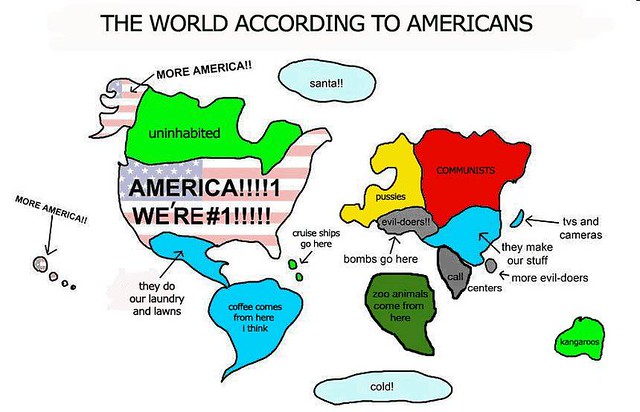
Much of the media in this genre is created in the United States, which is hardly surprising given the hegemony of American pop culture.  Because of the pervasiveness of American pop culture it has come to constitute a form of American soft power.  No country ever wants to see itself as anything but the center of the world but American pop culture has exceedingly made a point of this not only in the fantasy genre but in pretty much everything it produces.  In the eighties, it was all about some brave American taking on a Russian threat and ending up victorious; the hero often wrapped in the stars and stripes, delivering a big dose of patriotism with their knock out punch.  In the nineties, with the end of the cold war, we saw a brief time of antagonists coming from different geographic areas but the hero resoundingly remained American.  With the dawn of the 21st century and the rise of the McWorld vs Jihad dilemma, antagonists have overwhelmingly been Middle Eastern, while the hero remained American. The point of all of these stories is to suggest to the reader, viewer and consumer that no matter the situation or the villain, America is always on the side of right and will emerge victorious based solely American exceptionalism.  The bigger the threat, the faster and stronger the American response will be and whether by might or intelligence, some American will have the right answer to the situation.

The very first time I became aware of this phenomenon in speculative fiction was the movie Independence Day.  Yeah, it was great to watch Will Smith, as Captain Steven Hiller, take on the aliens but it’s telling that it was Jeff Goldblum, as David Levinson, who came up with the solution to the alien invasion. Yes, Levinson graduated from MIT and was an environmentalist but am I really supposed to believe that there was no one else outside of an American smart enough to figure out the invasion countdown clock? And what about the fact that the rest of the world seemed to be sitting around waiting for someone else to come up with a solution? Not only did Hiller and Levinson take the war to the aliens on behalf of the rest of the world, the Americans co-ordinated the attack which occurred on July 4th.  Could American exceptionalism be any more obvious?  Even President Thomas J. Whitmore, played by Bill Pullman, joined the fight because he was a former Vietnam vet. If that were not enough, Whitmore declared July 4th the Independence Day for the world. It's not like the independence of any other country from colonial rule could possibly be significant.

“Perhaps it’s fate that today is the 4th of July, and you will once again be fighting for our freedom, not from tyranny, oppression, or persecution -- but from annihilation.
We're fighting for our right to live, to exist.
And should we win the day, the 4th of July will no longer be known as an American holiday, but as the day when the world declared in one voice:
"We will not go quietly into the night!
We will not vanish without a fight!
We're going to live on!
We're going to survive!"
Today, we celebrate our Independence Day!”

Considering that the Americans would not have gotten to their Independence Day without the French, one really had to suspend belief to buy into the whole rally the troops moment delivered by the impassioned Pullman, as President Whitmore.  Naturally, the president had to get into the action because like the rest of his people, he was a problem solver and epically brave. Thank goodness this is fiction because despite having the title commander in chief, there has only been one president since Eisenhower to actually serve in an active duty position.

Friday, September 27, 2013

Why The Recent Upsurge of Zombies?


In the fantasy genre, supernatural creatures fall in and out of fashion. In recent years, we have seen the revival of the zombie with movies like World War Z, television shows like The Walking Dead and books like White Trash Zombie.  What is it about the zombie that has re-captured the public imagination? They are after all rotting, disease ridden and dead.  Surprisingly this is exactly why people are now fascinated with zombies. They represent our near universal fear of death - in particular what happens to our remains. Unlike vampires who become undead and retain their intellect and beauty and gain superhuman powers, zombies reveal in the starkest manner possible that the sweet phrases we parrot to bring comfort only hide the ugliness and dehumanisation of death.

With zombies come a dystopian world. In almost each instance in which zombies appear currently, the society in which they inhabit has broken down. In fact, we have seen a large resurgence of dystopian world recently. This likely has to do with the ongoing depression and the general sense of social malaise which has become the norm. With no sense of anomie or real hope for change, people have become almost anesthetised.  Each day is struggle to pay the mortgage, or hold onto a job that pays below subsistence wages. In a sense, the economic downturn is the equivalent to many of the dystopians we read about or watch on screen. The zombie then becomes the person who shuffles along, powerless to create change - a cog stumbling with no vision and no hope.

For some, these fictional dystopian worlds are meant to show us that life, no matter how bad it is today, can always be worse. We may be struggling to attain the basics like food, shelter and clothing, but at least we are not being chased by zombies desperate to eat our brains.It represents the constant refrain of it could be worse, which is said to lower classes as a way to pacify them. Yes, things could always be worse but if we have reached the point where we are reaching for zombies to soothe, perhaps things are bad enough. At very least, a zombie dystopian world is so different from our world as to be a far greater level of escapism than we often find in Urban Fantasy

One element of zombie stories that differs from other modern monster stories is that there is very little attempt to “redeem” them into sympathetic or romantic characters. We’ve seen this with virtually every other creature - especially vampires (who have almost lost their status as monsters and are often more tragic - or sparkly -  than horrifying). Vampires, werewolves (or were-anything for that matter), faeries, gods and an entire Greek legend of weird and wonderful creatures; they’ve all started featuring more as romantic heroes, soulful protagonists and bare chested, turgid love interests as often as monsters.

Wednesday, September 11, 2013

World War Z

Brad Pitt plays UN specialist Gerry Lane.  The world is caught up in a zombie apocalypse and initially all Gerry Lane wants to do is protect his family.  He is not allowed to stay on the sidelines because of his expertise and so Lane travels across the globe in the hopes of finding a way to save the world from the zombie threat.  This movie is supposedly based on the book by the same name. 

Like the book, the movie does travel across the globe but the first major break is that the movie has one set protagonist.  This turns World War Z into yet another run of the mill picture because instead of telling the story from multiple points of view as would be befitting in a war that encompasses the entire world, we are forced to watch yet another film in which an American, straight, cisgender, able bodied White male is the only hope for humanity.  I wonder if there will ever be a time when Hollywood will tire of offering us this trite over privileged narrative?

Instead of giving us a complex story as the book did, World War Z the movie was heavily reliant on special effects.  Zombies moved incredibly fast, no matter the rate of decay.  Zombies quickly scaled walls and chased humans with super human speed. I suspect that this was to increase a feeling of peril but let's face facts, just something determined to eat you should be scary enough.  The story was essentially sacrificed to give us super threatening zombies.

Very few people of colour make any kind of appearance in this story.  One family actually provides refuge for the Lane family. Gerry tells them that he is an expert and that they must keep moving. Of course the family of colour chooses to stay, which leads to the death of them all with the exception of Tomas their son.  The Lane family quickly becomes the guardians of Tomas, who despite losing all of his family to zombies shows little to no emotion; while the Lane daughters are a wreck and filled with grief by all they have seen. This of course gave the Lane girls far greater depth of character than Tomas. The other two character of colour of any note were Thierry Umutoni (Gerry's boss) and an unidentified W.H.O. doctor. Neither were given much character development at all.  Though all were focused on finding a solution to the zombie apocalypse, their answers all revolved around Gerry.