Showing posts with label 10th Doctor. Show all posts

Monday, February 29, 2016

The Feast of the Drowned (Doctor Who: New Series Adventures #8) by Stephen Cole


The naval ship the HMS Ascendant has mysteriously sunk in the North Sea.  The Doctor isn't inclined to investigate until Rose and her friend get a ghostly visitation from one the seamen who was aboard ship.  Though it makes absolutely no sense, Keisha is determined to head to the Thames and throw herself in because she believes that somehow against all odds that she will find her brother and rescue him before the feast.  It would be bad enough if the Doctor, Rose and Mickey only had to deal with one person who had lost touch with reality, but many of the inhabitants of London are determined to throw themselves in the Thames and the ones who do, never resurface for some reason. With more and more people disappearing each day, it's a race to find out what is going on and how to stop it.

The Feast of the Drowned very much reminded me of the Waters of Mars, largely because the Doctor is fighting an alien species which thrives in water and takes over human bodies.  Part of the reason I pick up these Doctor Who books is to enjoy new adventures with characters I've grown to love and or miss terribly.  In fairness to Cole, The Feast of the Drowned was actually released quite a few years before the Waters of Mars but because I have already seen the episode in question so many times, this book felt very repetitive to me. It did however make me wonder if this book was the inspiration behind The Waters of Mars?

The repetitiveness was not at all helped by Mickey, and Keisha's fixation on the fact that Rose had disappeared with the Doctor for a year.  By this point, everyone should be over this. Keisha in particular seems very jealous of Rose and angry by the way that her friend has changed.  Because of all that Rose has seen, she cannot simply go back to being content bar hopping on a Friday night and this has created a disconnect.  She has moved so far past some people that the relationship will never be the same and Keisha seems determined to make her pay for it. I really just wanted to be done with the guilting of Rose.

In terms of characterization, I feel that Cole did a pretty good job with Jackie, Rose and of course our beloved 10th Doctor. One of the things I remember the most from Tenant's era is every alien being offered the chance to leave or end the damage they were causing before being annihilated by the Doctor. Tenant's Doctor was often brutal in his application of justice and we can see that coming into play in The Feast of the Drowned.  When the aliens who have drowned humans in order to use them as incubators for their offspring refuse the Doctor's offer of relocation, the justice he exacts is swift and final.  This time, there's no one to tell him to stop or to wait, no one to remind him of his own rules - the Doctor simply acts.

Thursday, January 28, 2016

Doctor Who: The Stone Rose (Doctor Who: New Series Adventures #7) by Jacqueline Rayner

Doctor Who: The Stone Rose

An excited Mickey brings Rose, The Doctor and Jackie to the museum because he has a surprise for them.  When Rose sees a statue of herself she cannot believe how the sculptor captured every last detail about her.  It's not long before she realises that this means that she has to travel back to Ancient Rome to sit for it.  In a blink the Doctor and Rose find themselves caught up in a search for a missing boy and trying to out think a Genie.

Often books based on television series tend to miss the mark in their characterisation but I am happy to report that is not the case with The Stone Rose.  Rayner gave us the Doctor's anger, his logic, his quick wit and more than anything else, his love and concern for Rose.  The banter between Rose and the Doctor was absolutely perfect and reminded how much I loved the two of them together.

As much as I thought that Rayner nailed her characters, the story itself felt confused and a bit all over the place.  When Rose and the Doctor first land in ancient Rome, they begin by looking for a young boy who has gone missing.  Then the issue becomes about a young man who has always wanted to be an artist and develops the ability to  turn living people into stone.  This quickly shifts to AI (artificial intelligence) genie which grants wishes and nearly destroys mankind.  If you can follow all of that then there are the paradoxes and the leaping around in time. Yes, Doctor Who is all about a clever man with a blue box travelling through time but it should be somewhat easy to follow. By the end of the story, I couldn't tell whether I was coming or going. In short there were too many paradoxes to make sense. 

Some of the characters also felt extremely extraneous.  Lucius Aelius Rufus exists simply to get the Doctor into the Colosseum to fight as a gladiator - a scene which essentially added nothing to the story whatsoever. Yes, the Doctor is always running around in an almost manic state and often takes on the bad guys in battle but it is supposed to fit into the framework of the story and not feel like an additive.  It's almost as though Rayner went into this determined to get the Doctor into the Colosseum and twisted the story to ensure that it happened.

Friday, September 11, 2015

Doctor Who Series Recap: Season Four


After losing Martha Jones, a resigned Doctor returns to his Tardis only to have the Titanic of all things crash into the side of the Tardis. After a few moments of astonishment (including his signature, "what") the Doctor fixes the Tardis and boards the ship. He works together with the other passengers (particularly Astrid) to find out why the Angels are determined to not only kill everyone on board but crash the Titanic into earth.  For a Christmas episode it wasn't bad though it did have the Doctor leave yet another dead woman in his wake.

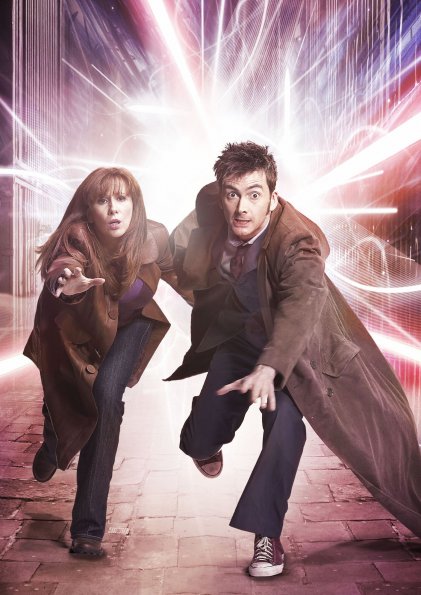
Season Four is easily my favourite David Tennant season thanks to Donna (Catherine Tate).  In Partners in Crime, Donna's second episode as a companion, (the first was Runaway Bride in series three)  it's immediately apparent that Donna is not the type of woman to just sit there.  Before even reuniting with The Doctor, Donna had decided to investigate Adipose - a company selling miracle weight loss pills. I don't know about you but this felt like a commentary on obesity, particularly because we learned that in the alternate universe, Adipose attacked the Americans.  I was irked by the heavier woman who planned on breaking up with her boyfriend because after some weight loss she decided that she was too good for him. This episode made it seem that everyone is desperate to lose weight and not at all happy with their bodies, particularly because those on the pill were on higher end of the scale. The fact that so many went on Adipose is absolutely about our fat hating culture but it was never really explored. The writer chose to skip social commentary on this one and make it all about the alien. In the Forest of the Dead, Donna casually mentions being on a diet.  The fat shaming might be subtle this season but it's absolutely there.  

The Fires of Pompeii and the Planet of the Ood reveal that Donna's role as a companion is to show The Doctor humanity. When the Doctor and Donna first arrive in Pompeii, he initially mistakes it for Rome. It's not long before they realise that not only are they in Pompeii, but that the eruption of Mount Vesuvius is imminent.  Donna pushes for the Doctor to warn as many people as possible to leave but he is adamant that the eruption is a fixed point in time. When the Doctor refuses to listen, Donna starts trying to warn people herself to no avail.  When Vesuvius finally erupts, the Doctor decides to leave with Donna, though it means leaving Lucius Caecilius Iucundus's family to die.  It's particularly compelling given that Lucius Caecilius Iucundus and his family actively beg the Doctor to save them on their knees and he still turns away.  If it were not for Donna, the Doctor would have left them to die.  Now we know that not only is the 10th Doctor vengeful and cold with his enemies, the cold streak runs extremely deep.

Companions not only improve the Doctor's empathy, they force him to pause fora moment to focus. It's only when we get to The Waters of Mars that it becomes evident how important companions are to the Doctor.  Despite landing on Mars during a fixed event in space in time, the Doctor intervenes, by saving the life of Captain Adelaide Brooke. The Doctor explains that since he is the last Time Lord that he is a survivor and make his own rules, declaring himself Time Lord Victorious. It's absolutely terrifying to watch his mania. The situation resolves itself because Captain Adelaide Brooke committed suicide thus allowing history to happen as it was meant to.  The Doctor knew from the beginning the importance of Adelaid and in order to play God he played with time.  A Doctor in control never would have done that.

The writers decided to comment on slavery in The Planet of the Ood.  Immediately, Donna is saddened by what the Ood have been through.  The slavery, and oppression, were all for the sake of profit.  In this case, the Doctor is quick to intervene on behalf of the Ood but at the same time, I cannot help but think that the last time he saw the Ood (Impossible Planet and Satan's Pit: series two), they were in a similar situation and he  did nothing to help them.  In fact, he viewed them as part of the threat against him and Rose. The Doctor just readily accepted that they (read: the Ood) were a mindless subservient species because that's what he was told by a human. Rather telling isn't it?

The Planet of the Ood was also about foreshadowing for the coming season.  The Doctor is warned that his song will soon end.  He is clearly upset by this revelation but he tries to brush it off as if it's nothing.  This is a warning to viewers to prepare themselves to lose the 10th Doctor.

The Planet Ood was not the only lesson in the ways in which we can be cruel to each other.  In Turn Left, Donna finds herself in an alternate universe and since she was not present when the Doctor battled the Empress of Racnoss  in Runaway Bride, the Doctor died because he was in such a rage that he didn't know when to stop on his own. This reinforces the idea that The Doctor is absolutely dependent upon his companions because they rein him in and focus him.  After London was destroyed because the Doctor was not there to stop the titanic from crashing into Buckingham Palace, the country is forced to go into disaster mode.  Donna and her family are forced to move to Leeds and live in a house which they share with several families.  Donna tires to stay hopeful but it's clear that the situation is stark.  When a family is removed because British leaders decide that England should be for the English, Wilfred (Donna's grandfather) comments that it's just like the last time.  This is all it takes to get Donna thinking. She tries to find out what's happening to the family which is being removed but is ignored. There's always been the false belief that when there's a disaster it pulls people together and that they forget their differences but that is not the case at all.  We don't all pull together as is clear from what happening with the Syrian refugee crises.

Donna was labelled the most important woman in the universe (don't get excited, the Doctor's companions are often called that).  The Doctor notices that they have constantly been drawn together.  It's evident in The Unicorn and the Wasp, when the Doctor needs a shock and Donna kisses him that theirs is a different kind of love. Rose may have been the Doctor's love interest but Donna is his friend.  The relationship might be different but they are absolutely equal. Donna may only see herself as a temp from Chiswick, but she has skills she doesn't even realise.  It's Donna who thinks to check human resources in Partners in Crime and it's Donna who notices the numbers above the doors in The Doctor's Daughter. It's Donna who yells, "oy watch it spaceman", as a warning when the Doctor steps out of line and she is even willing to slap him if she has to.

Tuesday, September 8, 2015

Doctor Who Series Recap: Season Three

At this point, the personality of the 10th Doctor is well established.  More than any other Doctor, the 10th is the one who should never ever travel alone.  As much as the Doctor is fascinated with humanity, he can at times forget to be humane and a companion serves to keep him grounded.  As far as The Doctor is concerned, Rose is pretty damn hard to replace, particularly given his romantic feelings for her.  He tries to pretend that he will be just fine but in his very first outing sans Rose, it's clear everything will not be  okay if he doesn't find someone soon.

Series Three resulted in one of my favourite episodes of Doctor Who of all time - Blink.  I was captivated as I learned about the lonely assassins (weeping angels) and found them to be a fitting match for The Doctor.  The Angels want to create a paradox from which they can feed and so the Doctor issues a warning from 1969 to Sally Sparrow, "Don't blink. Don't even blink. Blink and you're dead. Don't turn your back. Don't look away. And don't blink.” The Doctor and Martha don't even feature largely in the story but the terror the Weeping Angels manage to cause is absolutely captivating. I don't think I've looked at a stone angel the same way since watching Blink.

The third series begins with The Doctor meeting his future companion (and greatest companion ever if you ask me ) Donna Noble, when she suddenly appears on the Tardis.  Donna is beamed onto the Tardis in her wedding dress of all things and is certain that The Doctor is a Martian who has kidnapped her. The Doctor quickly realises that there is a mystery behind Donna's sudden appearance and after failing to get Donna to her wedding in a timely fashion, sets about solving it.  What ensues is absolutely hilarious, as the Doctor clashes with Donna's brash style.  She's not afraid to slap him when he gets to wrapped up in techno babble either.

In The Runaway Bride, Donna loses her job and her fiance in one day when she learns that Lance had drugged her coffee in order to make her suitable food for the children of the Empress of Racnoss. It absolutely fascinated me that the Empress was the last of her kind and that the Doctor had very little compassion for her.  He was particularly indignant about her race's history of violence and murder. The Doctor offers the Empress one last chance to give up, promising to relocate her if she agrees but the Empress refuses.  The Doctor takes his terrible justice by killing all of her children, as the Empress screams in pain.  It's Donna, who has to tell the Doctor that he can stop now.  In their parting scene together, Donna tells The Doctor that he needs to find someone because he needs someone to tell him to stop.

Martha Jones, The Doctor's companion for series three is introduced in Smith and Jones.  The hospital Martha works in is transported to the moon so that the Judoon can find an alien hiding there. Jones and the Doctor team up very quickly to assure that the correct alien is taken into custody and the hospital returned to Earth.  Upon arriving back on earth, The Doctor asks Martha to take a trip with him, making it clear that she will not replace Rose and that he is only offering one trip.  I suppose that's the Doctor's way of saying, "I'm just not that into you", but it doesn't stop Martha from giving him the eye for the rest of the season.

On their first trip together in The Shakespeare Code, The Doctor and Martha travel back in time to meet Shakespeare.  Martha is initially curious about what impact she will have being there and if she is going to get carted off as a slave - a valid concern for a woman of colour to have.  Unfortunately, the writers drop the ball by having the 10th doctor's response be glib.  I suppose it could be taken as the Doctor simply not really seeing Martha but I choose to see it as yet another example of the writers not knowing what to do with characters of colour.

Monday, September 7, 2015

Doctor Who Recap: Series Two


David Tennant's first full episode of Doctor Who was the Christmas Special of 2005. Tennant would go on to be one of the most beloved of the Doctors, with his rakish good looks and awesome comedic timing. I must be honest, I was absolutely not onboard with the change in Doctors.  I loved Eccleston and really was not pleased to see him go, particularly because at first, Tennant's Doctor felt like a complete stranger to me.  Thankfully, Billie Piper stayed on as the Doctor's companion, so she gave the regeneration a bit of much needed continuity, even if I could have done without her mother Jackie.

The Christmas episode is the first hint of the type of Doctor David Tennant would be.  The Doctor's regeneration left him quite incapacitated and so Rose brings him back to her home to recuperate. This is a confusing time for both Rose and new fans.  At this point, we have no idea what form the 10th Doctor's personality will take.  When the Santa robots attack and the Christmas decorations go absolutely bonkers, Rose wakes the Doctor and he responds by sitting directly up in bed, and using his sonic screwdriver.  The Santa Robots are followed by the Sycorax, who force a significant portion of humanity up onto rooftops, thus holding humanity hostage.  Because of the Doctor's regeneration, negotiations are initially handled by Prime Minister Harriet Jones.

When the Doctor arrives on scene, he quickly manages to free the humans from the roof tops and challenges the Sycorax leader for possession of the earth.  In the battle, the Doctor has his hand cut off (yes, that hand will appear again) but because he hasn't finished his regeneration, he is able to re-grow it.  After a short battle, the Doctor is unsurprisingly victorious.  When he turns his back on the Sycorax, it decides to make an under handed attack and without warning, the Doctor kills him.  In quite an impassioned speech, the Doctor makes it clear that humanity and the earth is protected.

In the Doctor's absence, Prime Minster Harriet Jones had gotten into contact with Torchwood, an organization which will feature strongly in this season.  Even though the Sycorax are retreating thanks to The Doctor, Harriet Jones decides to send a stronger warning and orders the Sycorax ship shot out of the sky.  This greatly enrages the Doctor and in response, he brings about the end of her political career, thus changing history.  In The Christmas Invasion, the first thing we learn about the Doctor is that he will give no quarter if crossed and is more than willing to set himself up as the moral authority on violence. This is quite a change from Eccleston, who had been more than willing to give his adversaries second chances and didn't demand absolute agreement with his position.

I found myself sympathising with Harriet Jones because the fact of the matter is that earth was indeed vulnerable to invasion.  In fact, Torchwood acted in exactly the way it was designed to act by its founder Queen Victoria. Torchwood would go on to feature in Tooth and Claw, Army of Ghosts and of course Doomsday. The situation with the Sycorax escalated in the first place because the Doctor was incapacitated.  Yes, The Doctor did pledge to keep humanity safe but what Jones ensured is that aliens would learn from this incident that with or without the Doctor, humanity had the ability to take care of itself.  Jones acted to ensure that aliens thought twice before invading again and it bothers me that The Doctor didn't think before he acted.  It seems that the 10th Doctor believes that only he has the right to decide who lives and who dies.

New Earth marked the first time that Rose traveled to another planet with the 10th Doctor and the return of one of my favorite characters/villains in the Whoverse, The Lady Cassandra (moisturize me moisturize me).  This is the episode that sold me on Tennant as the Doctor.  I loved watching as Cassandra moved back and forth between The Doctor's body and Rose's body.  Piper and Tennant's acting was absolutely perfect and their transitions seamless.  I also loved New Earth because I found the story of artificially grown humans bred to produce cures for other sick species/people particularly compelling.  Medical research has long been advanced through testing new innovations on particularly marginalized people.  New Earth however missed the mark by making the artificially grown humans nearly homogeneous, thus missing the opportunity to tell a story about the vulnerability of people of colour when it comes to scientific research.

I cannot address New Earth without talking about the end result for Lady Cassandra ("spoilers" said in River Song's voice) Lady Cassandra happens to be the only trans* character introduced in NuWho. Once again, she is up to no good and is absolutely determined to not only live on but live well.  Once foiled by The Doctor and forced to give up Rose's body, she inhabits Chip - a cloned human. Unfortunately, Chip is unable to survive the transfer and Cassandra is forced to concede that her life is over.  With the help of The Doctor, Cassandra travels back in time to her happiest day, and tells herself that she is beautiful before dying in her younger incarnations arms.  The ending of New Earth, bothered me for quite some time.  Yes, everything dies but Cassandra's end was particularly tragic and problematic given that she was framed as someone who had outlived her worth - a Norma Desmond unwilling to admit that her time is over.  It once again cemented the idea that only certain bodies matter and even then, they are restricted to a specific from.  As long as Cassandra could pass as a beautiful Cis woman, she was entitled to accolades and the moment she drifted away from that, she became nothing more than a sad perversion.  Given that the Lady Cassandra is the only trans* character in all of the Whoverse, she absolutely deserved better.

My two favourite episodes this season are The Impossible Planet and Satan's Pit.  Having lived for nearly a thousand years at this point, it's quite easy to believe that the Doctor has in fact seen everything that the universe has to offer but Satan's Pit puts that theory on end when the Doctor meets The Devil.  Even with all of his intellect, the Doctor cannot categorize or even fully understand what he has seen. He simply resigns himself to the fact that he was victorious in the end.