Friday, December 20, 2013

Goblin Quest (Jig the Goblin #1) by Jim C Hines


Jig is a goblin. That means cannon fodder. That means pest. That means nuisance. It means creature that wandering adventurers repeatedly stamp into the dust on their way to bigger and more dangerous things.

Not only that, but Jig is the runt of his people. Small, frail, poorly equipped even for a goblin and short sighted. When a bully forces Jig out on patrol and he runs into adventurers looking for loot, Jig’s death looks certain

Through wit and common sense (both of which sorely lacking from the “heroes”), Jig manages to live – but is dragged along to play guide as the adventurers rampage through his mountain home looking for their great prize; while Jig desperately hopes to stay alive in the face of hobgoblins, poisonous lizard-fish, the undead and, of course, a dragon.

He’d also quite like it if his people weren’t massacred. Again.


This book is, I think, specifically aimed at a certain class of reader. If you have read a lot of high fantasy books, if you have played a lot of Dungeons & Dragons, if you are saturated in the tropes that come with that genre and that game and all the stuff that goes with classic sword and sorcery fiction – then this book is aimed at you and you will enjoy it.

It has numerable instances of calling out and poking fun at the tropes in the genre – some of them are tiny references (like poking the improbably-melon-breasted-depictions of women) or the basis of several characters (like Riana, the elf – who isn’t tall and elegant, isn’t classy aristocratic or anything else we assume about elves. And yes, she’s a thief – but why should a thief know how to find traps anyway? Since when do merchants trap their coin purses?) or even poking fun at player habits of the way these games/books are written (Darnak having to carry a massive pack to hold all of his gear – and his obsessive cartography to even navigate the dungeons). There’s a lot of these excellent tropes being poked

But above all there’s the very premise – our protagonist is a goblin. A creature, in this genre, that exists to die. Not even die in a heroic encounter, they barely count as monsters, they’re a nuisance, trash, something to grind through. Inept and incompetent and thoroughly bullied and exploited by everything around them – they would be pitiable if they weren’t so unpleasant. And through their lens you get to see the heroes – the bickering, the arrogance, the contempt, their greed and just how hard it is for a poor goblin to even live with this rampaging heroes attacking his home and stealing anything that isn’t nailed down. It’s a fun reversal and, for me as a player of the games and lover of the genre, it makes me smile to see so many of the staples being challenged –and realising how often my heroes have been these arseholes, albeit seen through a different lens.

The Walking Dead Volume 19: March to War


This volume really highlighted the weakness of Rick’s leadership.  He doesn’t trust the people he should.  Let’s be clear, Andrea and Michonne have been with the group from essentially the beginning.  They have fought by his side and followed his orders without question yet suddenly Rick believes that Michonne is some uncontrollable blood thirsty savage?  It’s ironic that despite all of his so called skills as a master planner that he engaged in the exact same behaviour he was worried that Michonne would commit.  Rick is so incompetent at this point that he doesn’t think he is infallible - he believes his own hype and that is the worst trait in a leader. A seasoned veteran does not necessarily make one a military strategist.

Also we need to examine further this problem of Rick treating Michonne like some kind of uncontrolled berserker is getting annoying. On the plus side, Michonne challenges this and explains, yet again, that she doesn’t like the fight, she doesn’t want to fight and if she can avoid fighting then she will - she’s not some loose cannon read to explode at the slightest provocation. This is good. But Rick should know this. He’s already been told this by her - and even if he hadn’t, they’ve been together for a very long time now. He should know her better than this. She should have been developed better than this - it’s a mix of her character growing and being revealed but that growth and revelation also exposing just how much she has just been a walking weapon until now.

Also, it’s not escaped our notice that Michonne and Ezekiel are homing in on romance. If there’s a Black guy around, Michonne makes her moves all the time.  Why is it that she is only a viable love interest for Black men?  Considering that this comic is written by two White men, it really is rather telling on their views of Black women.  I know it’s not interracial relationships because they had no problem putting Maggie and Glen together.

We did have some POC characters being awesome in this episode - Michonne (of course), but also Jesus and Ezekiel. Ezekiel’s back story did a great job in cutting through the whole ridiculous eccentric persona he had adopted and showed him to be far more aware (and capable) than that. In fact, he displayed decision making skills and leadership that completely eclipsed Rick.

Andrea also stepped up pretty awesomely - showing she was more than just a sniper (even while we saw the difference between a good shot and a professional sniper) and her epic “We don’t die” was an excellently powerful moment for her.

And there’s a problem with all of these characters being so competent and awesome. Rick still leads (and doesn’t treat them as the competent people they are) and I have no damn clue why. In fact, I think the writers got insecure at Rick not being in the lime light this episode and threw in the whole speech from Jesus about why Rick is the super leader, better than all the others. Why is he? Oh yes… Even Negan respects Rick (in fact, the whole scene was Spencer seemed to be another attempt to keep him on his pedestal, no matter how it wobbles)!

Thursday, December 19, 2013

I am Satan (Hellbound Trilogy #2) by Tim Hawken


Now ruling Hell, Michael has a lot to handle and little time in which to acclimatise to his new role. He has to consolidate his rule to ensure that Hell doesn’t fall into complete chaos without Satan at the helm and start making plans for his ultimate goal

But that also means pinning down exactly what his ultimate goal is – revenge against Asmodius, or rescuing Charlotte, his true love, from Purgatory. Which is more important to him and does it matter which path he chooses?

And can he become powerful enough to do either?

The more he learns and prepares the more he learns about the entire world around him and how sorely in need of reform it is – but how can one man manage that in the face of the will of god? And what would he reform it to?


There is a change of focus in this book, as Hellbound was a very personal book, focused almost entirely on Michael, on him learning who he is, learning the nature of Hell and, ultimately, the big reveal. This was an excellent way to firmly establish the character and his viewpoints as well as to explore the world through his lens – a limit that was necessary to make the end reveal all the more powerful.

I Am Satan expands the world a lot more, we see a lot more of Hell, Purgatory and Heaven through the eyes of many inhabitants (even if told from Michael’s point of view) and, therefore, more of the nature of the world without Michael’s views, Asmodius’s hate or God’s propaganda. It took things that were hinted at before and widened the lens to show how deeply flawed the creation is in so many different ways. Even elements that looked so possible on paper in the first book, like the redemption from Hell when souls have confronted their sins, fades with this wider lens and we see how conditions in Hell are such that most souls will inevitably end up further corrupted more than they will ever face redemption as they’re put into a rule-less, brutal world where the strong and ruthless are rewarded and the weak suffer and are preyed upon (this also, as a side note, also makes for an excellent comparative metaphor to our own prison system).

The book also makes an excellent job of not just demonising god as evil – that would be easy and simplistic, and this book is anything but simplistic. There’s even parts of the book where it’s expressly said that the world suffers when god is inattentive. It’s more that god is incapable or unwilling to see things outside of his own lens of experience – it’s a classic case of ignorance and lack of empathy more than active malice (at least before the end of the last book) as well as a complete lack of understanding the human experience. This leads to suicides being harshly judged, being unable to see the burdens placed . God sees the forest and ignores the trees – and sees no problem in cutting huge swathes out of them to improve his view and make everything prettier.

Grimm, Season 3, Episode 8: The 12 Days of Krampus


“Oh Christmas Tree,
Oh Christmas Tree,
How Steadfast are your branches…”

‘Tis the holiday season and it’s time for festive Grimm! Starting with some naughty teenaged boys stealing Christmas presents from a car and a very very angry Father Christmas (with horns and a long tongue) catching up with them, viciously wielding a switch and stuffing one of them into his sack, while the other cowers under a car, managing to escape more than claw marks to his face.

He leaves behind a lump of coal

Ho Ho Ho

Nick and Hank are called to the scene of the crime, assuming that two people fought over what they stole; they find a jacket with “QB” written in it, the coal, a blood stained switch and, they assume, the body of a teenaged boy. But when Wu climbs into the car to check, he wakes up – he’s not dead.

They get him to the hospital and find his father, who has pretty much written his son, Derek off, it seems. The jacket belongs to his friend Quinn though. They interview Derek who tells them Quinn was kidnapped but he’s panicky and scared – and has a full blown panic attack when he sees a mn in a Father Christmas suit.

Hank and Nick get the full name of Quinn Baxter, the missing boy and across town at a market another teenaged boy steals some Christmas presents and runs away – only to be caught by an angry horned Father Christmas with a switch. A passer-by witnesses him putting the boy in his sack and walking away with him. Again, he leaves coal behind.

Hank and Nick go to Quinn’s address and find Bud there – he knows Quinn’s father and they confirm that Quinn is missing – before they’re called to the next crime scene. Another witness description, another missing boy – which means questioning people dressed as Father Christmas, yeah there’s a lot of them. They find one with a record who is a Wesen and it escalates terribly – end result; Hank and Nick on the news arresting Father Christmas in front of a lot of kids. HO HO HO!

Bud sees this on TV and checks to see if Nick has found Quinn – Nick has to hurry but tells Bud all they found were lumps of coal – which causes Bud to have a minor freak out, as is his wont. Speaking of the coal, Wu (after snark about arresting Father Christmas) tells Nick that the coal is from the northern most tip of the arctic.

Nick and Hank check with Monroe about a Wesen he mentioned in the past associated with Christmas, but Monroe denies it can be them because they’re generally benevolent. But he does recognise what they’re talking about – Krampus, who punishes naughty children by beating them with a switch, kidnapping them, hanging them from a tall tree and then eating them on the night of the solstice (cut to Krampus loading up a teenager into a basket to hang from his tree). That solstice would be that night – and they’re in Portland so finding a tall tree in the highest spot is just… not easy. They argue about which park or forest is appropriate when Bud arrives and instantly says one location. They decide to trust the beaver man to know his trees and head out (including a very very nervous Bud).

Wednesday, December 18, 2013

Haunted (Anna Strong Chronicles #8) by Jeanne C. Stein

Anna is drawn to Beso de la Muerte when an old acquaintance of Culebra's suddenly appears to cash in on a blood debt.  Anna, Culebra and Max the DEA agent, soon find themselves in Mexico trying to thwart a drug king pin and in the process, exact revenge for the murder of Culebra's family.  Anna has wondered for a very long time about Culebra's background because his mind has never been fully open to her and now she is going to realise that sometimes one should be careful what they wish for.

For the first time in this series, Culebra becomes someone more than a servant (a role which always irritated me) at Anna's beck and call.  We learn that Culebra is an outcast amongst his family because he is he first one in generations to touched by the curse (shapeshifting), as a result, they don't invest in him and he becomes a poor youth with very little options.  When he is approached by the cartel, for the first time he has hope of becoming more than what he is. What he does not know, is that this choice will alter the path of his life forever.  I found this part of the story extremely compelling and found myself sympathizing with Culebra and irritated with the overly privileged Anna, who decided to sit in judgement of him. This is not to say that becoming an assassin is a good moral choice, just that it irritated me that Anna couldn't see past her own privilege empathize with his story.

As you might well have guessed, much of this book involves the ongoing criminal activity of the Mexican drug lords.  Stein took great care to point out how innocent women and children quickly become their victims through no fault of their own.  She writes about the silence of communities who regularly hand over their daughters and the pain which results.  Though this is clearly a work of fiction, it is a story that needs to be told.  I liked that even in their powerless state, Stein still found a way to make these young women strong, brave and hopeful.  That was an extremely tall order given the tenor of the story. Yes, Anna did in the end rescue them but they were active participants in their own emancipation. 

Almost Human, Season 1, Episode 6: Arrythmia


In a very busy and overwhelmed hospital, complete with holographic, malfunctioning doctors, a man pulls a gun and holds one of the staff hostage. He burst into the back room and demands a surgeon – he says he’s going to have a heart attack. He reads from a list the exact machine he needs. The doctor tries to calm him down – and the man has a heart attack and collapses. The doctor rushes to him and the man gasps an apology and that “they killed me.” And he dies.

Over to John and Dorian in the car – which means lots and lots of Dorian tormenting John because it always does. John complains that Dorian needs to break the rules occasionally (what?! NO! No this murderer should not tell Dorian who is already happy with torture to break the rules more! NO NO NO! More rules please! More!)

They head to the hospital, responding to the call, and find another DRN android repairing the broken machine – he looks exactly like Dorian. John thinks it must be weird to see a copy of yourself but Dorian finds it weird to see a DRN on repair duty – DRNs were made to be police.

On to the body of Leonard Lee who had terminal heart failure – 3 years ago. Yes, it should have killed him 3 years ago and yes he was still walking around. He apparently had a biomech heart – expensive and nifty (not as good as a stem-cell regrow which is implied is more expensive), but he’s not on any transplant list (would you really need a transplant list if you weren’t transplanting actual human organs?). They show them a record of how the dead man acted and Dorian translates what he says in Cantonese “it’s almost 9:18” – his time of death.

As they leave, Dorian brings DRN 494 with him… much to John’s bemusement – he insists that Dorian take him back since he’s hospital property though 494 says his shift is over. John objects to 494 calling him “man” which shows that he may see Dorian as human, but his general attitudes towards androids haven’t changed (Actually this episode was filmed before earlier ones for reasons unknown which may be why his attitudes have changed). John refuses to drive with 494 in it, so Dorian starts remotely moving the car forwards while John splutters. Yes he’s breaking some rules.

Dorian gets his way and pokes John with extra taunting because you have to and 494 keeps up the annoying noises that John stopped Dorian making. John stops the care and demands he gets out – and he does, running to tackle and arrest someone much to their shock. This causes a car to roll into a fire hydrant, the hydrant to fly off and hit a hover drone which then crashes into a police android. Oops.

The man 494 has tackled? Was wanted for armed robbery – years ago. But he’s been released since then. Dorian gave 494 his case files back that are badly in need of updating. Oopsie again.

Tuesday, December 17, 2013

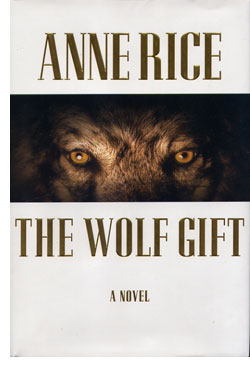
The Wolf Gift (The Wolf Gift Chronicles #1) by Anne Rice

Reuben didn't know that when he went to see the house on the cliff  to write a story for the paper that it would be a definitive moment in his life.  At 23, he was still a young story teller but innocent to many things.  In a matter of hours that would all change in a vicious attack by a beast. With his life in the balance, Reuben was transported to the hospital, only to discover that he was changing.  This metamorphosis led to things like increased strength and vigor, as well as an acute sense of hearing.  Before he knew it, the change was upon him and Reuben found that he was no longer simply a human male but a wolf creature whose nature was to hunt the evil dooer.  In a previous time when man had not advanced far scientifically, this might not have been so bad but in the age of secret government labs, and DNA testing, his new talents could potentially be more danger than gift.

I have read just about everything that Anne Rice has ever written and I went into this novel with a great deal of excitement, only to find myself struggling to finish by the time I reached 1/3 of the way through.  The Wolf Gift is absolutely ponderous and filled with ridiculous purple prose.  Throughout the novel, Rice continually uses three or even four words when one will suffice.   It further didn't help that The Wolf Gift was filled with info dumps and I must say that this completely surprised me.  Rice has always been a master of showing rather than telling. We didn't need continual descriptions of the house or what people were wearing and at times I resorted to skimming for the sake of my sanity.

Much of the novel felt like a cheap philosophy class. There have to be better ways to explore the nature of good and evil than this trite book.  At times I felt like she was testifying, despite the fact that many of her characters were atheists.  Evil, despite what Rice believes, is not always about perspective.  If someone is harming or abusing a child for instance, they are simply an evil fucker. There is no grey and there is no nuance; some things are simply irredeemable.

Lost Girl, Season Four, Episode Six: Of All the Gin Joints


This episode opens at a opera with only one attendee.  When her performance is finished, the diva is almost stopped from escape by a whistle but manages to get away.  Kenzi and Bo are at the Dahl and Kenzi reads a letter from Tamsin about the fact that she has struck out on her own.  Bo wonders if Tamsin can know herself because she has no memory.  The opera diva rushes into the Dahl and almost collapses.  When she sees Bo, the diva starts to speak excitedly about finding Bo and Kenzi translates because the diva is speaking in Russian.  Bo says that she has never seen the singer in her life and the singer protests that she was told to come to the Dahl by Bo.

The diva is now asleep with Trick looking over her.  When Bo enters the cellar to see how she is doing, Trick says that Ianka needs to rest. Bo says that she needs to speak to Ianka because apparently, Ianka said that Bo instructed her to come there.  Trick gets insistent because Ianka is some kind of bird fae and running in the cold might have strained her very delicate vocal chords.  Bo surmises that singing is how Ianka feeds.  Trick reveals that Ianka's song can even take life and evoke powerful memories.  Bo leaves asking to be informed when Ianka wakes up.

Lauren is getting her party on when she interrupted by The Morrigan.  It seems that The Morrigan is there to help her move and has brought beer and pizza.  The Morrigan asks to be called Ebony since they are going to be working together. Lauren has a bit of geek moment over her Star Trek collectibles and The Morrigan declares that she arrived in time.  The Morrigan then presents Lauren with several books.

Dyson is back at the Dahl after a ten day stretch. He reports that Lauren has gone with the Dark and Bo reveals that she is also Dark fae.  Bo says that her hand was forced by The Wanderer and Dyson promises to fix this.  The two exchange a kiss and Dyson says that it is forbidden for them to be together.  Bo grabs Dyson and takes him to the back and the two begin to engage in sex when Trick interrupts them.  Trick says that Light and Dark cannot fraternize and warns that the Onamenz are everywhere.  When Bo suggests Trick turn a blind eye, Trick makes it clear that they are to get their brains out of each others pants and get out of his bar.  Trick then reveals that Ianka is awake and asks Bo not to aggravate her.

Bo heads to see Ianka and Ianka embraces her as a hero.  Bo questions what she is talking about and Ianka reveals that Bo visited after she sang for her.  Ianka is a bit blank on the details of where they met but is sure that Bo encouraged her.  Ianka begins to sing and tells Bo to listen.  Bo flashes to herself running through a field and then she is back on the train.  Ianka asks if it was a good memory and Bo calls it a vague memory, then asks her to sing more. Ianka refuses and says that Bo promised to get her what she wants most in the world - freedom.  Bo demands that Ianka not hold her memories hostage and Ianka says that she only has the key.  When Bo asks for the key, Ianka claims that Bo is just like the others.  Ianka reveals that she is starving and cannot feed and needs to sing for an audience.  Ianka then reveals that Bo said she would not remember and asks her to look in the handle of her knife.  Bo pulls out a message which says, "Ianka you will sing for me and I will bring you freedom." Bo recognizes the hand writing as her own.

Suddenly, a man starts screaming for Ianka. Bo goes upstairs and says that Ianka is not a thing. Dambers replies that Ianka has been in his family for centuries.  Bo asks for Ianka to be let go but Dambers demands that Ianka be brought to him.  Bo tries to lie and say that Ianka is gone but Dambers has a GPS in the necklace around Ianka's throat.  Bo says that Ianka wants to sing her famous aria but Dambers counters that it is wasted on the masses.  Bo counters saying that when the public finds out that Dambers said no, they will see who he really is.  Dambers than starts making demands for a performance of Ianka.