Saturday, June 20, 2015

Between, Season 1, Episode 5: End of the Rope


20 Days Under Quarantine

Pat needs Wiley’s help – their cousin Amy cut her leg, she needs medical attention but none of Pat’s family dare go into town for fear of being shot after Chuck’s little reign of attempted terror. They need Wiley to be an ambassador for them – they’re also keeping her baby while she goes and gets help, ostensibly because she can’t do both but mainly because Ronnie tried to rape her and they don’t want her to run without helping. Yes the baby is being held hostage. No, Tracy, “Sorry” doesn’t really make up for that.
   
To Gord and Hannah where Gord describes how Hannah being a Mennonite and sticking to her Mennonite friends made them very much outsiders at school. She also doesn’t want a ride back to her community, when it’s clear she doesn’t want to explain, Gord lets it lie and offers her a place to stay. Hoepefully she’ll have home cures for their cows which are all ill with cow disease.


Two of Chuck’s minions are wandering and helpfully telling us that while the power is on, the phones are still down when Vince becomes very ill. To Gord who is there to fix everyone’s problems and is far too good or these people!

He goes with them and, after examining him, tells them that Vince’s appendix has burst which is very not good in a town without hospitals or doctors. Chuck decides they need to fly Vince over the fence and, thankfully, one of his other minions, Kevin, has had a couple of flying lessons. How lucky, I’m sure every small town has a trainee pilot or two under the age of 22 hanging around.

Wylie joins them looking for antibiotics but, of course, Chuck refuses because he hates them so much (despite the fact the Creekers have done absolutely nothing to him – unlike him to them). Chuck will only allow the family to have antibiotics if they get the pain killers Ronnie took back

Gord (who is too good for these people) points out that Kevin flying in a no fly zone with his limited experience of flying and trying to get a hospital to accept a sick quarantine kid is pretty suicidal but Chuck won’t hear it – he has to DO SOMETHING (even if that something is not helpful or sensible). Chuck dismisses Gord to his farm, calling it a mistake to call him despite Gord having made the diagnosis – but he then dared to disagree with the precious Chuck.

Next step on Gord’s list is reassuring a fretting Melissa.

Olympus, Season 1, Episode 11: The Speed of Time


Flashback beginning – to when Daedalus was a young man with a pregnant wife (who wasn’t impressed by his inventions) and no money. In the present these remembered rantings not only make him grieve even more, but also to inspire him to rant at the gods that they are of nature not magic.

He draws a symbol in the snow and hisses a threat at Apollo about using his secret against him – which Apollo listens – or some god does, since time stops except for Daedalus and he walks through the eerily stopped snow following a trail of footprints. Keading to the god Apollo – a child, apparently. A teeny, tiny, terribly CGI-boy. I’m talking is-this-show-from-the-80s? bad CGI. Daedalus repeats his vague threat before begging to have his son returned. Apollo isn’t impressed – Daedalus didn’t give a damn when the boy was alive.

Apollo kills a rat (for reasons) and wanders off, not believing Daedalus can change and announcing “you know nothing John Snow old man, or you would have hurt us already.”

In Athens, Hero and Medea are trapped inside the throne room by ice because they’ve annoyed the God of the North Wind. Which is also an epic retort to Daedalus’s whole “you’re made of nature” rant. But Hero thinks this is actually a test so he can make the third epic sacrifice after love and heritage. He thinks the cold will drive him to the brink of madness (honestly, people from hot countries get so dramatic when it gets a little chilly) and will give him insight. Medea, ominously, agrees and talks about going against all codes and standards which is ominous from the lady who murdered her kids.

They huddle together against the cold, talk about Hero’s mother and he hallucinates her crying out (actually I think his mother’s ghost screamed out because she thought, like I did, Hero was about to have sex with his step-mother after discussing how beautiful his mother was…). He goes out to his hallucination mother who has cut herself, apparently – so he sucks on her arm.

…As you do? That can’t be hygienic. And she kisses him because ghost!mother thinks he’s Aegeus.

Oh, so step-mother shagging is called in favour of biological mother shagging? She begs for one kiss which he agrees to – and Medea slapped him because he’s actually kissing her. She protests that he’s her step-son and how dare he! No, Medea, it’s fine, see he actually thought he was getting down with his actual mother…

…someone needs to have a word with the writers. Really. Medea interprets this as a vision pushing him (probably towards sex with Medea) right before Ariadne and Oracle visions both appear to declare themselves Hero’s real love and demand Hero chooses (and in case we’re not aware of the symbolism, one makes a point of being sensual and wild and passionate while the other is godly and pure and virginal. Because they’re subtle like that). Hero kisses Ariadne – which turns into more making out with Medea.

Friday, June 19, 2015

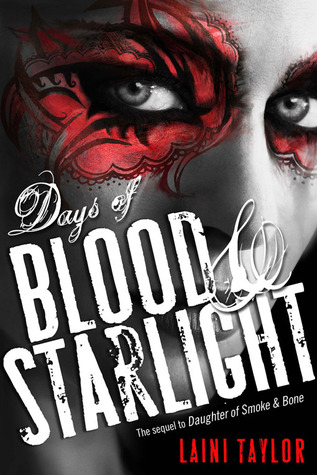
Days of Blood & Starlight (Daughter of Smoke & Bone #2) by Laini Taylor

All of her life Karou wanted to know why Brimstone made her collect teeth and as with many things in life, the answer is so much more than she is prepared for.  Facing the genocide of her people, the Chimera, Karou is racked with guilt for having not only dared to love an angel but to dream of a new world.  She must now reconcile what her people think of as her betrayal, her guilt and the love she cannot stop feeling for Akiva.

Akiva knows what he has done cannot be undone and yet he dares to hope that Karou/ Madrigal's existence will mean that somehow their naive dream will bear beautiful fruit.  To the seraphim, Akiva is not simply the weapon of his father and uncle's blood lust for war and power.  The lines on his hands indicate each kill in battle and the toll ways heavily on him.  Somehow, he must make a difference, somehow he must atone.

Karou and Akiva aren't united in their struggle thanks to all that has passed between them but they cannot help but love each other from afar and dream that one day their people will find peace, even if it doesn't end in happiness for them.

Days of Blood & Starlight has a very different tone than the first book in the series, Daughter of Smoke & Bone. Where Daughter of Smoke and Bone has moments of lightness, very little of that feeling finds its way into the pages of Days of Blood & Starlight.  It seeks to ask harder questions like what survival looks like. Is there a true objective to war, or is it simply the amassing of power? Is there a point where vengeance becomes futile? Are the children of our enemies deserving of death simply for the potential that they might one day grow and wield a sword?  Interspersed with these larger questions, the tragic romance between Akiva and Karou/Madrigal plays in the background.

Both Akiva and Karou/Madrigal feel the weight of the war between them.  No matter the torture Akiva suffered at the hands of the Chimera, participating in genocide is never acceptable.  At this point, I don't really see how these two can have a happy ending. Yes, Karou/Madrigal still loves Akiva but how can she possibly have a HEA with the person who is directly responsible for the slaughter and near extermination of her people?  I am not even sure I can accept that Karou/Madrigal is still drawn to Akivia and the determination on Taylor's part to seemingly paint him as good particularly when juxtaposed to Thiago. 

Syfy Q&A: Luke MacFarlane, Hannah John-Kamen & Aaron Ashmore from Killjoys


We were invited to another Syfy Q&A with some excellent insight - this time an interview with Luke MacFarlane, Hannah John-Kamen & Aaron Ashmore from Killjoys. The full transcript is below

Operator:             At this time, I would like to welcome everyone to the Killjoys conference Call. 

                              Gary Morgenstein, you may begin your conference.

Gary Morgenstein:    Hi everyone, Syfy’s new scripted series about a trio of badass interplanetary bounty hunters, premiers this Friday June 19th at 9 and we’re delighted to have all three of the badasses with us today Hannah John-Kamen, Aaron Ashmore, and Luke Macfarlane.  Welcome.

Luke Macfarlane:     Hello.

Aaron Ashmore: Hi, guys.

Luke Macfarlane:     Hi.  Hi, hello

Hannah John-Kamen:          Hi.

Operator:             Your first question comes from the Line of Jamie Ruby.  Your line is open.

Jamie Ruby:        Hi. I really enjoyed the first two episodes that we’ve gotten to see.  And all of you have really great chemistry together, was that kind of -- did it happened right away, can you talk about the first time you guys kind of met and work together as a group?

Luke Macfarlane:     Sure.  I mean, it’s always – and so much of it is credit due to the casting process, we had a really great casting director that took the time to really kind of do mix and matches.  So as we’re sort of slowly assembling this group, we kind of auditioned with like various people and that’s always terribly nerve racking as an actor but I think ultimately it’s really a useful sort of thing to do.  Because yes we got along from the beginning almost immediately, very similar sense of humor. 

                              This is Luke Macfarlane by the way, I play D’avin. 

Aaron Ashmore: Yes, and I think that as far as chemistry and stuff like that, you know, you either have it or you don’t.  That is something that obviously due to casting process and when they’re doing a show like this that obviously revolves around the characters having sort of dynamic chemistry, it’s really important.  But, you know, sometimes you just really lockout and I think the three of us have become, you know, really good friends and we got along so, so well, and it’s kind of rare.  So I think it’s special and I think that we all appreciate it and it’s kind of lucky too that you get three people that just get along so well.

Luke Macfarlane:     It’s almost…

Hannah John-Kamen:          And I think it’s a great – but it’s important to like have the chemistry on the screen and off.  And I think that we all have the same sense of humor which really helps and…

Luke Macfarlane:     Weird, weird.  I think we’re all weird.

Hannah John-Kamen:          Much fun.  And we sing a lot too.

Luke Macfarlane:     Yes, we do, we make up songs on the set all the time. 

Jamie Ruby:        You got to release those, see 

Luke Macfarlane:     Yes, DVD extra, special behind the scenes.

Jamie Ruby:        Yes, we hope you do.


Jamie Ruby:        And then the other question I was going to ask is obviously we’ve only seen the first three but it seems like this group they don’t tend to always follow that rules that are set forth, is that going to become a problem or do the company just kind of doesn’t care as long as they get what they’re after?

Luke Macfarlane:     It’s a good question.  I think what is interesting with Killjoys is like, you know, there’s been a lot of comparisons to Firefly, that show.  And what I think makes Killjoys really different as an entity and as a show is that we do have to abide by those rules. 

                              So the tension exist within that sort of how far can you bend the rules.  And I think that makes for an interesting thing, it’s not like we’re just rogue cowboys, we really – we really do have to operate with inside the system so that it becomes a sort of like doubly complicated way of sort of bending the things as far as we can but yes of course it becomes complicated because we don’t always abide by the rules. 

Thursday, June 18, 2015

Engage (Ignite #2.5) by Erica Crouch


Kala is a guardian angel – but not considered a very good one. She is derided for her disability but, far more, she has a pesky belief that humans should set their own destiny. And that the hard morality of Heaven is too limited and lacking in nuance for the real world.

The angels do not approve – something has to change.


This book is an excellent short story in that it brings a whole new angle to the original series – it’s not an essential angle, you can read the whole series without this short story but it brings some excellent depth to the book series. For me this is exactly what I want from a short story – not an essential part of the ongoing meta (therefore not a necessary read) but also not entirely pointless or off topic

The main series is told largely from Penn’s point of view. Which means we see hell and demons and the many many many reasons why she isn’t happy with either and only affection for her brother and having nowhere else to go keeps her bound to hell. We know why she rebels. We know why she is desperate to find another way. We know why she is rebelling

But Heaven? We’re told it’s rigid but beyond that thrown away line we don’t really know what exactly is so wrong with Heaven. What are the angels so rigid about? What real reason do the angels have to rebel? What was so bad that it would drive angels and demons to ally together in their rebellion?

This is the book that fills the gaps. This shows us heaven, it’s rigid rules, it’s outdated resistance to change, it’s savage refusal to accept any kind of nuance or grey morality. It’s utter rejection of any kind of free well, it’s vicious judgemental nature, it’s constant quest to control humanity down what it considers the true path and, in many ways, Heaven is almost unable to even identify good and purity any more, just adherence to rules.

And backed by all of this is Heaven’s brutal purges of its own, of any angel that dares to be independent, to think of themselves, to make their own judgement – or, almost as bad – allow anyone else to make their own judgments.

Jonathan Strange & Mr Norrell, Season 1, Episode 5: Arabella


War – a massive battlefield where English and French forces clash. In a fort Jonathan is called on repeatedly to use his magic to aid in the fort’s defences with his friend the major repeatedly yelling “Merlin Merlin, problem! Merlin” – until he is killed. The attacker then comes for Jonathan and the wizard snaps and kills the man with magic

Really impressive, shiny magic. But something he said he wouldn’t do

He returns to England, apparently after the war and writes his book as he promised Arabella he would (abandoning practical magic). She is loving and he is clearly haunted – as we see in flashbacks back to the conflict (and the major isn’t dead, merely inconvenienced).

Wellington remarks the war is over – but also pointedly asks “what do you think they’ll do with us now?”

In the present Arabella illustrates his book and they continue to be loving even as Jonathon’s pain is barely hidden and Arabella’s love clear.

Meanwhile Norrell berates his publisher for daring to publish Jonathon’s book. The publisher isn’t impressed, he’s a publisher and he has no truck with Norrell’s “orthodoxy.” Or his threats. Or drama.

Norrell and Lascells both climb on their respective crosses, whining about how could Jonathon do such a thing and alas, poor England. Childermass’s facial expressions are just awesome through all this.

When Norrell takes his concerns to Sir Walter, they’re worried because the Raven King is being used as a symbol by Luddites and the Swing Riots and they even believe he is coming back. Norrell thinks this is nonsense- but seizes on something Sir Walter fears – rioting poor destroying machines that cost them their jobs – as an excuse to push opinion against the Raven King and Jonathon’s book.

The Gentleman’s plotting begins – a man riding through the snow hears bells and sees the fake!Arabella struggling through the snow, though she doesn’t come when he calls her. The man goes to tell Jonathon. Of course, Jonathan insists Arabella never left home.

Jonathan and Arabella settle into quiet, contented domesticity and hope to have a child.

Meanwhile Lady Pole has a terrible nightmare in Honeycut and Segunsus’s institution – she warns them something terrible is going to happen to Jonathan. Of course, she starts babbling making no sense.

Wednesday, June 17, 2015

Killing Rocks (The Bloodhound Files #3) by D.D. Barant

With a lead on Asher and Stoker, Jace is headed to Vegas to hopefully catch the one mage who can take her home and fill out her employment contract by taking Stoker out. Naturally, any plan that Jace is involved in cannot run smoothly.  Before she knows it, Jace is seperated from her team, Charlie has been enchanted and her only two allies are Tair - her former doctor/friend turned evil and a spy from another world she doesn't know.  All of Jace's choices are bad but she knows that she must move forward if she has any hope of saving her friends and while she's at it, the world.

Of all of the books in The Bloodhound Files that I have read to date, Killing Rocks seems easily the most confused.  First, we have the switch to several different planes of existence and the creatures which inhabit them.  It made it hard to understand what was what and where exactly the story was taking place at any given moment.  There were too many unfamiliar myths wrapped into the story and some quite frankly never become relevant.  At times, Killing Rocks is overly descriptive making it a struggle not to skim - a struggle I lost in passages of the novel.  

In Killing Rocks, we saw a lot of Jace's former life as part of a dream spell which haunted her.  In these scenes we saw her work interactions with serial killers, trying to assure that they paid for their misdeeds and the toll it took on her.  This is one of the few times we have seen Jace vulnerable and it really worked.  The kick ass protagonist able to whip her gun out and order people around is a bit of a cardboard trope and Jace's backstory and personality needed to progress beyond the constant and mostly juvenile sarcasm.

In Killing Rocks, Barant started to deal with what makes one a slave, with uprising of the golems.  Charlie believes strongly that golems should be in charge of their own reproduction and no longer wants to be viewed as a commodity.  He tells Jace that lems are people even they don't care about food or sex.  It takes a little while for Jace to start to see Charlie's point of view and when she does, she realises that parents don't charge their children for being born, yet that is not the case with Lems. She further realises that the right to procreate should be a basic right, yet it's withheld from Lems.  This line of thought by Jace is unfortunately very brief.  I think that Barant could have delved deeper into this.  I did however like who the world learned how central lems are for running it efficiently.

Salem, Season 2, Episode 11: On Earth as in Hell


Mary Sibley has been accused of adultery and is ritually humiliated in the town square and the stocks. He sentences her to be stripped of all possessions and no surname – calling her names that of her husband and father. I don’t know if it’s intentional, but Mary seems virtually bored by the whole proceedings.

Marburg and Sebastian hunt, magically extract information and then murder the Native Americans who gave John his woo-woo. Well they played a huge role, providers of woowoo then murdered

She then goes to taunt Mary but I can see it working against Marburg as Mary hits back that she’s happy to suffer to protect her son – unlike the countess (hey there Sebastian!) Unwisely, Mary talks about how the kid’s going to be exorcised, revealing her plans. Marburg is sure exorcism will kill the boy

John and Cotton are preparing to exorcise evil devil child which, inevitably, reveals that John is the father of said evil devil child. Oh and Cotton seems to agree that the kid will die. While Cotton wanders off to wrestle with the godly implications, evil child tries to convince John to loosen his ropes. Cotton returns before John does so – John has also forgotten the black eyes and evil voice and argues that his son is a normal boy. Well he never was the smartest cookie. Cotton tries to prove his point by making John junior recite the Lord’s Prayer which he can’t do without great pain - John objects, completely missing the implications of his kid not being able to repeat Cotton’s words until the kid goes all demonic again.

I think that was slightly more convincing.

Back at the Marburg’s ship, Sebastian mopes mightily about how much his mother doesn’t care that much about him and she is kind of disappointed that she didn’t get to kill him. Then there’s the playing second fiddle to Marburg forever more and, later, to Possessed baby John. He’s a very pouty evil witch and he’s completely fixated on precious precious Mary looking awfully mopey and angsty. She dramatically uses a wonderfully elaborate “plenty of fish in the sea” but now, twu lub has struch Sebastian.

She tells him to grow up and kicks him out. As ever, I agree with Marburg.

Back to Cotton who wants John to light candles so he can rouse his beast (the show makes that line much less innuendo filled than I just did). Marburg uses woo-woo to seduce/horrify/something