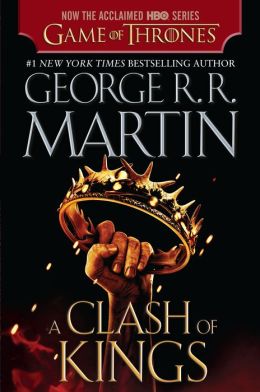
At the Edinburgh International Book Festival, George R R Martin, author of the Song of Ice and Fire Series (Game of Thrones) was asked about the lack of gay characters and intimate gay scenes in his books. This is his response:
He said the books are narrated through his "viewpoint" characters, so he was more limited than the TV shows. "Frankly, it is the way I prefer to write fiction because that is the way all of us experience life. You're seeing me from your viewpoint, you're not seeing what someone over here is seeing.
Because none of the viewpoint characters are gay, there are no explicit gay sex scenes in the early books. "A television show doesn't have those limitations," he said. "Will that change? It might. I've had letters from fans who want me to present particularly an explicit male sex scene – most of the letters come from women."
But he added: "I'm not going to do it just for the sake of doing it. If the plot lends itself to that, if one of my viewpoint characters is in a situation, then I'm not going to shy away from it, but you can't just insert things because everyone wants to see them.
"It is not a democracy. If it was a democracy, then Joffrey [the sadistic boy king] would have died much earlier than he did."
There’s a lot to unpack here - and it’s a whole lot of wrong
When we write fiction, we create a brand new world. The operative phrase in the previous sentence is “we create”. A Song of Ice and Fire is most certainly an epic and unique world but it is a world created specifically by George R.R. Martin and as such, Martin is ultimately responsible for everything the characters say and do and for the world itself. To then suggest that explicit same sex scenes cannot happen because all of the characters are straight, ignores the fact that Martin created an all straight universe, thus making the possibility of same sex interaction impossible in the first place. Martin is right, what he chooses to place on the page is not a democracy and thus he is solely responsible and is therefore open for critique. He can write whatever he wants - and what he wants is nothing but straight people and we can criticise him for that.
What is further disturbing is that Martin then goes on to add:
"I'm not going to do it just for the sake of doing it. If the plot lends itself to that, if one of my viewpoint characters is in a situation, then I'm not going to shy away from it, but you can't just insert things because everyone wants to see them.”
Since this series is from the beginning a creation of one person the plot was always malleable and the only limitations in actual existence were, and in fact are, the limitations of its creator.
Further, Martin suggests that this kind of inclusion boils down to fan service and given his tumultuous relationship with his fans, it would on first appearance justify his response. The problem is that we aren’t just talking about whether or not Joffrey should live or die but the inclusion of marginalised characters. This isn’t about throwing meat at overly demanding slashers but inclusion of a group of people who society actively oppresses, erases and frames as having a deviant sexuality. The more GLBT people are represented in the mainstream media alongside straight, cisgender people, the more we affirm that there is nothing inherently problematic or morally wrong about being a member of the alphabet soup.
This is why inclusion is so important and not something to be reduced to overly demanding fans, once again making unreasonable requests of George R.R. Martin, in attempt to reduce him to their “bitch” as it were. Including GLBT people is an imperative and moral good given the heterosexist society we live in. Sure, inclusion alone won’t change the bigotry of many, or the laws of the state but good inclusion (note: operative word here is “good.”), will have tangible social effects. At the very least, it could be one of the few series in which a young person could see themselves represented in a world which tells said person that they should not exist. Given the high rate of substance abuse, suicide and bullying, every social action which upholds and asserts the humanity of the TLBG community is important.