- Home
- About Us/Policies
- Book Reviews
- TV Series Reviews
- Other Reviews
- Discussions & Musings
- Interviews & Podcasts
- Fangs Lexicon
Showing posts with label motherhood. Show all posts
Friday, February 15, 2013
Problematic Motherhood on 'The Walking Dead'
Motherhood means life, so in some ways it is not surprising that a show where the dead rise and walk the earth, contains problematic treatment of motherhood. Despite all of the running, hiding and struggle to survive, motherhood has actually featured quite largely on The Walking Dead, the problem is that each instance in which motherhood has been an issue, it reveals not only the strong gender roles that The Walking Dead has enforced since the very first season, but an idealized form of motherhood.
The first mother we were introduced to was Lori. She escaped the city with Carl and Shane (thank Gods he’s dead). Lori’s main motivation was keeping Carl safe, when she wasn’t engaged in subsistence labour. It is Lori who sat down with Carl and forced him to continue his studies. It is Lori who tried hard to establish discipline and order in his life. Lori’s only real identity for the bulk of her appearance on the show was to nurture. The one time in which she chose to reject this limitation because of the impact that it would have on her life, she was shamed. If a woman can’t choose to have an abortion during a zombie apocalypse when food, and shelter are scarce, then when can she? Her life essentially meant nothing if she was not fulfilling her role as a mother. When she went to Hershel with her fears, she was given the “there there” treatment and sent on her way. Even in the best of situations, labour can mean death but for a woman who had serious issues with her first pregnancy and now faced labour without any modern medical intervention, it was an absolute surety. In the end, Lori paid for her motherhood with her life.
Lori’s death did not however convince Rick to take on the nurturing role for his family. This duty was instead passed to Beth. Before taking on a role as primary caregiver to the newborn, Beth’s greatest claim to fame was lying down in her bed and giving up. Yes, in this day and age, The Walking Dead actually had a young woman take to her bed. With a child to care for, Beth is suddenly reinvigorated and taking an active interest in life again, she has even gone as far as to talk about how she always wanted to be a wife and mother. These are certainly admirable goals but the fact that she didn’t have other aspirations as well, speaks loudly about the role that women are expected to take on The Walking Dead. As young as Beth is, she is already being constructed as a mother type figure with no other discernible traits. Even Carl, who is several years younger than her is walking around with a gun and entrusted with protecting the prison. Though Judith is his sister, Carl’s involvement in her daily life is minimal at best. The only other caregiver we have seen look after Judith is Carol, despite the fact that Beth chose to claim Darryl as the reason for Judith’s survival and Rick chose to thank him for his contribution. The efforts of both Beth and Carol have gone unrecognized.
Labels:
dystopian,
gender,
motherhood,
sexism,
The Walking Dead,
women,
Zombies
Friday, June 1, 2012
Motherhood in Game of Thrones
In real life, motherhood is many things. It is love and bonding, affection and protection and most certainly inspiration. Mothers have been inspired to incredible feats over the years on behalf of their children, for their children and for the world their children live in. We have a world where motherhood can be a great strength and a source of great power and resolve.
In Game of Thrones, however, motherhood seems to coincide with victimhood - being a mother is rarely, if ever, a source of strength for the mothers of Westeros, but so often another avenue through which they can be vulnerable, attacked and manipulated
This is, perhaps, clearest of all with Cersei Lannister, Queen of the 7 Kingdoms, and mother of Joffrey, Marcella and Tommen. Cersei has lead a life with little love and a great deal of harshness. A callous father lead to a loveless marriage which in turn has lead to her seeing love as a weakness. She openly advises Sansa not to love because to love is to leave one vulnerable to being hurt. And with that assertion she has another lament - that you cannot help but love your children, she sees her children as an weakness.
And, considering her eldest son, it’s no surprise. Joffrey is, without a doubt, the most evil character in the Game of Thrones. Callous, selfish, cruel, sadistic and not very intelligent, he is a blight on Kings Landing and the throne - and everyone loves it when Tyrion slaps him. Cersei isn’t blinkered to the flaws of her son. She sees what he is and how truly awful he is - and has expressed so with Tyrion on more than once. She has told Sansa that she knows she will not be happy as Joffrey’s queen and she’s fully aware of the atrocities he’s committed, whether it’s slaughtering babies or having prostitutes brutalised.
Yet, she is still driven to protect and support him. She still worries about him when he goes into battle, she still wants to save him, she is still driven to support him. She is bound to the loathsome boy and even as she sees his crimes, she cannot turn away from him. She doesn’t even get any power from being the mother of the king as she is increasingly both outmaneuvered by Tyrion and, ultimately, unable to curb the excesses and foolishness of her son. Her son is a burden, something to endure.
Labels:
Game of Thrones,
gender,
motherhood,
sexism,
the Friday discussion
Friday, May 25, 2012
Absent Mothers in Urban Fantasy
This piece was originally posted at BitchFlicks
![]() |
| Urban Fantasy is here to stay |
Urban Fantasy -- the bringing of the fantastic (vampires, werewolves, magic, fae and so much more) to a modern, real world setting -- has become ever more popular as a mainstream genre. From Twilight to True Blood to The Vampire Diaries, it is now firmly entrenched on our televisions. The books regularly reach the best seller lists - this isn’t a fringe genre. It’s here, it’s huge and it’s here to stay.
This means the portrayals represented matter. Any popular media has the power to shape culture and society; any stories that are consumed by a large number of people are going to draw upon our societal prejudices and, in turn, feed and encourage those prejudices and portrayals.
Urban Fantasy is a genre that seldom gets critical examination. At first blush, the opposite would appear to be true when one considers the social conversation around Twilight or True Blood, but these are only two examples within an extremely large genre. It is interesting to note that much of Urban Fantasy contains female protagonists and is largely produced and consumed by women. Considering the ongoing gender divide, it is hardly surprising that this immensely popular genre is being ignored by critics.
Just because Urban Fantasy is largely produced by women and consumed by women does not mean that it is free of sexism and misogyny. When it comes to motherhood, a role that most women will one day assume, it is hardly surprising that within the genre most examples are highly problematic -- when they appear at all.
The lack of representation of motherhood is so extreme that the viewer is forced to ask is, “where are the mothers?”. It seems like such an odd question, because you’d expect most characters, like most people, to have a mother lurking around somewhere; especially since most of the heroines in these stories are young women or even teenagers. Search as we might, the mothers are conspicuous by their absence.
The most common cause of the missing mother seems to be death -- indeed, it is almost mandatory for an Urban Fantasy heroine to have a tragically dead mother. In The Vampire Diaries Elena’s mother is dead. True Blood has the orphaned Sookie; Charmed killed the sisters’ mother off before the series even started; Cassie, Diana, Melissa, Jake and Adam all have dead mothers in The Secret Circle. Buffy’s mother died part way through the series. In The Dresden Files, Harry’s mother died before the series began. In Grimm, Nick is yet another protagonist with a dead mother. The whole beginning motivation of Supernatural revolves around their dead mother. In Blood and Chocolate, both mother and father are brutally murdered. In The Craft Sarah Bailey's mother is dead. In Underworld, Selene’s mother is murdered by Viktor.
This list is extremely -- even excessively -- long but it’s shocking that we looked through all the shows and movies that we’ve watched and actually found it hard to find a series where the mother was alive and present.
Even in stories where the mother is lucky enough to have dodged the bullet and is actually alive, she is still often absent. In Stephenie Meyer’s Twilight, Renee, Bella’s mother, is absent, living in a completely different state. In The Vampire Diaries, Bonnie’s mother, Abby, is absent through much of her childhood and, when they are finally reunited, Abby not only presents Bonnie with a child that she raised as a replacement, but quickly disappears after becoming a vampire. Abby is well aware of the pain that her absence has caused Bonnie and yet she steadfastly finds a reason not to engage with her daughter. Once Upon a Time sets records for absent mothers -- Augustus never had one, Snow White and Ruby’s mothers are dead, and Emma grew up in the foster system without her mother.
I suppose we should be grateful these mothers ducked the Urban Fantasy plague that has put so many parents in their graves, but they still have little to no actual influence and presence in their children’s -- the protagonists' -- lives.
With such a massive pattern, we have to ask why. Why is it almost a requirement in Urban Fantasy for the young, female protagonist to be lacking a mother (and often a father too for that matter)?
One reason seems to be to make the characters sad, relatable and, frankly, angst ridden. It’s quick, cheap and easy characterisation to establish a sad, tortured or otherwise issue-laden character with “depth” to kill off a parent and have them be sad about it. These dead mothers are sacrificed for quick and easy back story for the protagonist. Take a heroine, load her up with a shiny ability, a bit of snark, a love interest -- now kill her mother so she has “depth.” The back story is established: we have a “3-dimensional character” who has suffered (which seems to be shorthand for an established character in far too much fiction).
Labels:
motherhood,
urban fantasy,
violence,
women
Wednesday, February 22, 2012
Being Human U.S. Season Two, Episode Six: Mama Said There'd Be Decades Like These
I don't about you, but I really liked this episode.
Sally
Josh is cleaning rooms at the hospital when he realizes that one of the patients is actually Sally's mother Rena. When Rena finally dies and runs into Sally in the hallway, it is clear that Rena is actually happy to be dead because she lived a life of so much pain. She wants to go off exploring but Sally reminds her that they need to check in her father. At the funeral, Sally catches Rena making out with her former neighbour Jerry Patterson. It seems that they had an affair for years and when Jerry died, Rena was forced to mourn in silence because of the illicit nature of their relationship. Sally is horrified with the knowledge that her mother is an adulteress and while she stays away from slut shaming, there is a level of clear disappointment.
For the first time ever, Sally is forced to realize that Rena is a complete human being. This really struck a nerve with me. Rena says, "It hasn't occurred to that you parents could be individuals, you know have a life of their own." All Sally sees is that her father did not abuse Rena the way that Danny abused her. She feels betrayed by her mothers love for Jerry. Sally is further hurt that Rena had no idea how she died and to her it seems that though she has been waiting for her mother to comfort her, all that Rena is interested in is Jerry. Rena makes it clear that she loved her husband and Sally but that she is entitled to this. It may have seemed selfish to Sally but I think that there is so much pressure on mothers to put themselves last. I don't agree with having an affair but I do understand the need to find some happiness in this life. Once one becomes a mother, that is expected to be the entirety of our identity.
In the end, the two women come to some sort of closure. Rena feels that she has failed Sally because Sally lived in an abusive relationship and died because of it. She feels that though Sally is dead she is still holding on because she is residing in the same house that she died in. In this she sees nothing but sorrow for Sally and I think that she has a point.
Labels:
4 Fangs,
Being Human U.S.,
ghosts,
motherhood,
parenting,
vampires,
werewolf
Monday, January 2, 2012
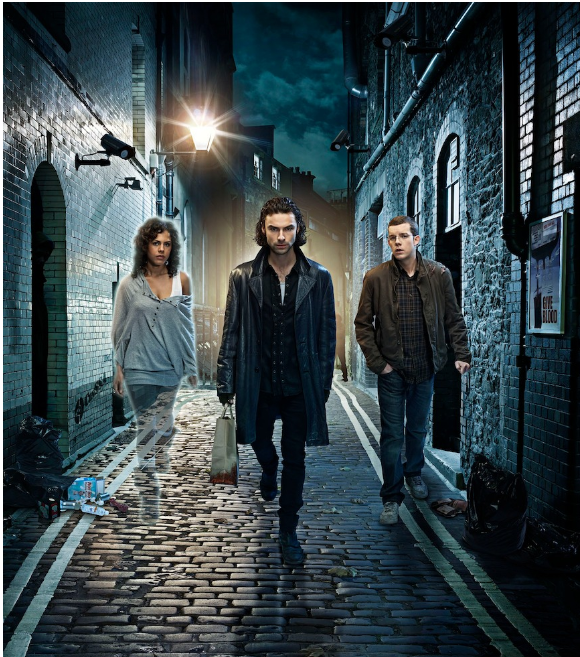
Being Human U.K. Season Two, Episode Five:
This episode opens with a flashback from 1969. Mitchell is lying on a bed covered in blood. When he sits up, he finds a dead woman lying next to his bed, also covered in blood. In the hallway, he finds another woman, who is also dead and covered in blood. He hears a toilet flush and hides, only to have Herrick come out of the room. Mitchell asks where they are, and how they ended up there, and Herrick asks if he cannot remember the party, the four hour drive, and the girls. Mitchell says that they have to get out of there, but Herrick tells him that they have to clean up, and that he does not have people to take care of this mess, because he killed the mother of the head guy in London. Herrick leaves Mitchell and tells him to do what he can, because he has to find their car. Mitchell straightens the apartment and washes off as much blood as he can, wrapping the bodies in sheets. He then runs down the stairs to leave the apartment, when he notices cops banging on one of the doors. Mitchell then forces himself and a woman into another apartment, and asks if there is another way out. The police knock on her door, and ask her if she has seen anything suspicious. When she says no, they tell her to stay in the apartment, because there was a murder upstairs.
In the present time, the police knock on the door of the house and charge up the stairs. They grab Mitchell, as he asks what he is going on, and speed off with him in their car. When Annie asks what he has done, George responds, "how far back do you want to go." William shows him a man locked in a room and explains that he is a pedophile and that he wants Mitchell to kill him. "I have a line of guys in there begging for the opportunity, I figured that you might enjoy this." Mitchell tells him that he is wrong because he is clean and does not kill anymore. "But you're a vampire, is that even possible?" William asks. Mitchell tells him that he is sorry that he could not be of more assitance and leaves.
Back at the house, George and Annie are talking about magazines, and George tells her that Sam has a daughter. Annie tells him that she didn't know that Sam had a kid, and that it is quite the responsibility. When Mitchell enters, they ask if he is okay, and Annie quickly tells him that Sam has a daughter. Mitchell simply says, "figures," and George is immediately upset. Mitchell replies, "I didn't mean anything by that. It's just the way you guys are together. Single mothers dude." George walks out and Mitchell says that this is textbook rebound, because he is obviously still in love with Nina.
At Sam's apartment, Molly opens the door and tells George that he has dog breath. She is not at all impressed with George's gift. When Sam introduces George to her mother, she walks by and refuses to acknowledge George at all. When George asks if her mother spent the night, Sam says that they share the apartment. George tries to have a seat and Molly tells him that this is where her father sits. When he shifts position, she tells him that this is where the cat sits.
Back at the house, a woman opens the mail slot and asks if Annie is going to let her in. Annie is shocked that she can see her but lets her in anyway. The woman walks in holding a child and Annie stumbles and says, "you're uh a ghost." Molly learns that Sykes told Kathleen all about her, and that she is a celebrity, because she has resisted death four times. Kathleen tells her that she has been dead for about a year, and that the baby will remain a ghost until they cross over. She says the slum lord responsible for their death is in court soon, and if he gets sent to prison then they are out of here. Kathleen points out that Annie has her own place and seems very responsible. She asks Annie to watch the baby, because she has met a dead fireman and does not want to scare him off on a first date. Kathleen says that there is no one else that she can ask, and that she does not have to worry about hurting him, because he is already dead. Kathleen tells her to keep him clean and to keep him cool because ghost babies prefer it that way.
At the funeral parlor, Mitchell is looking through paperwork and Campbell walks into the room and says that he has been dreaming about his ex. Campbell says that he tried to recruit her, but no one would show him how and so she died. He goes on to say that he had not dreamed of her in 15 years and that little things are starting to come back to him and he is scared. Mitchell tells him that he has to stick it out, and that it happens, but that eventually it will stop.
In another flashback, Mitchell is back in London. He ties Josie up after he notices that she wrote the word help on the window. She asks him what his motive was for killing the girls, and he tells her that he did not have one. When Mitchell looks at the pictures on the mantle, he notices that she is an only child and she asks him if he killed his parents as well. Josie goes on to ask how many people he has killed, and Mitchell responds, "more than a hundred, less than a thousand."
Lucy meets Mitchell on the street, and they confirm their dinner date for the next day. When Lucy walks away, she meets Kemp around the corner, who tells her that what is going on is an interesting mating ritual. Lucy tells him that this will not end in mating, and that she signed on to discover the genetics of evil. Lucy asks, "if he is clean as he says he is, what's the urgency?" Kemp responds that they have a duty to future generations, as well as to those already lost."
In another flashback, Josie asks Mitchell if he feels any remorse. She tells him that she is not scared of him, at least not as scared as she probably should be. Josie asks Mitchell if he wants to know her name and he screams shut up. Mitchell says that he had to kill them, and that he didn't have a choice. In frustration he gags her.
Labels:
3 Fangs,
Being Human UK,
ghosts,
motherhood,
sexism,
television,
vampires,
Werewolves
Subscribe to:
Posts (Atom)