Showing posts with label women. Show all posts

Saturday, April 29, 2017

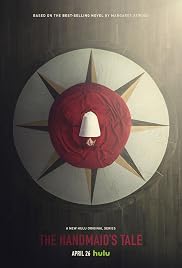
The Handmaid's Tale, Season One, Episode Two: Birth Day

In case you weren't horrified enough by Offred, Birth Day opens with the commander once again raping Offred. Offred looks at the ceiling which reminds her of a car that she bought off of Craigslist. It all has a veneer of banality now because rape is now so much a part of Offred's life that it's scheduled.  Serena Joy is not pleased by how long the whole thing is taking to happen while for his part, the commander is clearly trying to concentrate enough to blow a nut. It's clearly not an erotic situation. 

What we still don't know is exactly how free the Commander is to refuse to participate in this ritualistic rape. If he isn't actually free, in some ways he is also a victim of the system. We do however learn that the Commander is free to break some rules when he invites Offred to his office one evening to play scrabble of all things.  This is absolutely thwarting the rules because a handmaiden is not allowed to be alone with her commander, nor is a woman allowed to enter his office. It seems a big risk to take just to engage in a game of scrabble.  Could it be that for all of the power he wields in part thanks to patriarchy, that he's just a lonely man searching for some meaning and some companionship? Offred plays the game well and learns that the Commander will be traveling in the next week as a payoff for being forced to entertain him and lose at scrabble. 

Offred and Offglen continue to establish their relationship. We learn that Offglen used to be a university professor and that the only reason she wasn't sent to the colonies is because she still has two functional ovaries. It seems that the government is willing to overlook her sinful life because of that.  It's a highlight of just how desperate the rulers of Gilead are for babies.  It's also telling that anything that takes a woman away from being a baby incubator is sinful.  A woman's so-called natural role is not to be educated or productive but to reproduce. 

Gilead now encompasses all but two of the former states, although they are still battling with the rebels to solidify their rule in some areas.  Offred and Offglen stop at the remains of a church. It seems that the government is busy tearing down Catholic cathedrals.  At this point we aren't informed if Catholicism is the only Christian denomination under attack; however, I cannot imagine any religion other than their twisted fundamentalist version being allowed. 

Offglen and Offred watch as a man is dragged away by the police.  Offglen suggests it's not bad for Offred to be relieved that it wasn't her that was snatched off the street. Given that Gilead publicly displays the bodies of those who they deem unfit, Offred's relief doesn't make her a coward. The handmaids are most certainly surviving in a state of fear with good reason. Everyone is being watched and there's simply no way to know for sure if anyone can be trusted. Nick warns Offred not to trust Offglen and in turn Offglen warns Offred not to trust Nick.  It does however seem that Nick's warning may have had more merit because one morning, Offglen is simply replaced with a new handmaiden. When Offred asks about Offglen, the handmaiden simply identifies as Offglen.  It seems that handmaidens are easily replaceable because they have no identity of their own. Because Handmaidens are possessions, no one cares if they've developed relationships which makes the drudgery and often times torturous lives easier to bare.  

The most chilling scenes of Birth Day involve Offwarren's labour.  Offred is informed that the birthmobile (yes, they used the term birthmobile) is there to pick her up. Given that getting pregnant is difficult and that only 1 and 5 children survive, labour and delivery have become huge community events. When Offred arrives, the first thing she notices is that there's a huge spread of food to celebrate the big event; the food however is not for the handmaidens. Offred comments internally on the ridiculousness of the food being for the wives when the handmaidens are the ones doing the actual work.  The wives actually have the nerve to surround the wife in charge of the labouring Offwarren, as she pretends to be in labour.  PRETENDS TO BE IN LABOUR. The woman pants and moans as though she is in pain and rubs her ever so flat stomach. At best, it's a simulacra of labour. Throughout the process, Serena Joy and Offred make eye contact many times and it's clear that Serena is filled with envy and rage.

Serena feelings are established a lot through flashback.  We are taken to see June in labour and when she arrives at the hospital with Luke, it's surrounded by praying people.  Clearly this is the start of the Gilead and their obsession with babies. Not long after June gives birth to Hannah, she visits the nursery to find that Hannah is the only baby which was born healthy, there are two others in ICU and the rest died.  One of those grieving mothers is Serena Joy and she is arrested after she tries to kidnap Hannah, claiming all the while that Hannah is her baby. I don't think it's an accident that June is now assigned as Serena Joy's handmaiden.

Friday, August 19, 2016

The Women of Zoo


When Zoo began it was fairly clear that Jackson was the protagonist. This was going to be the main character, he was going to be the one we followed, he was going to be the key

But at the same time, if someone argued that Chloe, Jamie and Mitch were co-protagonists as important and central to the plot, I wouldn’t agree with them but I would concede they have a point and wouldn’t laugh at them cruelly (now if they claim Abraham was? Maybe).

Unlike so many of these shows where a cishet, white man simply must lead us all to safety and freedom, Jackson’s efforts are matched by his colleagues and that includes the women (this shouldn’t be shocking. But, alas, it is). Chloe is clearly established as the leader. She is the one external agencies turn to. She is the one who controls all the resources. She is the one who decides where they go and why. It is her influence and connections that gets them to see powerful high level officials. She’s the boss, it’s undisputed and no-one even really tries to challenge it.

And Jamie? It’s her dogged research that drags a reluctant and unhappy Mitch on board. It’s her skills as a journalist and researcher that find them many answers, and her drive that certainly helps contribute to the group. In no way can she be considered a shrinking character and her efforts are frequently integral to the plot line going forwards

It really looked like this was going to be a show where the two women would step up alongside the men and be equally as important as their male co-stars. I was hopefully

Silly me.

As the show progressed we, sadly, saw this potential crash and burn rather messily. This is really epitomised by Chloe

Chloe was the leader. Oh, she started the first episode as a fleeing victim in Botswana, but she quickly stepped up. Chloe was the one with the resources and the influence… and it was all taken from her. Her influence turned out to be a long plot from Reiden Global. Her resources was their money. She had no official authority from the French government - or any government. The very essence of what she was, the role she fit in the group, was destroyed. She was the legitimacy, the authority, the one who was in control - and it turned out she controlled nothing, led nothing and didn’t even bring resources to the fight.

If this were a DnD team, Chloe just became the Cleric who forgot how to heal.

The revelation not only destroyed her role in the group, it also destroyed her expertise. Ultimately, Chloe is a spy. She’s an intelligence agent. She’s supposed to judge people and decide if they’re suspicious or trustworthy. She’s supposed to be able to expose conspiracies. This is who she is, this is what she does. Just how bad is she at her job?! Added on to that, the fact her sister was sleeping with her boyfriend just confirms that this is “spy” is absolutely incapable of discerning when people are lying to her! She even has an angsty moment with Jackson where she bemoans just how terrible she is at her job

She’s right. She is. She really is.

Friday, July 22, 2016

Women and Death in Fox's Wayward Pines


The first season of Fox’s Wayward Pines, was very faithful to it’s source material - the trilogy written by Blake Crouch. What separates Wayward Pines from others in the dystopian genre is that instead of zombies or aliens being the threat to humanity, evolution as a response to the ways in which we have destroyed our planet is the threat. It’s a stark warning that humanity, despite its ingenuity, is indeed vulnerable and at it’s best, Wayward Pines warns its viewers not to assume that human superiority is indefinite.

As much as the concept of Wayward Pines stands out in the dystopian genre, akin to many similar texts, it fails when it comes to gender.  For some reason, the dystopian genre cannot move away from the idea that a straight cisgender white male is meant to save humanity from its destructive tendencies. Season one began with Pilcher, the megalomaniac  creator of Wayward Pines doing battle with former secret service agent Ethan Burke for control of humanity’s last town.  Gee, two white man battling for power how original. The first death of a speaking character in season one is Beverly. Beverly is the first person to admit to Ethan that something is wrong with the town and that she is not there of her own free will.  She includes Ethan on an escape plan she made with the now dead Bill and together they try to get out of Wayward Pines.  Even though they remove their tracking chips, it’s not long before their absence is noted.  Ethan does his best to distract the townsfolk so that Beverly can escape but she is quickly captured and executed in the town square by Sheriff Pope.  Beverly is killed as an abject lesson that people are to follow the rules and to show Ethan exactly what kind of world he is living in now. Sure, Ethan is upset about the execution for a New York minute, but he quickly forgets about Beverly and moves on.  Beverly ends up being less valuable than an end note.

Beverly’s death seals the antagonism between Ethan and Pilcher and from this moment on they are at odds.  Even when Ethan appears to capitulate to Pilcher after learning the truth about Wayward Pines, he cannot bring himself to follow orders and murder former lover and fellow secret service agent Kate Hewson, when her uprising fails.  Kate leads two rebellions during her time in Wayward Pines and both failed. Ethan’s rebellion ended in victory and though it cost his life, Ethan died a hero, even if he was not universally viewed that way by the citizens of Wayward Pines.  Though Kate is a former Secret Service agent like Ethan,  Kate’s skills were never primary to her character and instead, Wayward Pines spent much of its time fixating on the love triangle between Kate, Ethan and Ethan’s wife Theresa.  

When Ethan and Pilcher died at the end of season one, I had greatly hoped that Kate and Pam would come together to rule Wayward Pines and usher in a new day but it was not to be. The show skipped right over Kate and Pam coming together, to Ben (Theresa and Ethan’s son) waking in a hospital room with Jason in charge. Kate only appeared in one other episode and it was to die when the second rebellion she managed to lead failed miserably, leading to loss of life, the exile of Ben Burke and Xander and her own suicide. Unlike Ethan, whose death was heroic and resulted in saving the town from an invasion by the Abberations, Kate’s death served no higher purpose.  Kate’s suicide ultimately represented her powerlessness to change anything about Wayward Pines.

In season one, Pam, as Pilcher’s sister was a trusted member of the inner circle. This put her into conflict with Ethan but never positioned her as a co-antagonist with Pilcher because ultimately, he made all of the decisions and she functioned as a blunt weapon to carry out his wishes. Like Kate, Pam didn’t have a happy ending.  In season two, having determined that Pilcher’s grand experiment to extend humanity's time on earth was a failure, Pam began a plan to exterminate the town by infecting its members with small pox. It was the last ditch effort of the desperate.  Of course, she had to be stopped by Dr. Theo Yedlin (Ethan’s replacement), even though he fully acknowledges that there’s so much desperately wrong with Wayward Pines. Pam’s punishment was death at the hands of the neo fascist leader of the town Jason Higgins.  For Jason, Pam’s betrayal was too much because he had grown up seeing her as a mother figure, thus greatly foreshadowing the relationship he had with Kerry.  Like Kate, Pam only appeared in one episode of season two, and it was essentially for her to die.  Like Kate, Pam’s death served no higher purpose in the show and seemed to occur simply to give the insufferable Jason some manpain.  

Theresa is the third major female character to appear in season both season one and two and akin to Pam and Kate, she is also dead.  Theresa is a former Secret Service Agent turned stay at home mom, who spent most of the time on the show worried that Ethan would have another affair with Kate, or worried about the survival of her son. At no point, could Theresa’s character ever be seen as powerful and even when put in the situation to fight for her life during the Abbie invasion, it was Ethan who came to the rescue.  Alone and adrift in the wake of Ethan’s death and Jason’s control of the town, Theresa seemed to wander around Wayward Pines like a ghost, never doing much concrete to find Ben. In fact, Theresa’s inability to formulate a plan to find her son or affect any change is symptomatic of her complete impotence.  

Friday, June 24, 2016

The Women of Penny Dreadful


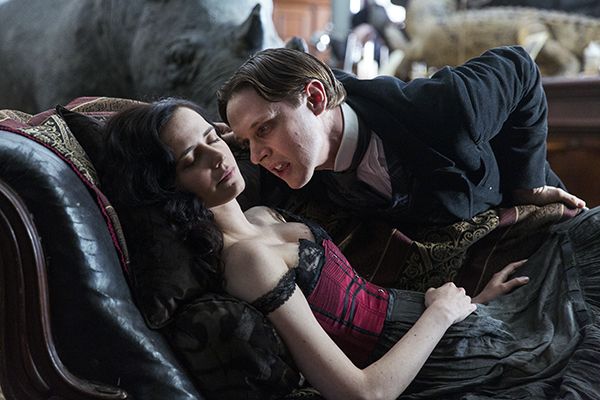
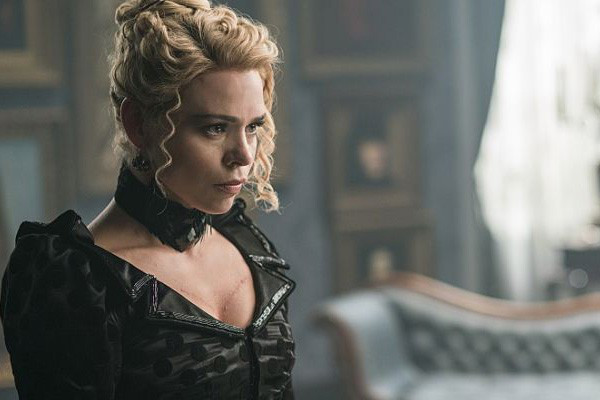
There are many positive things to be said about Penny Dreadful.  It’s easily one of the most artistically beautiful shows that I have ever seen and had the ability to deliver a strong punch to the gut that would leave me speechless.  Like many, I was saddened to learn that this years season finale actually was the series finale. Though Penny Dreadful had many characters, it was always Vanessa who led the way.  Without the brilliant acting of Eva Green, Penny Dreadful would not have been the same.  As much as I loved Vanessa for her triumphs and her courage, her character was not without it’s problems.

From a very early age Vanessa was a haunted woman.  It began when she seduced her best friend’s fiance.  Certainly in the present time that would be a great violation of trust but in Victorian England, it also amounted to behaviour that would be deemed decidedly wanton and worthy of isolation. The sexual woman simply wasn’t socially acceptable and so it would have been a real twist had this congress happened out of desire but instead it was motivated by evil forces.  Much of Vanessa’s time from that moment on was spent trying to make amends and fighting off the darkness inside of her.

The battle for Vanessa’s soul would not only consume her but anyone who came into intimate contact with her.  Vanessa became less than a person in many ways and simply became a victim in need of constant saving.  We watched as Ethan, Victor, Sir Malcolm, and Lyle devoted themselves to the protection of their precious Miss. Ives. For Miss. Ives they would risk their lives repeatedly and the revelation of their deepest darkest secrets.  I will admit that it would have all been several degrees worse had Vanessa not been active in her own defense. Vanessa actively attacked the witches and matched them spell for spell and while she depended on her circle of supporters she never lost sight of the fact that this was her battle.

The complexities of Vanessa are never ending and this is why her demise in the series finale so undercut all the work that Penny Dreadful had done for three seasons. To watch as Vanessa gave up and simply accepted that she was predestined for darkness was sad. To accept that there was something about her intrinsically evil was quite simply defeatist. It was further toxic to the messages of agency that that episode in particular told - here was Vanessa being seduced not even by darkness or a beautiful man - but by the seductive promise of being and accepting herself. An acceptance that was not only toxic for her but quite literally the entire world. Considering the themes of resisting conformity, especially for women, that Penny Dreadful showcased, this narrative is exceedingly destructive.

Sure, some might say that Vanessa death was a way of freeing herself from a struggle that would never end and was thus an act in affirmation of agency but at the end of the day, regardless of how you try to spin it, Vanessa died. Vanessa died like so many female victims leaving the men behind to wallow in their manpain. Vanessa was created and lived and died as the perpetual victim.

Think of all of the suffering that Vanessa went through in three seasons.  She was placed in a mental institution, force fed, and had electroshock treatment.  She was slashed with a knife on numerous occasions, attacked psychically and was left bowed over in agonising pain. We watched as Vanessa literally ripped out her nails and bled from grievous wounds. Each time Vanessa was knocked down she got back up determined not to be defeated.  As I watched her struggle with the supernatural it did not escape that at times Vanessa’s life amounted to torture porn. What’s worse is that this torture porn was positioned as entertainment for the masses.

In our recent recap of Penny Dreadful, we looked at the parallels between Vanessa and Lily, because both read as cautionary tales for what happens when a woman is empowered. In some ways, it’s an especially toxic form of Spunky Agency. There we see a woman making decisions - terrible terrible decisions - and trying to tempt the reader into wishing they would never make a decision again. This tv show shows the watcher the consequences of what happens when a woman has power - she ends the world or tries to gather an army of rather ineffective murderers.

Friday, November 13, 2015

The Failure of Female Leadership In the Walking Dead World


Both The Walking Dead comics and the television show begin with Rick waking up in the hospital completely unaware that his world has changed forever. Though Rick interacts with many characters, there is never any doubt that this is his story and that as readers and viewers, we are to identify with his struggle and empathise with the way he is forced to change, based in the circumstances which he is presented with. From almost the moment he reunites with Lori and Carl and becomes a member of a group, Rick takes on a leadership role (especially when Shane is… disposed of. The unfortunate fate of anyone who challenges The Almighty Rick). People look to him for guidance and are willing to risk their lives on just about any plan he formulates.  


Of course, it helps that Rick Is Always Right. Throughout the television show and in season six in particular, we have seen several examples wherein Rick makes a decision and then later on in the same episode, something happens in the plot to prove Rick right. In fact, simply challenging Rick’s ability or right to lead is enough for a character to end up dead, as we have seen with several Alexandrians in season 6 (I think Rick keeps a pack of pet Hit-Walkers to silence any dissent). Not only does Rick have plot immunity, he is in the enviable position of always being proven right. Rick isn’t just the leader, he is the alpha who makes the tough choices no one wants to make or is capable of making.


Strong White, straight, able bodied cisgender male leadership in a dystopian style show or book is absolutely commonplace. It seems that at the end of the world, writers and showrunners firmly believe that the White het, cis, guys will save world, whether they are competent enough to do so or not. This scenario necessitates the “depowering” of other characters, and especially marginalised characters. In the case of The Walking Dead, no matter who Rick interacts with, they will always in some fashion be less competent to lead.


A perfect example is Carol who, on the TV show, would be a terrifyingly excellent leader, a fact she has proven time and again. Yes, it seems the show is determined to present her as too damaged to lead: Carol being a survivor of domestic abuse and losing her only child, has been twisted in such a way that suggests that no matter how awesome her acts are, that damage outweighs her leadership. Having seen her daughter become a walker, it’s Carol. who takes it upon herself to teach the prison children how to protect themselves, even while mentally defeated Rick focuses on teaching Carl to farm. Carol’s interactions with children come to represent her damage. While Rick making similar ruthless decisions is seen as making necessary hard choices.


The Carol of the television show is quite different from the Carol of the comics. The Carol of the comics always remained dependent upon not only Rick, but everyone in the group.  Eventually, she succumbed to the pressure of the world falling apart and tried to hug a Walker. There was never any hope of this incarnation of Carol ever challenging Rick for so much as a slice of bread, let alone leadership of the group, the Carol of the television show is absolutely the antithesis of her comic book version. Carol is not only strong and capable, she has shown the ability to make the tough choices.  (“Look at the flowers Lizzie” has become infamous).  Unlike Rick, when she lost Sophia, she didn’t decide to stop participating in the group and instead used her loss to steel her determination to survive no matter what.

Friday, October 2, 2015

The Wasted Potential of the Women on Teen Wolf


We have spoken before about the dubious treatment of women in this series - including the laughable label of the Argents as a Martriarchy despite their complete male dominated society. The female characters were too often victimised, utterly wrong  or killed off and discarded after being woefully underused

This has changed to a degree over the seasons - but even as the characters have become richer, with ever more increasing potential, that under-usage has continued

What is most frustrating about this gross under-usage of women on this show is that they have had some incredible female characters. It’s almost more insulting that they haven’t just made empty tokens to stand around and look pretty - because they’ve gone out of their way to create really well developed, interesting and inspiring women… then treated them like empty tokens who stand around to look pretty.

Lydia - a Banshee with her own arcane powers. A brilliant thinker, an excellent planner, a great source of knowledge and research for the group… yet how many storylines have we followed that involve her? Her Banshee powers are an interesting tool for tracking down useful information like the latest bodies or the whole force behind the “murder list”. But do we actually have any research or examination of what it really means to be a Banshee? Beyond “she screams and hears death”? Anything of their history, their legends, what else it means to be a Banshee, the history of her grandmother and what it means and how it affects her? Even her excellent relationship with her excellent mother, Natalie?

Where are these storylines? Look at all of that! All of those plot hooks? You could write several spin offs on Lydia’s storylines alone! Equally irritatingly, Lydia is one of the most involved women on the show, probably the most involved since Alison died - and her most prominent storylines tend to be related to her love interests (Jackson, Stiles, Ethan, Parrish). And, sadly, her most prominent appearances are inevitably of her in peril. Lydia has spent entire seasons of being in peril - her whole character is stained by endless peril to the point where we both begin and end the latest season with her in a catatonic state

Then there’s Kira. Again, another female character with amazing potential for her own storylines. She’s a Kitsune, a supernatural being that is screaming out for more development especially with all the hints we’ve had - all the touched on world building about different kinds of Kitsune, the tails as blades, even the Fox taking over Kira all beg for more attention. This is demanded all the more by the presence of Noshiko, Kira’s mother, a Kitsune with several centuries of existence and experience behind her. It is mind bogglingly ridiculous that none of the cast has felt the need to consult more with Noshiko, to delve into that incredible well of experience she must have. It goes from mind boggling to offensively ridiculous that Kira herself didn’t, especially as she grew more and more concerned about her Kitsune powers being out of control.

Friday, January 9, 2015

Super damsels - Strong Women in Peril


Urban Fantasy, as a genre, is no stranger to “strong female characters.” It’s not perfect, by any stretch of the imagination - we still have a lot of female characters who make us want to tear our hair out, and Spunky Agency is, alas, so common that we’ve run entire posts trying to decide which Spunky character takes the prize for the worst decision ever. We also have a lot of “strong female characters” who are little more than weapons with breasts - which often also comes with “strength” being misinterpreted as “anger management problems”.

So, yes, problems. However, putting these aside for a moment, this genre has no shortage of women who can kick arse, claw faces, chop off heads and, occasionally, throw various kinds of magical death. These women are dangerous. These women are lethal. These women can take on small armies and come out the other side with nothing more than a snarl on their face and a very big cleaning bill.


So, with all these kick arse female protagonists and main characters, why do so many of them end up in peril? Why are so many of them severely weakened, traumatised, rendered helpless and, in all too many cases, in need of rescue?


I’m using the word “peril” here for a reason. When I do a google image search for the word “peril” I get picture after picture of women largely tied up and helpless. (Even when removing deviant art from the equation). Peril, the way it is used in fiction, has very different connotations than “danger”. I would expect any Urban Fantasy protagonist to face danger on occasion, it’s an obvious part of many books with any kind of action in them. But “peril” conjures images of helpless damsels tied to train tracks while some mustachioed villain cackles over their helpless forms.


It is peril - weakness and helplessness - that differentiates this trope from the classic action-hero who gets terrible beaten up but keeps on going because they are just that tough and awesome. Or the action hero who is taken prisoner and cooly spits defiance at his captors even when they use torture and prepare the slow-killing-laser. We are not meant to be awed by these women’s ability to suffer incredible damage and still keep moving, we’re not meant to be impressed by the will of these women to keep fighting like Harry Dresden carrying on the fight while his hand is seared to the bone, or Atticus fighting on with terrible burns all over his body. Those are scenes that use danger to emphasise the protagonist’s strength - not peril to bring them low.


Kelley Armstrong’s extensive Otherworld Series is, perhaps, the poster child for this trope, so much so that her own characters even lampshade it - with Savannah commenting on how she’s starting to match Jamie in the number of times she’s been kidnapped (yes, the female protagonists in this book can have a kidnapping league. It’s almost unrealistic for them to be scared because it should be such a mundane occurrence). It’s especially vexing with Savannah because so much of the series emphasises her power (when it’s convenient to have her as a loose cannon) then we have two entire books where her power is stripped from her - and she is imperiled. Jaime sometimes manages to be captured and imprisoned several times a book but Hope could quite likely take the gold from her in the kidnap olympics. They’re truly impressive damsels. Elena is little better, despite her being one of the most lethal women in the series: being kidnapped in Bitten (where her plan involves running off alone to the bad guys to be captured because Spunky), the whole plot of Stolen revolves around Elena being captured and abused (after she drove off alone seconds after being warned of disappearing supernaturals because Spunky). Broken is another book that revolves around Elena’s peril (made more perilous by Elena being pregnant) exacerbated by her deciding to go see the bad guy alone (because Spunky).

Friday, November 14, 2014

Supernatural Love - Mighty Men and Fragile Ladies


Urban Fantasy is a wide and rich genre. The whole world’s mythology is open to development and weaving into broad, diverse and amazing stories. We have monsters beyond count, creatures beyond measure and more legends than you can shake a stick at. With such scope, you would think infinite variety awaited us - yet some of the same tired tropes keep arising that are not only infuriating, but seem like such a terrible waste of the potential the genre hands us.

Take that most classic (and heteronormative) of stories - boy meets girl and twu love happens; and almost inevitably the boy will be stronger than the girl. In a world where we have vampires, werewolves, fae, demigods, angels and wendigo (always the wendigo) we still can’t seem to get past the idea of weak womanhood and big, tough manly men.

How many supernatural paranormal romances have a fragile human woman or girl falling in love with a supernatural creature?

Many of these take a human woman (at least at the beginning of the series) who knows absolutely nothing of the supernatural world - her ignorance making her even more vulnerable compared to her mystical, experienced and informed male love interest. They are not even close to each other in terms of power, experience, knowledge or capability.

Twilight, Love Hurts, The Victoria Nelson Series, The Fallen Series, Fantasy Lover, Night Pleasures, Night Embrace, Dark Side of the Moon, Archeron, Dream Hunter, Night Play, Unleash the Night,  Wolf’s Haven, Guildhall Guardian, The Burning Star, Wicked Lovely, Ink Exchange, Cold Iron, Fever Series, The Vampire Journals…. the list is enormous and could go on forever. The human woman-meets-supernatural-male-love-interest is a template written in stone.

If she does manage to be an supernatural she’ll almost inevitably be weaker, younger or otherwise less powerful or less experienced than her male counterpart. Even when she’s powerful, her male lover will inevitable be more so.

This applies to pretty much all the Dark Hunter Series that aren’t listed above.

The Vampire Diaries starts with Elena as a mortal - so inherently weaker than her vampiric love interests - and the bridge is hardly closed when she becomes a new born vampire contrasting with their centuries of experience.

Charlaine Harris brings us The Southern Vampire Mysteries with Sookie Stackhouse - but her woo-woo hardly serves to empower her - in fact, it makes her more vulnerable than anything else and certainly never puts her on par with her shapeshifter, werewolf or vampire love interests.

The Mercy Thompson Series has Mercy be a skinwalker - definitely supernatural but it’s abundantly clear that Adam, and any werewolf, are immensely more dangerous than she is. Even the Alpha and Omega series took werewolf Anna and paired her with one of the most lethal werewolves of them all - Charles, the Marrock’s own enforcer and executioner. Her own enhanced physical powers are easily eclipsed by his

In Kelley Armstrong’s Otherworld Series we have the necromancer Jaime and half-demon Hope - both with supernatural gifts that are certainly useful in places, but certainly not in any kind of physical confrontation or combat. Both of them are paired with werewolves, the bruisers of the world setting. The one female werewolf in this series, Elena is paired with Clay the terror of werewolf kind, the most dangerous and brutal fighter - ensuring that even with her physical prowess she is still eclipsed by his strength.

In Nalini Singh’s Guild Hunter Series we have Elena who is a skilled and powerful hunter who later becomes more. A powerful character, definitely - but she’s paired with Raphael, an Archangel; a being that is so much more powerful than Elena it defies description.

Jeaniene Frost’s Nighthuntress Series is a particularly frustrating example - as Kat increasingly grows in power and even develops her own unique woo-woo that should bring her close to Bones in power… but never seems to quite manage it. He always stays ahead either through age and experience or by her having to borrow powers that she can never quite master. The Night Prince Series doesn’t even try to pretend Vlad and Leila are peers.

In the Underworld Detective Agency all of Sophie’s love interests are stronger and more powerful than her nearly-pure-human-mess (but then, so are small children. She’s not the most competent of characters). H&W Investigations may give Shiarra a magic belt to prevent her for being completely helpless but she is beyond overwhelmed (and often in need of rescue and protection) from her love interest. And I love the Kara Gillian Series with a fiery passion of a thousand suns, but, again, Kara is not on par with her love interests in terms of power.

So many of the Black Dagger Brotherhood Series took either completely ignorant humans like above (Dark Lover, Lover Eternal, Lover Unbound), or the woman is a much weaker vampire than the warrior Brother (Lover Awakened, Lover Avenged).

On top of this repeated disparity in power, even when the woman is supernatural and has her own power there will often be something in the story that will actively disempower her or weaken her in comparison to her love interest; often requiring him to provide comfort, support or even rescue and protection.