Showing posts with label gender. Show all posts

Friday, November 9, 2018

The Friday Discussion: Midnight Texas - TV series & Book Series


There are a lot of book to TV show adaptations - they’re popular in the same way reboots are: they give you a built in fanbase to carry over and a quick and easy plot. Naturally these vary a lot in terms of quality and faithfulness to the source material (Vampire Diaries barely resembles LJ Smith’s books, while the Dresden Files was moderately faith but poorly executed), sometimes those adaptations and changes deserve some more scrutiny

When Midnight Texas was announced as being adapted I was intrigued: I consider it to be one of Charlaine Harris’s better book series with better rounded characters and certainly better (if flawed) treatment of minorities and slightly less of a single, slightly Mary Sueish, focus. (If this sounds like damned with faint praise… it kind of is. We experienced the horror that was the Aurora Teagarden series).

When the show started I was happy to see it was pretty faithful to the book series - the first season parallels the original trilogy of books (so I have no idea where the story progresses from here) but there are some noteworthy changes that really need analysing

Firstly several characters have have their race changed for the adaptation Lemuel and Fiji were both white in the books. This is not uncommon in book to TV adaptations - look at Tara on True Blood and Bonnie in The Vampire Diaries both of whom were white in their original book series. There are several possible reasons for this but, cynically, I tend to think that in the visual medium of television it becomes much more glaringly obvious when your cast is whiter than a Republican camping trip in Maine. That, coupled with the wider consumption (and a desire to be consumed by POC as a marketable demographic which seems to be less of a concern in publishing), means I think we tend to be MARGINALLY less tolerant of a completely racially erased cast - though usually one or two tokens is enough to placate this minimal objection. In the third book, Fiji does remark on how rainbow and progressive her little town is… and it’s slightly embarrassing since it includes Madonna and Teacher who are vanishingly minor characters, an Asian woman who used to live there but hasn’t for a while and a Native American character who just moved into the area who was, probably wisely, not included in the TV series (she also forgets several latino characters)

In the books this character arrives to explain that Manfred has his powers because of distant Native American ancestry and demons. Which is just an AWFUL trope. In the TV series instead they went for Romany con-man/psychic heritage instead. Which is another awful trope. Honestly this is just pick your poison.

I, naturally, do not object to these characters becoming POC but it is interesting how this has caused the characters to change elsewhere. Like Lemuel - he’s an absolutely excellent character in both the books and on television but the most dramatic change is that in the books he was a cowboy when he was alive. On TV that has changed to him being a slave. Neither storyline is particularly bad, but I can’t help but think that too much of our media is incapable of seeing Black people in historic roles that don’t involve slavery. Especially since the mythos of the cowboy in the US has missed just how many of them were Black - and how many more were Latino for that matter. The TV storyline isn’t bad, but it speaks volumes of how historic Black characters are too often limited to this single narrative.

I have more issues with Fiji - and how she and Manfred’s roles have changed. In the books I would say it’s difficult to point to one character as protagonist - Manfred starts prominently in the first book, but by the final confrontation with Kolkonar Manfred is definitely a much more minor character - not insignificant but certainly not the protagonist or the main fighter against the demon. If anyone is central to this conflict, it’s Fiji. This is Fiji’s fight, not just as someone who needs rescuing. It is Fiji’s… ritual that defeats Kolkonar, not Manfred’s epic confrontation with dark spirits.

Friday, June 30, 2017

American Gods: The Good, The Bad and the Awesome


Ever since it was announced that Neil Gaiman’s American Gods was going to be made into a television adaptation, there was a vast amount of hype about it.

I’ll admit, we weren’t the ones overly hyping it. On the whole while the book was interesting and original in some ways, we weren’t huge fans and, we’ll further admit, there was a whole lot of chuntering between us about how utterly overhyped this was and how it was going to be painful to watch. We sat down to the first episode, faces set to frown and all prepared to take on the world and tell you all how wrong you were.

We were ready. You were all going to be told. Oh yes.

Sometimes it’s good to be wrong (novel experience though it is)

For awesome as American Gods is, like everything else on television, it’s not perfect.  Given that we live in a White supremacist world, it’s hardly surprising that the Gods which got the most attention were Norse and or white. Sure, we had two episodes of Bilquis snacking on people with her forever hungry vagina, a Jinn, Mr. Nancy, Anubis, Mr. Ibis and of course brown Jesus, but it would be fair to say that they didn’t feature heavily in the story. The Gods originating from cultures of colour were each given moments of complete awesome, like Mr. Nancy’s speech on the slave ship explaining to the slaves what to expect for generations once they landed.  The problem is that they were additives and this belies the importance that each God has in their specific culture.

I would also be remiss if I didn’t mention the absence of Gods like Kali or Ganesha. Where is Buddha? Where is Muhammad? Where is Hachiman or Omoikane?  There is supposedly a war between old Gods and New Gods and yet somehow, the older Gods who still have power because they continue to be worshipped are somehow absent?   The Gods from Islam, Buddhism, Shinto, and Hinduism are all respectively old Gods and all of them to this day still have a sizeable portion of the earths population praying to them and giving offerings. The writers might have been able to reduce Jesus to a peace loving hippy, who posed no legitimate threat to the current celestial unrest but no such storyline would have been possible with Hachiman or Kali. The centering of Eurocentric Gods in the face of this once again sets up a hierarchal order of what religious beliefs matter and what can simply be dismissed and or ignored because the people who are devout are of colour. Odin, for all of his wisdom and power could not and would not be such a singular symbol of power without the exclusion of the aforementioned deities.

It’s further telling that when Odin did reach out to older Gods to form an alliance he chose Czernobog and Vulcan; two God who are clearly lesser in strength than him. Wouldn’t Hachiman, as a God of war be a far more fitting ally? Europeans have no more claim on North America than people of colour. Just as Europeans brought their beliefs and or Gods, as Mr. Nancy explained, the Gods of people colour also travelled to the so-called new world.

When these Gods arrived, just like European colonisers they didn’t simply erase the people and their beliefs who were present for centuries before.  Why is there no mention of Gitche Manitou for instance? Each Native American tribe had their set of Gods and religious beliefs and what did American Gods offer us? They gave us a white buffalo which died when its people stopped believing in its divinity. For Native American Gods to have disappeared so completely, Indigenous people themselves would have had to disappear.  Given the holocaust brought upon by European settlers and the ongoing resiliency of Aboriginal people in the face of this, their erasure from American Gods, even if not intentional, is quite certainly harmful and definitely myopic.  

There’s also Salem and the Djinn; as beautiful as their scene was (and it was), equally the LGBTQ inclusion on this show was a bisexual woman who literally ate people with her vagina and two gay men who had one amazing scene and then never really took part of the plot in any meaningful way. If it weren’t for that beautiful scene, we would probably call these characters tokens.

But really, compared to, well, so many of the other shows we watch (nearly all) it covered inclusion and social justice themes and minority characters with astonishing skill and tact.

Thursday, June 15, 2017

The Handmaid's Tale, Season One, Episode Ten: Night

Image result for the handmaid's tale television

In many ways this first season of The Handmaid's Tale has been unrelenting. Through flashbacks, we watched as the Gilead was formed and how by the time people realised that their rights were gone, in many cases, it was too late to flee. We watched as June became Offred and struggled to find a way to exist in this new reality.  Nolite Te Bastardes Carborundorum became the order of the day, as the handmaids attempted to find a form of resistance. 

The Handmaid's Tale has long been one of my favourite books even though Atwood left her readers dangling at the end.  Did Offred/June escape the Waterfords? The epilogue doesn't answer that and instead seeks to take a critical look at the Gilead from years in the future.  As much as the season finale left me wanting more, I am heartened by the fact that I will finally get to find out what happened to Offred/June. 

Night begins with Offred entering the Red Centre for the re-education (read: indoctrination) Aunt Lydia wastes not time in calling the women sluts and berating them on their dress and posture. The first thing that future handmaids are told is that their hands are to be clasped in front of them and that their eyes are to be downcast to show submission to God. June hasn't quite realised how her life has changed yet and she stares at a passing Handmaid, which causes Aunt Lydia to use the cattle prod on her.  Welcome to the world of the Gilead. June/Offred is made to apologise to Aunt Lydia.  This apology shows June's submission to the new world order but later, the same apology will be an act of rebellion. 

The Handmaids used to make eye contact and share a look of collective horror but those days are gone. As June walks back from the butcher with her illicit package, she likens them (read: handmaids) to a silent army. Since the beginning of the Gilead, the rulers have used violence and threats of violence to keep society in order but what happens when you are no longer afraid? What kind of freedom does the lack of fear bestow on a person? June rushes back to her room and quickly hides the package.

June was so fixated on doing a mission for Mayday that she forgot that the real danger lies a lot closer to home.  Serena Joy has learned of Offred/June and Fred's visits to the bawdy house and lashes out physically at June/Offred, in the process, slicing June's face open. At this point, Serena is so complicit that she doesn't recognise that June/Offred had no power to decide whether to stay or go and blames June/Offred for not saving anything for her. It's a return to the theme of women being complicit in their own oppression, a theme that will continually crop up this episode.  June/Offred is then forced to take a pregnancy test and much to her horror and Serena Joy's delight, the pregnancy test is positive.  June/Offred is absolutely incredulous when Serena Joy claims that their prayers have been answered. With her pregnancy, June/Offred has finally become what the Gilead wants her to be, a walking womb. June/Offred has fulfilled according to the Gilead, her biological destiny.

Serena then decides to press her advantage by confronting Fred next.  Serena waits in his office ready to play scrabble in the place of June/Offred.  Fred is quick to remind Serena Joy about the rules in order to avoid playing and Serena Joy is quick to remind him that she is the one who helped create them.  Yes, Serena Joy actually wrote the very laws that ended up restricting her life, how's that for being complicit. And now that the mask of civility is gone, the Waterfords confront Fred's raping of Offred/June outside of the ceremony.  Fred, like a typical man, blames Serena Joy and points out that it was she who brought temptation and lust back into their home. To assert his power, Fred actually attempts to send Serena Joy to her room.  This moment reveals just how little difference there is between Serena and Offred/June in Fred's mind.  Serena may be able to abuse June/Offred at will but at the end of the day, they are both always secondary to men. Serena Joy lays the ultimate trump card when she informs Fred that June/Offred is pregnant and that it isn't his because he wasn't man enough to make a baby.

Thursday, May 25, 2017

The Handmaid's Tale, Season One, Episode Seven: The Other Side

Image result for the handmaid's tale

We know that Luke, Hannah, and June, were desperately trying to cross the border into Canada when they were seperated.  June and Hannah were taken and from June's perspective, Luke was probably dead at the side of the road.  This is absolutely true in Atwood's brilliant book.  Because Hulu's The Handmaid's Tale, is going to be a series, rather than a miniseries, it's necessary to enlarge Atwood's world and perhaps fill in gaps Atwood originally allowed the reader to do for themselves.  The first such attempt at this is The Other Side, when we see what happens to Luke. 

In the book as well as the show, Luke, while concerned for the well being of his wife and daughter, doesn't seem to quite get how dangerous life is rapidly becoming for them.  In the book, Luke stops June from going to protest. On the show, he valiantly promises to protect June and Hannah though he clearly doesn't have the skill set to do so.  This is a man who doesn't know how to load or fire a gun but is too proud to admit it, even when the lives of his wife and daughter depend upon it. Luke may be a good man but he's short sighted.

Rather than dying on the roadside, Luke is shot and placed in an ambulance, so that he can receive enough medical care to be well enough to be questioned. Fortunately for Luke, the ambulance that he is traveling in ends up slipping on ice and crashing, leaving him the only survivor. Luke then makes his way back to where is car went off the road and walks into the woods. There he finds the torn family album, he and June tried to preserve, along with Hannah's stuffed animal. Luke continues to travel and makes his way through an abandoned town. The store fronts are graffitied  with "gender traitor" and "fag". Luke makes his way into an abandoned business and collapses.

Fortunately for Luke, he's found by a group of people who are also fleeing the Gilead.  He's resistant to even going with them though he is warned repeatedly about patrols and the fact that he won't make it far on his own and is injured. Even now, Luke cannot grasp the reality of his situation.  His fellow travellers are “an Army brat, two strays, a gay, and a nun”. One woman is so traumatized after being repeatedly raped that she doesn't even speak.  Even in the face of this, Luke is determined to get out of the van to somehow get back to Boston and find June.  It's only when a gun is pulled on him that Luke is forced to settle the hell down.  

When the van finally stops and Luke is free to go, the Nun says a little prayer for his safety.  Luke doesn't fully grasp his situation until Zoe, the woman who saved him, drags him into a church to see the bodies hanging from the ceiling. Apparently, people tried to hide the fertile women and the Gilead responded by hanging them all in retribution.  Luke is informed that there are places like this in every small town because this is how the Gilead deals with resistance.  It's the sight of the dead bodies hanging from the ceiling which finally wakes Luke up.

Thursday, May 11, 2017

The Handmaid's Tale, Season One, Episode Five: Faithful


For the past five episodes, as viewers we've watched as the Gilead attempted to ground women under their feet using any method at their disposal. Each handmaiden has a partner, whose job it is to spy on them.  Every aspect of their lives is under strict control.  If that were not enough, handmaidens are subjected to ritualistic rape in order to supposedly fulfill their biological destiny.  Women are meant to do nothing but birth babies. 

The directors and writers have weaved brilliantly between June/Offred's former life and her present to remind us of how much she's lost. We've watched as June lost access to the funds in her bank account and when she was informed that she's no longer allowed to hold down a job.  When June and Moira couldn't take it anymore and decided to protest, soldiers fired into the crowd.  We had moments of hope: when June and Moira were able to briefly escape the indoctrination center, only to be forced to witness in horror as June's feet were beaten for believing that she's entitled to be able to go or stay at her own choosing.  Nothing is out of the control of the Gilead and should a woman forget herself, the reminder are swift and harsh. For Ofglen the result is circumcision and for Janine, the loss of an eye.

The eyes are everywhere and the people not only know it, they fear it. Each small step away from the programmed existence is an act of rebellion.  Perhaps the most apt line of the night came from the commander himself when he explained that the Gilead is trying to make things better and that better for some, means worse for others.  There is no doubt that for June, Moira, Emily and even Janine, things are substantially worse. They've been forced to trade their independence and sense of self in order to obedient little baby making machines.  For the new Ofglen however, life has improved. She now lives with a family she believes cares about her and for the first time in a long time, she's off drugs, has food to eat and a clean place to sleep. For the new OfGlen, the restrictions of the Gilead are a small price to pay for the safety she now feels.  This comment doesn't serve as an exoneration of the Gilead, but it does serve as a proof that even in freedom, there are those because of how society was structured that fell through the cracks and remained there.  OfGlen isn't now free because she lives in a gender essentialist society but because she now inhabits a world in which capitol has no bearing on her material needs. 

Rebellion in the Gilead takes the form of things we consider to be everyday now. It's the commander handing Offred a women's magazine to read as a treat. It's her being able to see the world she lost and how different things are today. It was real, it wasn't a fantasy.  It's Serena Joy beginning to wonder if the Commander is infertile and arranging for Nick and Offred to have sex.  Serena Joy even uses the threat of the colonies to get Offred to agree.  What neither discuss however is that even though this is clearly against the rules, Offred cannot disagree. In the guise of saving Offred, Serena Joy is simply arranging for Offred to be raped by a different man.  Offred must take this risk because Serena Joy wants her to. It's the commander gazing at Offred with lust during the ritual and touching her legs in a sexual manner, wanting her to enjoy it as much as he does. It's even as simple as Janine sticking out her tongue, copying her young child. 

Friday, March 24, 2017

Grimm Women and Power

Image result for women of grimm

Grimm has now been running for six seasons and like any show that has been running for that length we can see some disturbing patterns developing - patterns beyond the standard Oh Hell No which we have been calling out for a long time.

One of those patterns that has clearly developed is how women are treated on Grimm - especially women with power.

Or not - because for much of the early seasons of Grimm we simply didn’t have strong women. Nick lived in a very male world and the only women who really dinged the radar were Adalind (a villain) and Juliette (ignorant and so uninvolved in the story). It was a recurring issue for far too long in Grimm before Rosalie was finally introduced alongside the eventual semi-inclusion of Kelly and Truble to add some occasional female power

But the “occasional” here is relevant. Kelly and Truble were both reduced to guest roles, not allowed to cast too great a shadow on the men of the plot - and Kelly was eventually killed off. To add to the insult of this, there was no real come back of this. Juliette - or Eve - was even accepted back by the gang despite this murder: bad enough this awesome, strong female character was so poorly used but to the have her death so casually handwaved?

Truble didn’t die - but my they put her on the bus with regularity. I wonder sometimes if there’s one writer they keep in a cupboard who eventually breaks out, yelling “no more damsels!” and then we get 3 episodes of Truble before they’re restrained

Rosalie is better - but even then there’s some gender coding in deciding that she would be the physically weaker, more cunning, Fuchsbau to Monroe’s dangerous Blutbaden. Rosalie is definitely one of the more powerful characters on this show in terms of intelligence and cunning but it would have been interesting to see her be cunning and intelligent - and dangerous.

But that brings us to the dangerous women of this show who have actually managed to hang around. Adalind and Juliette/Eve

Every thinking writer knows that simply setting up a woman to become a damsel in need of continual saving is not a marker of good writing anymore. Women are demanding more nuanced characterisation and less female victimhood. Grimm’s way of meeting these demands is to create powerful female characters; however, it comes with the caveat that strength equals  evil which, while moving aside from position women as eternal victims, reifies a sexist trope that a strong woman cannot possibly be good and is inherently dangerous to men. It’s a way of disciplining women into submission by the simple virtue of strength/power being equated to evil and a lack of attractiveness. Yes, we see you Grimm.

Adalind was introduced in the very first episode as an antagonist.  It became clear very quickly that Adalind was not someone to be played with.  Over the years, Adalind, whose hatred of Grimms was absolutely epic, made no secret of her desire to rain down misery upon Nick’s life. As a Hexenbiest, one of the more powerful Wesen, Adalind absolutely had the chops to back up any threat that she made and when her power couldn’t directly cause a problem the spells in her arsenal absolutely could, as evidenced by her poisoning of Juliette.

It’s telling that despite Adalind’s animosity towards Nick a lot of her spells actually directly attacked Juliette, thereby hurting Nick by proxy. Adalind, for example, used a cat to put Juliette into a coma and she also crafted a spell to give Juliette the hots for Renard (also, who needs a spell for that?). This, of course, furthered the narrative around Juliette as damsel in distress for the majority of this series, even as it affirmed Adalind’s oh so evil persona. Adalind’s final bad act ended up in rape by deception which resulted in the pregnancy redemption. The Adalind at the end of this series is the exact opposite of the Adalind who we met in the beginning. Gee what could have induced such a drastic change?

All of these tropes are really emphasised when we look at Nick, Adalind and Juliette because it really brings home which women are allowed to be powerful.

Friday, February 17, 2017

Friday Discussion: Isolated Tokens: Being the Only One


In our not-nearly-as-aware-as-we-wish times, more and more media creators are looking at their books, television shows, comics and games and realising “oh shit, everyone’s a cis, straight, white guy!” and realise they’re going to face the ultimate, horrendous scourge to ever befall an author: angry tweets

It’s amazing how they survive such cruel attacks

To avoid this terrible fate, they quickly drop in a marginalised character to wave that minorityness at the screen and call it done. Behold a token. One single, solitary, lonely token that, despite so much mocking, they still seem to think will earn them brownie points

But let’s examine this isolated token more closely and see just how bad it is.

So the author has decided to take the not so original step and dropped an isolated token into your story. Yes they are the one POC character in a sea of white folks. The one woman surrounded by men, the one LGBTQ person overwhelmed by an amazingly huge number of cishet people. The one woman to act as healer (or be “one of the guys”) in an all-male team. We have the one or two isolated, token characters giving a spot of “diversity” in a sea of homogenous privilege

And right away we will call “token” because “there can only be one” is such a classic indicatory of tokenism and a clear indication that the author is not actually invested in including the said marginalised groups so much as earning diversity cookies.

Why does this stand out so? Because marginalised people do tend to try and find themselves. From parades to churches, to barber shops to cafes to festivals to community centres to activist groups to shelters to co-ops to bars to clubs to hotels to resorts to craft clubs to sports teams  to dating apps, to community websites to ANYTHING - even the briefest of briefest google searches will find an enormous number of entities expressly created so marginalised people can find each other, socialise with each other and live in/create communities for themselves.

Honestly, it shouldn’t be surprising that real marginalinsed people not living in token world often build and seek out their own communities and aren’t always content being the odd one out in every single room they occupy. We, as fans of media, can completely understand the desire for fans to look for communities of their fellow fans just to discuss our hobbies, to cross entire continents to attend conventions and events - it should not be a bemusing idea that marginalised people would seek each other out for safe spaces, commonality of experience, understanding and community, it really shouldn’t.

But, ok, your token IS the only POC/LGBTQ/Woman/Disabled person in the village. That happens, we don’t all have communities and, for various reasons, we don’t all seek it.

Friday, July 22, 2016

Women and Death in Fox's Wayward Pines


The first season of Fox’s Wayward Pines, was very faithful to it’s source material - the trilogy written by Blake Crouch. What separates Wayward Pines from others in the dystopian genre is that instead of zombies or aliens being the threat to humanity, evolution as a response to the ways in which we have destroyed our planet is the threat. It’s a stark warning that humanity, despite its ingenuity, is indeed vulnerable and at it’s best, Wayward Pines warns its viewers not to assume that human superiority is indefinite.

As much as the concept of Wayward Pines stands out in the dystopian genre, akin to many similar texts, it fails when it comes to gender.  For some reason, the dystopian genre cannot move away from the idea that a straight cisgender white male is meant to save humanity from its destructive tendencies. Season one began with Pilcher, the megalomaniac  creator of Wayward Pines doing battle with former secret service agent Ethan Burke for control of humanity’s last town.  Gee, two white man battling for power how original. The first death of a speaking character in season one is Beverly. Beverly is the first person to admit to Ethan that something is wrong with the town and that she is not there of her own free will.  She includes Ethan on an escape plan she made with the now dead Bill and together they try to get out of Wayward Pines.  Even though they remove their tracking chips, it’s not long before their absence is noted.  Ethan does his best to distract the townsfolk so that Beverly can escape but she is quickly captured and executed in the town square by Sheriff Pope.  Beverly is killed as an abject lesson that people are to follow the rules and to show Ethan exactly what kind of world he is living in now. Sure, Ethan is upset about the execution for a New York minute, but he quickly forgets about Beverly and moves on.  Beverly ends up being less valuable than an end note.

Beverly’s death seals the antagonism between Ethan and Pilcher and from this moment on they are at odds.  Even when Ethan appears to capitulate to Pilcher after learning the truth about Wayward Pines, he cannot bring himself to follow orders and murder former lover and fellow secret service agent Kate Hewson, when her uprising fails.  Kate leads two rebellions during her time in Wayward Pines and both failed. Ethan’s rebellion ended in victory and though it cost his life, Ethan died a hero, even if he was not universally viewed that way by the citizens of Wayward Pines.  Though Kate is a former Secret Service agent like Ethan,  Kate’s skills were never primary to her character and instead, Wayward Pines spent much of its time fixating on the love triangle between Kate, Ethan and Ethan’s wife Theresa.  

When Ethan and Pilcher died at the end of season one, I had greatly hoped that Kate and Pam would come together to rule Wayward Pines and usher in a new day but it was not to be. The show skipped right over Kate and Pam coming together, to Ben (Theresa and Ethan’s son) waking in a hospital room with Jason in charge. Kate only appeared in one other episode and it was to die when the second rebellion she managed to lead failed miserably, leading to loss of life, the exile of Ben Burke and Xander and her own suicide. Unlike Ethan, whose death was heroic and resulted in saving the town from an invasion by the Abberations, Kate’s death served no higher purpose.  Kate’s suicide ultimately represented her powerlessness to change anything about Wayward Pines.

In season one, Pam, as Pilcher’s sister was a trusted member of the inner circle. This put her into conflict with Ethan but never positioned her as a co-antagonist with Pilcher because ultimately, he made all of the decisions and she functioned as a blunt weapon to carry out his wishes. Like Kate, Pam didn’t have a happy ending.  In season two, having determined that Pilcher’s grand experiment to extend humanity's time on earth was a failure, Pam began a plan to exterminate the town by infecting its members with small pox. It was the last ditch effort of the desperate.  Of course, she had to be stopped by Dr. Theo Yedlin (Ethan’s replacement), even though he fully acknowledges that there’s so much desperately wrong with Wayward Pines. Pam’s punishment was death at the hands of the neo fascist leader of the town Jason Higgins.  For Jason, Pam’s betrayal was too much because he had grown up seeing her as a mother figure, thus greatly foreshadowing the relationship he had with Kerry.  Like Kate, Pam only appeared in one episode of season two, and it was essentially for her to die.  Like Kate, Pam’s death served no higher purpose in the show and seemed to occur simply to give the insufferable Jason some manpain.  

Theresa is the third major female character to appear in season both season one and two and akin to Pam and Kate, she is also dead.  Theresa is a former Secret Service Agent turned stay at home mom, who spent most of the time on the show worried that Ethan would have another affair with Kate, or worried about the survival of her son. At no point, could Theresa’s character ever be seen as powerful and even when put in the situation to fight for her life during the Abbie invasion, it was Ethan who came to the rescue.  Alone and adrift in the wake of Ethan’s death and Jason’s control of the town, Theresa seemed to wander around Wayward Pines like a ghost, never doing much concrete to find Ben. In fact, Theresa’s inability to formulate a plan to find her son or affect any change is symptomatic of her complete impotence.  

Friday, June 24, 2016

The Women of Penny Dreadful


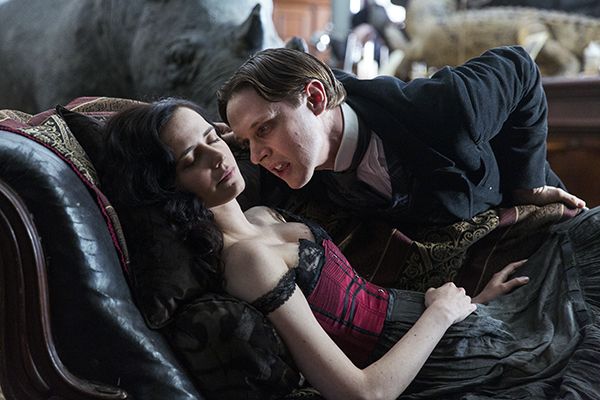
There are many positive things to be said about Penny Dreadful.  It’s easily one of the most artistically beautiful shows that I have ever seen and had the ability to deliver a strong punch to the gut that would leave me speechless.  Like many, I was saddened to learn that this years season finale actually was the series finale. Though Penny Dreadful had many characters, it was always Vanessa who led the way.  Without the brilliant acting of Eva Green, Penny Dreadful would not have been the same.  As much as I loved Vanessa for her triumphs and her courage, her character was not without it’s problems.

From a very early age Vanessa was a haunted woman.  It began when she seduced her best friend’s fiance.  Certainly in the present time that would be a great violation of trust but in Victorian England, it also amounted to behaviour that would be deemed decidedly wanton and worthy of isolation. The sexual woman simply wasn’t socially acceptable and so it would have been a real twist had this congress happened out of desire but instead it was motivated by evil forces.  Much of Vanessa’s time from that moment on was spent trying to make amends and fighting off the darkness inside of her.

The battle for Vanessa’s soul would not only consume her but anyone who came into intimate contact with her.  Vanessa became less than a person in many ways and simply became a victim in need of constant saving.  We watched as Ethan, Victor, Sir Malcolm, and Lyle devoted themselves to the protection of their precious Miss. Ives. For Miss. Ives they would risk their lives repeatedly and the revelation of their deepest darkest secrets.  I will admit that it would have all been several degrees worse had Vanessa not been active in her own defense. Vanessa actively attacked the witches and matched them spell for spell and while she depended on her circle of supporters she never lost sight of the fact that this was her battle.

The complexities of Vanessa are never ending and this is why her demise in the series finale so undercut all the work that Penny Dreadful had done for three seasons. To watch as Vanessa gave up and simply accepted that she was predestined for darkness was sad. To accept that there was something about her intrinsically evil was quite simply defeatist. It was further toxic to the messages of agency that that episode in particular told - here was Vanessa being seduced not even by darkness or a beautiful man - but by the seductive promise of being and accepting herself. An acceptance that was not only toxic for her but quite literally the entire world. Considering the themes of resisting conformity, especially for women, that Penny Dreadful showcased, this narrative is exceedingly destructive.

Sure, some might say that Vanessa death was a way of freeing herself from a struggle that would never end and was thus an act in affirmation of agency but at the end of the day, regardless of how you try to spin it, Vanessa died. Vanessa died like so many female victims leaving the men behind to wallow in their manpain. Vanessa was created and lived and died as the perpetual victim.

Think of all of the suffering that Vanessa went through in three seasons.  She was placed in a mental institution, force fed, and had electroshock treatment.  She was slashed with a knife on numerous occasions, attacked psychically and was left bowed over in agonising pain. We watched as Vanessa literally ripped out her nails and bled from grievous wounds. Each time Vanessa was knocked down she got back up determined not to be defeated.  As I watched her struggle with the supernatural it did not escape that at times Vanessa’s life amounted to torture porn. What’s worse is that this torture porn was positioned as entertainment for the masses.

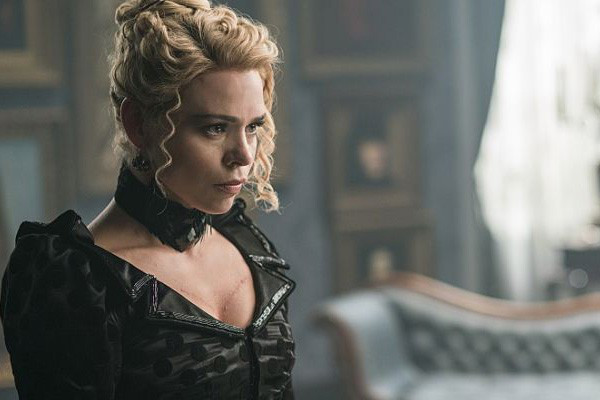
In our recent recap of Penny Dreadful, we looked at the parallels between Vanessa and Lily, because both read as cautionary tales for what happens when a woman is empowered. In some ways, it’s an especially toxic form of Spunky Agency. There we see a woman making decisions - terrible terrible decisions - and trying to tempt the reader into wishing they would never make a decision again. This tv show shows the watcher the consequences of what happens when a woman has power - she ends the world or tries to gather an army of rather ineffective murderers.

Friday, September 11, 2015

Making Sense of the Dimes and Nickles in Urban Fantasy


Urban Fantasy is, very often, a wonderful form of fantasy escapism. They depict worlds that are similar to ours but full of the fantastic and wonderful, a place where we can escape the mundane worries of our lives to go to a land where vampires brood in the shadows (or glitter in the sun), werewolves manage to make excess body hair hot and magic can make anything possible.

So, it’s not entirely surprising that money and money troubles are rarely a common topic in these books. After all, we can spend our very real, mundane lives worrying over next month’s bills or mentally battling over whether we can afford just a few more books… just one or two… they’re on sale, right? Especially when those money worries can be so all consuming, so painful and so difficult.

But Urban Fantasy is very close to our own world, it’s one of the primary definitions of Urban Fantasy, after all. As such the repeated glossing over of issues and the realities of wealth is a hole in this genre, it’s a failure to develop the lives of the characters and the world building around them and, looming over this, it’s completely avoiding or casually brushing over the very necessary issues of class and poverty that should still be in these settings.

Most commonly this is seen with protagonists - or sexy male love interests - who simply have money. How and why they have money is not really covered. They just have cash as and when they need it without any real explanation as to where the money comes from.

Sometimes there will be a convenient rich relative, friend or inheritance introduced to render it all moot (Mary-Janice Davidson rather appalling introduced a millionaire Black girl in the Undead series to bank roll Betsy, who managed to afford extremely expensive designer shoes on the salary of an office temp).

If they’re employed, we rarely see them actually perform their jobs (when was the last time anyone saw Anita Blake raise a zombie?) sometimes to a laughable degree (does Sookie even still work at Merlottes any more?). Or their job will require minimal effort - they’ll own a business that someone else will run, or it will have big pay-offs for only occasional work such as Elemental Assassin series with Gin’s lucrative assassin job or Dresden Files with Harry always seeming having money in his pocket despite rarely actually working as a wizard for hire. Or Jeremy in the Otherworld Series managing to amass a fortune that requires only the occasional painting to maintain, or Dorina Basarab in her series always had money to drop on some very expensive and rare weaponry despite her only occasional work for a Council that hated her.

They have ready money, they work for it - but working for the paycheck is never more than a small sidenote to their lives, rather than the 9-5 most of us have to put in to get by and they can often pull out large sums of cash at very little notice and with very little consequence - like Joanne Walker can put their day jobs on hold (or actively abandoning it for a while) to pursue whatever adventure has hit this week.

Of course, often wealth is just there and age or random woo-woo is often used as a justification - Anne Rice’s Vampire Chronicles is an extreme and typical example where everyone is dripping in wealth often with little real explanation as to why beyond the desire to have every scene smeared with purple-prose opulence porn. Age is why Anita Blake Series’ Jean-Claude (and most other vampires) have gathered their wealth, why Twilight’s Cullens live a lifestyle that rather exceeds the wages of one doctor and why every vampire in the Blood Destiny series is rich enough to throw their wealth around and play with credit-limit-less cards and why the Night Huntress Series’ Bones (and fellow vampires) have a near infinite budget to play with.

From the moment Damon appeared, The Vampire Diaries geared the story towards a love triangle between Elena, Damon and Stefan. Many of their interactions in terms of difference between vampires and humans tended to fixate on their abilities and need to drink blood. What I would like to know is where is the discussion of money? We know that Damon and Stefan’s home is the Salvatore family home but how do they sustain themselves, or at the very least pay for their enormous alcohol bill?  Both drive expensive cars and seem to have an unlimited budget for designer jeans. The Salvatore Brothers may pause to think about how to take out a Big Bad but any logistics which involve money are never part of the conversation. We are to accept that they are old men in young mens bodies and somehow this entitles them to wealth. Not only are they supernaturally entitled, Elena never ever questions it and accepts it as part and parcel of their vampiric state.

Friday, June 26, 2015

Women in Blake Crouch's Wayward Pines Series


I'll be perfectly honest and admit from the get go that I had never heard of Crouch or his series until Fox decided to air the television series Wayward Pines, based on Crouches trilogy Wayward Pines. .  Whenever I discover that there is a print version of a movie or a television show that we are watching I try to read it because I believe that it gives a fuller picture of the story.  As wonderful as television and movies are, and for all of the progress in technology, there are simply some things that come across better with the written word.

I picked up the first book,  Pines after watching five episodes of the Fox series, certain that I had by then attained at least a basic understanding of Crouch's story and world. It seems that thus far at least, the show is pretty faithful to its source material.  This is good in many ways because Crouch takes a unique approach to his dystopia, particularly in this era where the zombie is king.  That said, in terms of gender, Crouch's Wayward Pines series is seriously lacking.

The Wayward Pines series is yet another dystopian story in which the straight, cisgender, White, able bodied male not only becomes a leader, but he is practically a saviour.  Time and time again, Pilcher brought Ethan out of stasis, only to have place him back in  stasis when Ethan refused to adapt to the community.  Ethan refuses to quietly go along and he above everyone else, gets the answers as to what is really going on with Wayward Pines.  It's the typical approach dystopians take because somehow authors who can picture the most fantastic scenarios, cannot seem to imagine a woman in charge, let alone being heroic.

With the exception of one female character, the women all exist to nurture Ethan, uplift Ethan, teach Ethan a lesson or simply follow his rules.  They are so wrapped around Ethan that they don't seem to have a personality of their own.  This is particularly true when it comes to Theresa, Ethan's wife.  When we first meet Theresa, it's been a year and half since Ethan has disappeared.  Theresa is vulnerable, lonely, grieving and desperate. Without a doubt, Ethan is everything to her and she is desperate to hold onto the memory of him.  She talks repeatedly about the hold Ethan has over her.  For his part, Ethan is certain that had Theresa been unfaithful instead of him, their marriage would have been over.  Theresa is absolutely willing to forgive him anything because at the end of the day, they both acknowledge that Theresa loves Ethan, far more than he loves her.  Immediately, this fact creates an imbalance of power in their relationship.

Only in the most egalitarian of relationships is parity ever reached in heterosexual relationships.  Theresa gives up everything to be a wife and mother and at the end of the day, that's all she really is.  She doesn't act to defend herself unless it's a life or death situation and even then, she's counting on Ethan coming to the rescue.  It never occurs to her that she might find a way to rescue herself.  The only thing that Theresa knows for sure, when she is given a choice between Ethan and his boss, is that she was meant to be a nurturer and it is for that reason that Theresa chooses Ethan. Theresa actually chooses to take a secondary role because that's natural to her.   When Theresa learns the truth behind Wayward Pines, she commands Ethan to fix it, once again not giving any thought as to what she might do.  When Theresa and Ben are on the run from Abbies, Theresa comforts her son by suggesting that Ethan will save them. So. not only is she naturally a woman who stands behind her man no matter what, she has absolutely zero agency.  She is a cardboard cutout trope.Theresa is a damsel waiting to be saved and or noticed.

Friday, May 1, 2015

Where is the Penis?


With cable TV there is a lot of scope to show things which make the censors clutch at their pearls and stagger helplessly to their fainting couches. We can show mutilated bodies, horrific violence, even flayed bodies. We can show murder, torture, horrendously abused corpses from wall to wall and endless squishy, nasty rotting zombies.


And we can show naked bodies and sexy times. Something some shows have embraced with immense fervour - indeed it wouldn’t be a HBO show if we didn’t regularly see some breasts bouncing their merry way across the screen.


One thing we don’t show very much is a penis. Breasts jiggle from every angle, buttocks clench with regularity and even vaginas are a not uncommon sight to such an extent that such displays are barely worth mentioning- but penises? No those are still a very rare beast worthy of comment and shock when they actually appear on screen


We’ve commented on this unequal representation before and there have been numerous scenes (commented on by others as well) where this has been blatant. The naked, blood stained Lillith leaves nothing to the imagination, but the newly minted Billith gets shy and the camera is careful to keep it from the back or above the waist. Game of Thrones can show fully naked female prostitutes so commonly that they’ve virtually become wallpaper, but when Olyvar has sex with Loras or Oberyn the camera is careful to keep all crotches carefully hidden - and it wasn’t like there wasn’t enough space between the two men at all times to show everything!


Even when, again as another said very well, the coyness of the camera even damages the impact of the storytelling, we still are careful to keep those penises hidden. We see this also with True Blood when a naked and embarrassed Sam always has the full impact of his nudity lessened by careful camera angles - and naked male prisoners kept by the Vampire Authority are generally allowed the dignity of filming above the waist. In scenes meant to emphasise their vulnerability, the camera angle allows some dignity and reservation

Friday, December 19, 2014

Virginal or Gently Used Heroines


One of the most prevailing and damaging tropes to follow women is the Madonna/Whore complex. An age old method of both putting women on high, restrictive pedestals, wrapped in gilded cages to be babied and sheltered and incredibly controlled while also debasing women as acceptable targets and victims of abuse and violence; the Madonna/Whore complex has always been a short cut for judging whether a woman is “good” or “bad”.


In the media, we often see this in villains with the pernicious trope of evil female sexuality. Whether the wicked temptress, the immoral slut, the lusty jezebel or the simply evil sexual deviant - one of the quickest and laziest way the media has to depict a female villain as a villain is to make her sexual. Only a villainous woman seeks out sex, only an evil woman initiates sex and only the most depraved of the depraved of women are actually sexually experienced. Being sexual is all too often the female equivalent of Kicking the Puppy - a simple coded way to depict a villain as evil without bothering with any development. Even when not actively villainous, she is likely to be a Femme Fatale - the same coding applies, a sexual woman is dangerous.


When we come to our heroic protagonists, of course, the Madonnas trot out.


A lot of the time we go full on old school - and our protagonist has never ever had sex before. She is a virgin and probably quite disdainful of sex (and especially other women who are sexual) right until her (usually much more experienced male love interest) opens her to the many splendored joys of True Love Sex. In some extreme cases she will have never even had an orgasm before


Sookie Stackhouse from Charlaine Harris’s Southern Vampire Series is, of course, a classic example and she also introduces a common justification for deciding on a virginal protagonist - some kind of woo-woo that makes sex impossible, unpleasant or undesireable. Sookie’s ability to read her lovers’ minds makes her unwilling to be intimate (albeit something of a stretch) but her’s is not the only woo-woo barrier to sex. In Dark Lover, vampire biology makes Beth completely non-sexual - until her awakening when her true love turns up and leads to oceans of lust. Which is another element of this trope - their one true love will definitely have the correct mojo to unlock the woo-woo chastity belt. In a way, magic serves to preserve these women for their proper owners.


I’m far more intrigued at this point by a protagonist who has a woo-woo that makes their sex lives awkward - and works around it because they are sexual and are willing to take steps to realise their desires (even if those steps are not ideal), like Lire in the Clairvoyant’s Complicated Life Series.


Another excellent way to ensure properly intact good-girl hymens is, of course, historicals - Steampunk is full of virginal protagonists - such as The Gaslight Chronicles. We can have a world with magic, steam powered contrivances and weapons of all kinds - but sexual good women is apparently a step too far. Again, I appreciate when we have a subversion that actually explores the potential of speculative fiction - like the Immortal Empire Series.


Of course, while woo-woo makes a convenient justification (especially in Paranormal Romance), it’s not necessary and many protagonists just happen to be virginally pure for their true loves - Damali in the Vampire Huntress Legend Series, Clary in The Mortal Instruments and Mona from The Protector