Showing posts with label Disability. Show all posts

Friday, August 31, 2018

Privileged Actors Playing Minorities


It’s a debate that won’t die as again and again we see cishet white, able bodied actors cast in minority roles. (And yes I had to use that meme). And every single time it happens there’s always a legion of supporters jumping out to say why it’s completely ok.

It is not. It really really isn’t. There are a large number of POC, gay, bi, trans, disabled actors out there who can perform these roles. And cishet, white able bodied actors will be ok folks - 90% of the roles out there are already tailor made for them. They don’t have to have the last 10% as well!

But beyond the fact that cishet, white, able bodied actors already grossly dominate the entertainment industry, casting them in these roles has severely damaging implications with a whole lot of terrible history behind them

We cannot separate what privileged people playing marginalised characters means and has meant, no matter what creators current intention is. Both collectively and for individual minorities. Casting white characters in POC roles cannot be separated from a context of deeply racist abominations and minstral shows. Casting cis people as trans characters cannot be separated from the context of people claiming trans people aren’t REAL men/women and that a trans woman is not distinguishable from a cis man or a that a trans man is not distinguishable from a cis woman. Casting an able bodied actor for a disabled role cannot be separated from the context of people believing disabled actors don’t exist and disabled people cannot actually act at all

You cannot separate these contexts from your casting.

And all of these share a common context of mockery - of privileged people putting on these identities and turning them into clowns, caricatures, something for everyone to savagely laugh at and regard in contempt. POC, disabled, LGBTQ people, all have been worn by cishet white able bodied people to portray something worthy of nothing but revulsion and hilarity. We can all think of numerous examples (and don’t tell me you can’t. You’re lying. You really are).

And all of these share another common assumption of, well, every industry but certainly the entertainment industry, that there is a complete lack of minority actors to fill these roles. This is an excuse trotted out constantly and it’s so blatantly not true. You had to cast Scarlett Johansson because you can’t find a talented Asian actor? Really? Out of the billions of Asian people in the world, you couldn’t find one with a modicum of acting talent? REAAAALY? You cast Jack Whitehall as a gay man because he’s the best actor for the job? Really? A stand up comedian is literally the best actor you could find?

How long did you look? WHERE did you look?

You cannot divorce your acting, your portrayal, from this context. You cannot pretend that your casting exists in isolation, that they do not carry these messages and aren’t perpetuating these issues. Every time we get this privileged casting we have these messages repeated and invoked.

Especially since we also have to remember how much minority actors struggle to get roles. The number of roles for POC is vanishingly small. LGBTQ actors repeatedly have spoken about having to be closeted to get roles and how much being out has harmed their careers. Disabled actors are almost invisible entirely and many people argue they don’t even exist.

Contrast that to how a straight, able bodied actor playing gay or disabled role is almost guaranteed to be award bait. Actors will be hailed for their “courage” and acting like they’ve somehow achieved something impressive by acting this role. They’ll get to gush in numerous interviews about how Important it was and how Hard it was or, even more nauseating, how they are doing such a wonderful service for the minority in question by taking this role, appropriating the story of marginalised people and profiting at it

Friday, April 7, 2017

Physical Disability on The Walking Dead: Comics, Games & Show


It’s not often that we see the portrayal of disability in a post apocalyptic world.  It’s easy to imagine that having any sort of disability would present and extra set of problems because they already do in our present world. Disability like all other marginalisations would provide a depth to a character and allow for far more diverse stories to be told. However, more often than not, when writers deign to include a disabled character, the super-crip raises its head and leaps over tall building in a single bound, or as in the case The Walking Dead, takes out a horde of walkers while barely breaking a sweat.

In general, physical disability is not addressed in any great detail in any medium of The Walking Dead. There have been disabled characters previously in the series - both in the television and the comics - but it’s noteworthy that they don’t last long. A one-legged Dale doesn’t last very long before being killed off, for example. It’s also noteworthy that the character singled out for this is already not regarded for his physical capabilities. In fact, he’s already largely regarded as not being very physically capable due to his age. Lee in Telltale Games series also loses an arm, but, again, he doesn’t last long - this is suitable for a temporary plot, not long term character development

We’re not saying running from zombies would exactly be an easy - or long - life for someone in a wheelchair or on crutches, but physical disability in general would be far more common in this world. Poor diet, lack of medical care, a much more physical existence (especially for people unused to physical labour), long periods of travel in unfamiliar territory - and that’s aside from the constant fighting against other survivor groups, walkers and occasional tigers. No this doesn’t mean everyone is going to start losing limbs - or people who lose limbs in such poor medical conditions are going to survive - but joint pain? Limited movement? Poorly healed breaks? Fatigue? It’s probably no surprise given that our society in general is very resistant to recognising any invisible disability (physical or otherwise) that we see it similarly not depicted in fiction.

However, The Walking Dead unlike most examples in this genre, has touched on some more prominent disabled characters - but it has been definitely flawed

The Walking Dead Comics and the AMC show are treated as two separate entities; however, some obvious overlaps do exist both in characters and how said characters are treated.  Carl of the comics only has one eye and similarly, Carl of the television show also only has one eye.
It’s said that everyone will have their fifteen minutes of fame and Carl has certainly had that in this post apocalyptic world; he’s Rick Grimes’s son. Carl can never escape the shadow of his father and consequently people treat him differently because of it. It’s Carl’s fame amongst the survivors that dims the amount of ableism he experiences because of the loss of his eye but that doesn’t mean that the scarring on his face makes people feel comfortable. It’s why when Lydia encourages him to reveal himself and even licks his empty eye socket during sex that Carl feels free for the first time. Carl suddenly doesn’t have to hide what he once viewed as his ugliness behind bandages; Carl is free. It’s important to note that prior to the eye licking incident with Lydia the only other time Carl removed his bandage was on orders of Negan for the express purposes of being shamed. This scene was played out in both the comics and the television show.

For all of Carl’s appearance issues with his eyes, he never seems to really have any trouble in battle. The writers never consider that Carl’s blind side could and would be a great disadvantage in any physical altercation whether it be with a human or a zombie. Carl can even shoot a gun accurately without a problem or any compromised depth perception. Sure, he might have learned to adjust over time for his vision but it’s never actively portrayed in either the comics or the television show. The loss of vision in his eye doesn’t really affect Carl in any meaningful way. Carl has more issues with living under his father’s shadow than he does with his disability which is never actively named as such, following a pattern of creating a disability while making it invisible in the meta: creating an oxymoron of visible invisible disability. Basically, Carl’s missing eye could just as easily be replaced by an unsightly scar.

So far so good but the same cannot be said of his father Rick. On the show Rick is still completely able bodied and fully embodying the role of leader. Despite the challenges that he has faced, the illness, the poor nutrition and the constant running for his life, Rick is more changed in personality than he is in body.

Friday, February 17, 2017

Friday Discussion: Isolated Tokens: Being the Only One


In our not-nearly-as-aware-as-we-wish times, more and more media creators are looking at their books, television shows, comics and games and realising “oh shit, everyone’s a cis, straight, white guy!” and realise they’re going to face the ultimate, horrendous scourge to ever befall an author: angry tweets

It’s amazing how they survive such cruel attacks

To avoid this terrible fate, they quickly drop in a marginalised character to wave that minorityness at the screen and call it done. Behold a token. One single, solitary, lonely token that, despite so much mocking, they still seem to think will earn them brownie points

But let’s examine this isolated token more closely and see just how bad it is.

So the author has decided to take the not so original step and dropped an isolated token into your story. Yes they are the one POC character in a sea of white folks. The one woman surrounded by men, the one LGBTQ person overwhelmed by an amazingly huge number of cishet people. The one woman to act as healer (or be “one of the guys”) in an all-male team. We have the one or two isolated, token characters giving a spot of “diversity” in a sea of homogenous privilege

And right away we will call “token” because “there can only be one” is such a classic indicatory of tokenism and a clear indication that the author is not actually invested in including the said marginalised groups so much as earning diversity cookies.

Why does this stand out so? Because marginalised people do tend to try and find themselves. From parades to churches, to barber shops to cafes to festivals to community centres to activist groups to shelters to co-ops to bars to clubs to hotels to resorts to craft clubs to sports teams  to dating apps, to community websites to ANYTHING - even the briefest of briefest google searches will find an enormous number of entities expressly created so marginalised people can find each other, socialise with each other and live in/create communities for themselves.

Honestly, it shouldn’t be surprising that real marginalinsed people not living in token world often build and seek out their own communities and aren’t always content being the odd one out in every single room they occupy. We, as fans of media, can completely understand the desire for fans to look for communities of their fellow fans just to discuss our hobbies, to cross entire continents to attend conventions and events - it should not be a bemusing idea that marginalised people would seek each other out for safe spaces, commonality of experience, understanding and community, it really shouldn’t.

But, ok, your token IS the only POC/LGBTQ/Woman/Disabled person in the village. That happens, we don’t all have communities and, for various reasons, we don’t all seek it.

Friday, August 1, 2014

Mental Illness and the Non-Neuro-Typical in Urban Fantasy


Mental illnesses and non-neurotypical people are both very much misunderstood in society. Feared, reviled, pitied and shamed, there’s a lot of ignorance, a lot of misunderstanding, a lot of fear and a whole lot of damaging tropes that are assumed and encouraged. Collectively these present real barriers for the non-neurotypical to seek help and support they may need or want (or even be aware they exist) and create massive difficulties in interacting with neuro-typical people whose assumptions and worries can render it almost impossible.

Needless to say, media depiction has a huge effect on this - with repeated depictions adding to all of these problems as we see the same tropes crop up over and over

Almost ironically, the most common mental illness and non-neurotypical tropes we see in Urban Fantasy doesn’t even involve the mentally ill at all; instead it epitomises neuro-typical people’s fear of becoming mentally ill or, as it is repeatedly called over and over “going crazy.”

Indeed, it’s very rare for an Urban Fantasy series not to take a neuro-typical person, introduce them to the supernatural world and have them not think “oh my god, I’m losing my mind!” with additional levels of angst and fear. It is indicative of just how much we have demonised being mentally ill that, when the character is convinced that what they’re experiencing is real, they commonly feel profoundly relieved.

Because a world where there are immortal supernatural beings with immense power that literally feed on people to survive is much more reassuring than the idea you may have a mental illness in need of treatment? Hey a supernatural monster is currently hunting me, but thank gods I’m not crazy!

Looking at it logically, this is an appallingly ridiculous reaction - but in series where the supernatural hasn’t already been established and it has to be discovered then this doubt and relief is almost ubiquitous. It’s considered as much a staple as the dead parent.

This trope of mental illness being a terrible worse-than-death fate that may afflict neuro-typical people is really well ingrained in our culture and frequently arises in fiction.

In Witches of East End rather than have Maura live with the mental illness Wendy magically inflicted on her (and, perhaps, be treated for it), they choose to magically send her into a happy deluded coma instead. That’s an extreme example - but there’s innumerable examples of neuro-typical people suffering the terrible fate of being wrongly locked in an asylum (especially in programmes set in the past). The whole of American Horror Story: Asylum rests on the trope. Teen Wolf had Stiles wrongly confined in Eichen House, Penny Dreadful has Eva confined in an asylum. Once Upon a Time in Wonderland has Alice escaping from Bethlem - in fact, Bethlem could have its own subsection of its own!. Her Own Devices has Claire rescue someone from Bethlem, one of the main terrors of Xandra in the Immortal Empire Series is being shut in Bethlem. The whole concept of Bedlam is set on the horrors of an asylum now afflicting modern neuro-typical people - and it’s even named after the infamous asylum.

All of these feature a neuro-typical person being wrongfully detained in an asylum. And it’s not being locked up in an asylum that’s the problem - it’s that they’ve been locked up while being neuro-typical. It’s the wrongful accusation. This even applies when the conditions in the asylum are horrific and brutal - the horror isn’t horrific for its own sake, it’s horrific because these people are “innocent” of being mentally ill. In fact, mentally ill inmates of these institutions are often used as background wallpaper or to even add to the horror the neuro-typical protagonist must endure. The mentally ill are often freakish horrors that add to the protagonist’s misery and torment until they can escape the unjust abuse.

Friday, May 23, 2014

Game of Thrones: The Complexities of Tyrion


Tyrion Lannister is the third child of Tywin of the prestigious house Lannister. He is a Little Person whose mother died shortly after giving birth to him. For much of his life, he has been viewed as a monster, something to tolerate by Tywin because he cannot prove that Tyrion is not his son. These facts have influenced everyday of Tyrion’s life. Tyrion knew that due to his disability he could never fight like his brother or birth the next generation the way that Cersei could. All Tyrion could ever rely on is his intellect and the class advantages that being a Lannister provided him. As much as he despises being a Lannister, even Tyrion could not be aware of what it would mean to be stripped of the power of that name.

For us, Tyrion is one of the most fascinating characters on Game of Thrones. This is in part possible simply because of who he is. Tyrion being a Little Person means that the authors are able to write situations for him which they could not possibly write for an average sized person. Take for instance the scene at Joffery’s wedding where Little People were payed to perform for the express purpose of humiliating Tyrion or the guffaws when Tyion has to negotiate furniture which is too large for him. Each moment Tyrion is made aware that he is different, that he does not fit. These are the slights that Little People face and they are made real each episode.  

It is always going to be important to include biases against marginalised people in any script which includes them. What makes Tyrion special is not only do these slights occur, but he is so much more than an avatar for his particular disability. When Tyion loves, he loves deeply and at least twice to his own detriment. He loves women and is more than happy to spend his time in a brothel. The kind of man who thinks he has the right to buy access to a woman’s body should not be deemed a good character per say, but relative to the other men who do so (read: Joffery, Little Finger etc), Tyrion seems almost benign. He has a set of morals quite different from the world around him, yet he revels in the game or the intrigue of Kings Landing. In short Tyrion is a man of many passions and it is these passions which humanise him, not his disability. This is why in each instance in which Tyrion is brought low, we, as an audience, can empathise with his pain.  We have been drawn into his world even though it so completely different from our experiences.

Tyrion has had many awesome moments in show, but also some extremely nuanced and complex ones especially in the episodes The Laws of Gods and Men and Mocking Bird in relation to Shae and Bronn.

Tyrion, on trial for murder, sees both of these characters turn on him, to a degree. Shae stands in the witness box and tells incriminating lies about him as well as characterising their relationship in brutal, harsh terms - that she is a prostitute who was bought by Tyrion and who served him as he wished, as he demanded with no affection or desire - just a woman forced by circumstance. While Bronn has accepted Cersei’s bribe for a comfortable, privileged life and also refused to stand for Tyrion in his trial by combat against Ser Gregor, one of the most feared knights in the realm.

In both cases these are seen as a betrayal, especially Shae, but these powerful scenes allow us to pull back the lens and see Tyrion through other people’s eyes - especially those who do not share his noble class. While Shae’s testimony seems cruel, how much of it is inaccurate? She is a prostitute, a vulnerable foreigner with no protection beyond that largesse of her employer. She was “acquired” for Tyrion and she did serve him in bed - did she care for him? We thought so, but then, since her safety, security and prosperity is reliant on him being pleased with her, isn’t it equally likely that she would put on an act to please him? To assume that Shae is able to be fully forthcoming with her feelings for Tyrion in this relationship is to ignore the vast power Tyrion has over her; not only does her income rely on him, but he would be quite capable of having her killed with impunity. We have seen Joffrey do exactly the same thing to Ros, another prostitute - and there are no dramatic trial scenes in Westeros for the death of sex workers.

Monday, November 19, 2012

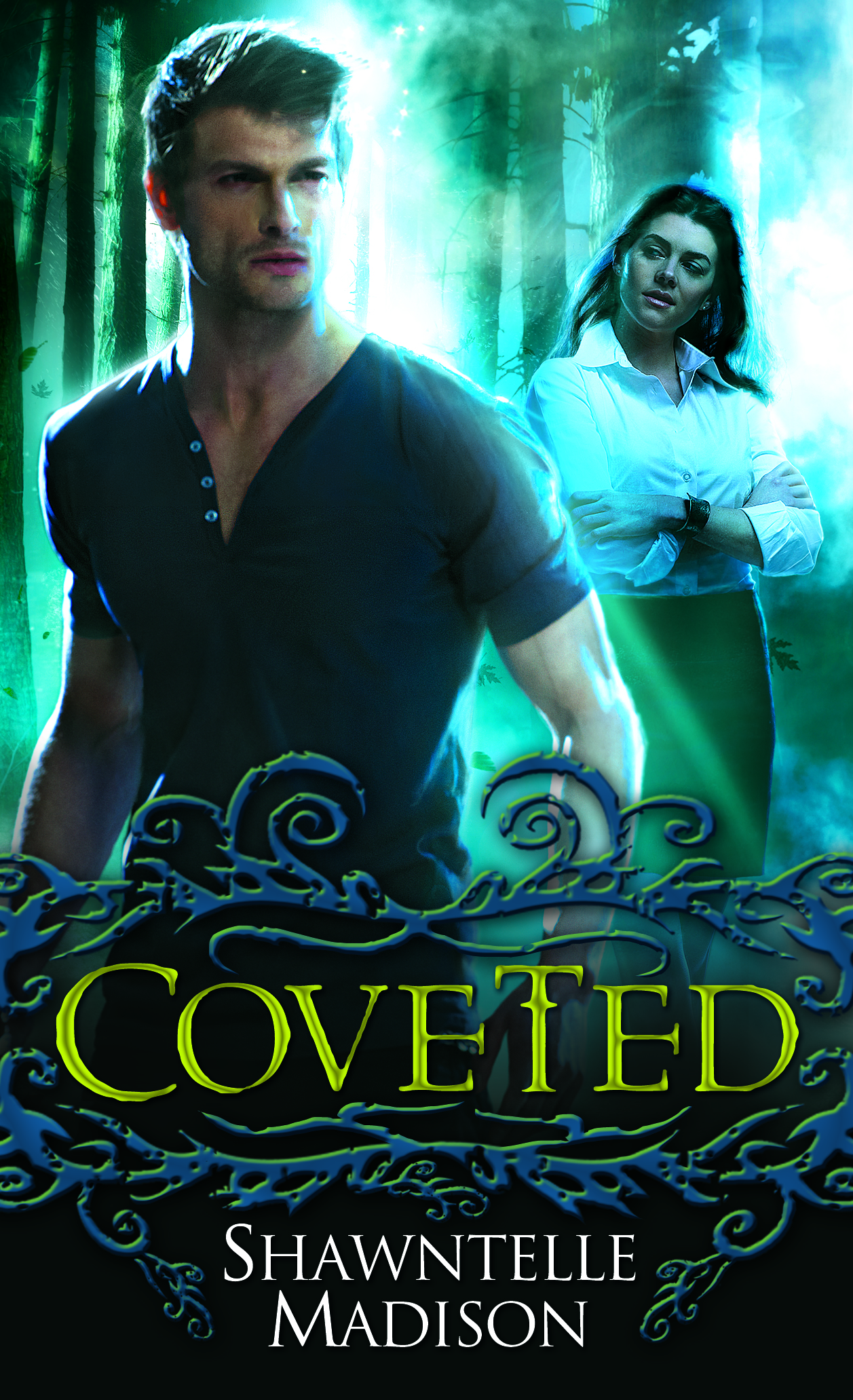
Giveaway of Kept by Shawntelle Madison Book 2 of Coveted Series

Hey everyone, it's time for a new and exciting giveaway. This time we are giving away Kept by Shawntelle Madison, book number 2 of the Coveted series.

Fresh from defending her pack in battle, Natalya Stravinsky, a whip-smart werewolf with a lovable neurotic streak, wants a little rest and relaxation. Once an outcast, she’s now eager to rejoin the ranks of her New Jersey pack, and has even gotten a handle on her obsessive urge to hoard holiday ornaments. Yet Nat barely has time to revel in her progress before the next crisis comes howling at her door.

Nat’s father has suddenly gone missing, captured by the Russian werewolf mafia. And as Nat steps up to save her dad from a mob boss’s deadly game, two men step in to play another round for her heart: her gorgeous alpha ex-boyfriend, Thorn, and her new flame, the sweetly sensitive wizard Nick. With her life growing more harried by the minute, Nat must stay cool, calm, and collected . . . or else risk losing everything.

For those who are interested, you can find our review of the book here.

Good luck everyone.

a Rafflecopter giveaway

Thursday, November 1, 2012

Kept by Shawntelle Madison Book 2 in the Coveted Series

At the end of Coveted, Natalya Stravinsky had battled alongside her friends and fellow pack members to protect their hunting land from invasion. Through therapy, she was working through her issues with OCD and hoarding.  When a flood had wrecked most of her precious Christmas ornaments, her family came together and for the first time since having a serious panic attack at a clan event, the Stravinsky family embraced Natalya.  All in all, things were looking up. Though Coveted ended in a happy place, it was clear that Natalya still had a lot of issues to deal with.

At the beginning of Kept, we see that the family bond between Natalya and the other Stravinskys has only grown stronger. The question is, has she grown strong enough to deal with the trials awaiting her?  Natalya is determined to get back into the pack, though all of the werewolves still see her as strange. When she takes on her father's blood debt, the task assigned is much more difficult than she could have imagined.  Being banned from taking any aid from another werewolf, Natalya is once again forced to rely on her friends from her therapy group, thus bringing herself closer to Nick the wizard.  Something sparks between them, but she is not sure if she can let go of her feelings for Throne, the alpha apparent of the pack.  If nothing else, the completion of this task will ensure that the Stravinsky clan will be able to remain in the pack with honour.  As Natalya tries to work out her feelings for the two men that she loves, Thornes betrothed is not the least bit pleased that such a low ranking wolf still occupies his heart. 

Having an ass kicking protagonist is not new in urban fantasy.  In fact, it happens so often that it's almost a cliche.  Natalya has a touch of the spunky agent in her, in that she rushes off without thinking things through clearly. Her motivations are good and she is most certainly honourable, but rushing into action without any plans whatsoever is ridiculous. It puts her in a position to call for help because she is overwhelmed and not because she has wisely decided that she needs it.

One of the things that I loved about this series from the very beginning, is the myriad of disabled characters.  I said it in the last review but it bears repeating, this is something rare for urban fantasy and I absolutely love it.  Madison could have taken the opportunity in this book to show growth of Natalya's character by erasing her disability.  We have too often seen disability cast aside in the media, when it become inconvenient because it is time to see a character grow and change. While Natalya does not spend as much time caressing and loving her ornaments in this book, it's clear that her OCD is in full swing, even as she battles the bad guys and takes on difficult challenges. Natalya just doesn't play "super crip" and rise above, she still performs acts like obsessive hand washing and wiping everything down with antibacterial wipes, as she fights for her family and her place.

Friday, September 28, 2012

Coveted by Shawntelle Madison Book 1 in the Coveted Series

Natalya Stravinsky lives in South Toms River, New Jersey and works cataloging antiques, having been forced to leave behind her dream job in New York.  Natalya, is a werewolf but unlike the rest of her family, she is no longer pack, after being thrown out when the alpha discovered that she has issues with anxiety and OCD.  To make matters worse, though she still spends time with her family, she often feels like an outsider at family events and they are no longer close.

Natalya developed a routine for herself going to work and buying Christmas decorations, which she comes to see as her friends. Though she is lonely at times, she is getting by, until her ex boyfriend and heir apparent to the local pack Thorne moves back to town.  Now she is constantly hoping to get a glimpse of him.  When her friend Aggie shows up looking for a place to stay, Nat reluctantly opens her home and in the process, creates a widening of her boundaries. This leads to her going on her first day in five years, buying new clothing and even restarting therapy, where she meets a wizard named Nick.  Chemistry quickly develops between Nick and Thorne, but she is not sure whether or not she is ready to move on with her life.

Things are are really starting to look up for Nat, until the Long Island werewolves decide that they want the territory of the local pack.  Nat approaches the alpha sure that she can help but is quickly rebuffed and shamed.  Things escalate, when she becomes a target and her family is attacked.  Nat is scared and unsure but loyalty forces her to find the strength that she needs to fight.

There were times when I felt that Coveted was overwritten because Madison included details that were obviously extraneous, yet I was completely drawn into the story and found myself rooting for Nat.  There are a lot of werewolf books on the market, but Coveted is absolutely unique.  Nat is neurologically atypical and so is every character in her therapy group.  Often in urban fantasy, the supernatural element spends time whining about how oppressed they are, but Nat really and truly is oppressed in a real world sense, though she is a werewolf.  Nat has to negotiate abelism in her community and is heavily stigmatized. Without a doubt, Madison's treatment of disability is the best I have read in the genre to date and as a disabled woman, I greatly appreciated the inclusion.

Another aspect of Nat's disability that I found fascinating is the fact that she is a hoarder.  Nat tries to deny this because she is extremely conscious of having everything as clean as possible.  She knows that the fact that she cannot stop buying Christmas decorations and storing them in boxes all over her house is a problem, but when she is stressed, or feeling down, she simply cannot stop herself.  Madison did an excellent job detailing the compulsion behind her actions.  Where she kind of went off the rails was when she revealed that Nat's great grandmother was a hoarder and her family assumed that this was something in the gene pool. Yes, there are generations of hoarders; however, it is usually passes from generation to generation when there is a shared living space.  It doesn't just hop generations.

Friday, July 27, 2012

Review: Waiting for Daybreak by Amanda McNeil


Freida had a difficult life. Living with mental disabilities, she had a hard time negotiating the world and, especially, the people within it. It certainly seemed she’d hit one of her low points after a particularly awful date sent her into disassociation, self-harming and depression.

Of course, if she hadn’t been in that low, she’d have been outside when the zombie apocalypse began, rather than in bed reeling from depression. She would have been like the rest of Boston – perhaps the world – roaming around seeking brains to feast upon.

In the greatest irony, she almost seems to be thriving far more in this new, bleak world than ever she did before – just her, her cat – and even a love interest who doesn’t seem nearly as awful as her last real date. Perhaps they can carve their own life in world of zombies, despite every day being a battle to survive under constant threat from the Afflicted


When I picked up this book, I had reservations. It’s a very short book, especially for something not part of an ongoing series. It seemed too short to be a self-contained story in and of itself.

So I was wonderfully surprised by the masterful pacing that made this book and this story exactly as long as it needed to be. We had plenty of flash backs of Freida’s life to have a greater idea of her as a character and her history of mental illness. We learned enough about her to flesh her out as a person, to get an idea of the outbreak and what happened to her and how she survived – but not so much that it was extraneous, padding or unnecessary fluff.

Similarly when she met Mike and had a relationship, we had enough information and scenes to see the shape of it, but not so many that we were drowned in excess detail that bogged the story down and turned it into a romance. We didn’t learn much about Mike, we didn’t need to know much about Mike. The story was a extremely well done balance –neither too much nor too little.

Which covers most of everything in the book – the action scenes were exciting, lasted long enough that you didn’t blink and miss them but not so long that you were tempted to skip forwards; they were well described enough to get a sense of what was happening, without being so over-described that it felt like the fighters were actually taking notes. This whole book just hits the sweet spot – that perfect balance between too fast and too slow, too much description and just enough, too much world building and backstory, and not enough

Friday, March 30, 2012

The Disabled can play the Game of Thrones


We analyse many tropes in many of the books and series we’ve read and often cover the many ways we find a representation to be lacking. While erasure is something that haunts marginalised people in nearly everything we come across, there’s also no small number of representations that make us wish that we’d seen erasure instead.

So it’s actually rare that we see a representation where we’re actually impressed and pleasantly surprised. As important as it is for critique the poor portrayals when we see them, it’s also necessary to point to those that get it (at least somewhat) right and praise them for it


But even in these positive portrayals there are inevitably some problematic elements that we cannot ignore - and it would be remiss to ignore these problems - they don’t become non-problematic just because there is good stuff around them.

And so we come to looking at the way the Game of Thrones treats disability. The disabled are erased in so much of fiction and where they are allowed to exist, the portrayal is normally deeply flawed and extremely limited. The Game of Thrones is surprising in that it has several disabled characters and they fulfill some very diverse and different roles.

One of the most popular characters in The Game of Thrones is Tyrion Lannister who is played by Peter Dinklage.  Tyrion is an absolutely compelling character and stands out not only because of the lines he is given to say, and the phenomenal acting Dinklage, but because he is a disabled character, in a largely able bodied show.

Normally when disabled characters are included they are shunted to the side and most certainly not central to the story line.  From the moment Tyrion is introduced having sex with with multiple women, it was clear that his role would be far different from the norm.  Disabled people are very seldom seen as sexual beings.  Tyrion is not only sexual, it would be fair to describe him as hyper sexual. For Tyrion expressing his sexuality is part of how he declares his manhood, in a world that simple seeks to dismiss him because of his size.

Tyrion is never allowed to forget that he deemed a half man because of his size, despite his intelligence.  His physical limitations do not stop his father from sending him to Kings Landing to become the hand of the king. The hand of the king is essentially an advisory role but Tywin intends for him to take over because he does not trust the cruel and petulant Joffrey to rule. This invests Tyrion character with power that is not based in rising above but in his natural strengths - his intelligence

For all of the progressive elements of Tyrion’s character, what is most troubling is his relationship with Shae.  Tyrion is a very good customer at brothels and he actually treats the women that he has sex with, with a degree of respect.  The problem of course is not his treatment of the prostitutes, but that the only time he has sex it is with prostitutes.  Tyrion’s only sexual interactions with women have all been with prostitutes.  The first woman that he had sex with was a prostitute, which his father arranged.  He thought it was love, until he was told that her affections were paid for, and this is a sadness he continues to carry with him. When Tyrion is sent to Kings Landing, Tywin makes it clear that Shae is not welcome to go with him.  Her response makes it unclear whether she is upset that she is being thought of as unworthy to be at Kings Landing, or the loss of income that Tyrion provides, or the thought of missing his companionship.  It makes it seem as though his disability makes him unworthy of someone desiring to sleep with him, without a financial reward, or even loving him for the person that he is.  For all his bravado, Tyrion is a lonely man. This is reductive and undermines some of the efforts of the writer to deviate from the typical construction of disability in the media.  When dealing with a disabled character, it is important that ableism is not erased to maintain reality; however, the character in question needs to be able to experience the full spectrum of human emotion and for Tyrion that means love.

Monday, January 23, 2012

Review of Sanctuary Season Three


Season Three opens with the continuation of the Big Bertha/ Kali storyline.  As I mentioned in my review of season two, I am not at all pleased with the appropriation of the Hindu religion for the purposes of a plot point.  Season three had 20 episodes and is the longest season to date.  Much of this season is dedicated to the introduction to Hollow Earth - a large city in the center of earth inhabited by an extremely technologically advanced race.

The new big bad this season is Adam Worth who might recognize and Dr. Jekyll and Mr Hyde. I suppose the best way to describe him is as the sixth wheel to the big five.  Worth was originally believed to be killed by Magnus and Druitt. If you have been following this series from the beginning, you will note that with the introduction of Worth we now have two characters who neurologically atypical and both of them are violent and criminals.  The fact that disability only appears in a manner that is dangerous is absolutely ableist.  Despite the common myth of the violent neurologically atypical person, the truth of the matter is that they are far more likely to be a danger to themselves than another person.  They could have kept the Dr. Jekyll/Mr.Hyde phenomenon as a product of an experiment gone wrong but instead they chose to construct him as unstable due to his mental functions.

A lot of this story continues to revolve around Will and Magnus but in rare moments we begin to see a bit more of Kate.  The problem is that a lot of time is spent reminding us that Kate has a bad girl past.  In Bank Job, the third episode of this season, Kate stages a fake bank robbery to cover for the teams attempt to secure an immortal hiding in the bank. It is constantly framed that Kate is reforming her ways thanks to her association with Magnus.  She is now on the path to good under Magnus' tutelage which of course fulfills the trope of Magnus as great earth mother who saves abnormals and brown people.

Tuesday, January 3, 2012

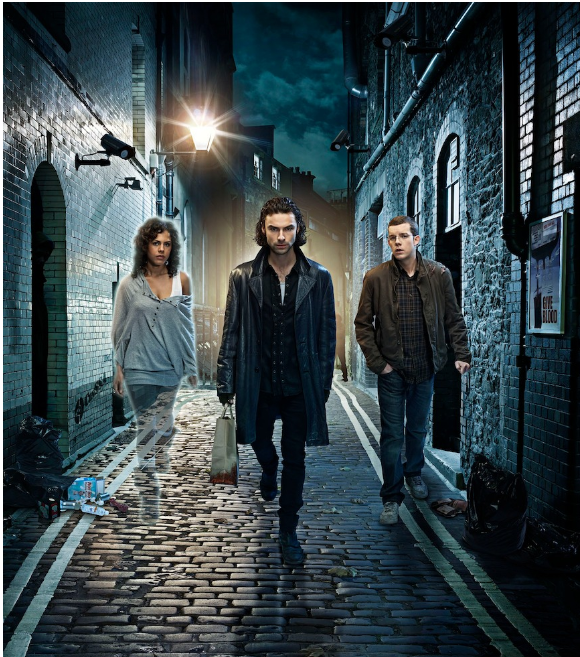
Being Human U.K. Season Two, Episode Four: Educating Creatures

This episode begins with a flashback from a year ago to Kemp talking to professor Janet aka Lucy, about a paper she wrote regarding her theory about a gene that is potentially the cause of all evil.  She tries to avoid the conversation by saying that those papers were all an intellectual exercise.  Kemp reminds her that last week she received a small sample of blood that made no sense, and that the sample was evil.  He tells her that if she wishes to learn more that she should call him.

It's early morning and Annie is following the mail man as he is doing his deliveries.  In an alley across the street, a policemen walks up to a dead body and Annie follows. When Annie sees the ghost of the dead man, she asks him if he is okay, and if he understands what has just happened to him.  "They told me to wait for you", he responds, and then attempts to drag Annie through yet another door.

Back at the house, George is awake and quite chipper and making sausages.  He tells Mitchell that he has had an Epiphany - a break.  He is making a list to make order out of his life.

When Annie becomes conscious, she meets a ghost named Sykes, who tells her that he saved her from the other side.  When he starts to leave, she follows him and says that he has to help her, because this keeps happening to her.  Sykes tells her that he does not have to do anything of the sort. "There's no automatic bond between us. We're just ghosts love" he says, as he attempts to walk away again. 

Back at the house, George says this whole time I never wanted to think about what happened to me once a month.  He says that you put a big scary animal in a cage, and thus he is going to buy a cage.  "I've been treating this whole wolf thing like this big life changing thing, running around doing jobs a monkey could do, but what is it really?  When you think about it, it's one night a month.  That's no reason for me not to live a long normal full life the rest of the time, and that is what I am going to do." Mitchell asks if that is on his list as well and George responds, "yes, yes it is in fact, number two get a better job."

Annie follows Sykes, threatening to haunt him if he does not help her.  Sykes tells her that fighting the men behind the door is grown up stuff, and she tells him that he is about nine.  Sykes goes on to say that he died when he was 23, and in ghost years he is 89. Annie stops him and says, "if you don't help me, then sooner or later they're going to get me".  Sykes responds, "you have resisted deaths door three times, which is written all over your aura, which I could teach you to read." Annie asks him to show her how to read auras at least, because apparently it's not like teaching, it's a magic trick.

At vampire headquarters, Campbell brings in a young woman for Mitchell to feed off of.  Mitchell asks what part of no blood do you not understand?  It seems that Campbell found her on a website for humans that have a vampire fetish.  He believes that this is different, because the woman is volunteering to be fed on, but Mitchell tells him that it is not different, and instructs him to get the woman out of there. Ivan tells Mitchell that Campbell's suggestion is a creative reinterpretation of the rules. Mitchell tells him that there is only one rule. 

George goes into a factory to get a cage built, and he starts to stumble when he's asked what size cage and how close the bars need to be together.  The welder asks if he wants a cage big enough for a man, because he believes that George is into S&M.  George says, "I was obviously embarrassed to say that I wanted a sex cage, but now that this is out in the open, I feel wonderful."  The welder tells George that he will throw in some handcuffs no charge.  

Back at the house, George is complaining that all the tradesmen he met that day think that he is a pervert and Skyes pipes up saying,"better they think that you're a nonce, than a werewolf surely."  When George asks who he is, Mitchell tells him that his name is Sykes and that he is dead and apparently very good at closing doors.  Mitchell asks if he can teach Annie how to do this, and when Sykes says maybe, maybe not, Mitchell asks him why he is there again.   Annie drags Mitchell into the next room and tells him that he is not her father, but Mitchell is concerned because of all the things that have been happening lately. Annie reminds Mitchell that Sykes saved her, and that she had to drag him to the house, only to have him act like an over protective father. She tells him to ease up.  Before going back to the living room, Annie asks how George is doing, and Mitchell tells her that he is manic and not talking about it.  Annie says that this not healthy, and that he needs to talk about it.

When they walk back into the living room, George is telling Sykes that if he can help Annie, that he has a responsibility to do so. Sykes says, "Do you want to know why I don't want to teach you? It's because there is only one passing grade. Anything less than an A+, and they've got you, and I really don't want that on my conscience."  Annie responds, "Sykes if you don't teach me, then I'm gone anyway." He tells her that they can meet a 9 tomorrow, if it's okay with her two dads, and walks out of the house.  George says that he liked him, and then mentions that he wants to switch rooms because of the size thing with the cage. 

Tuesday, December 13, 2011

Review of Blood Rights by Kristen Painter Book One of the House of Comarré

I have to say that I was quite impressed by this book despite the absolute absence of  GLBT people and problematic  references to people of colour. Blood rights is essentially the story of what are commonly called dhamphirs.  In this series they are known as comarré.  They have been breed for the potency of their blood and have developed their own form society alongside that of the various forms of vampires.  All vampires must drink human blood to survive, but only the noble vampires who are descended from fallen angels are able to afford to purchase the blood rights to a comarré.

Painter's world was vast and the following list includes the list of supernatural bodied mentioned in the series: Nothos, which are hellhouds, Varcolai, a race of shifters descended from fallen angels and animals, Fae, who are actually another race descended from the fallen angels, fringe vampires, who are descended from Judas Iscariot, Anthema who are vampires who have been cast out of noble society and finally, Castus Sanguis are the fallen angles themselves.

Chyrsabelle is a very special comarré and no other has had a price in the millions paid for the rights to their blood.  On the night of the ceremony which would grant her, her freedom after a hundred years of servitude, her patron is killed.  Chrysabelle must flee into the kine (read: human world)  world in the hope of disappearing and finding safety.  Unfortunately for her, Tatiana is fast on her heels, because she wants the ring of Chrysabelle's former patron in the belief that this will make her ruler of the vampires.

Chrysabelle meets up with Mal  in a human vampire bar where he tries to help her escape because immediately recognizes her for what she is - a comarré.  Chrysabelle, quickly stabs him just inches below his heart and makes her escape.  When next they meet, Mal is less trusting but in the end, determines to help her free her aunt, who has been kidnapped by Tatiana and clear her name.  What is interesting about the relationship between Mal and Chrysabelle, is that he continually attempts to act as her hero and she consistently reminds him that she is capable of taking care of herself.  He has a habit of reminding Chrysabelle that she is a comarré, and therefore no match for a vampire, let alone a vampire of royal blood.  This is of course is a sexist patriarchal streak, but Chrysabelle has little patience for this.  She spends much of the book proving to him that she is more than capable of defending her self.  The comarré are not the helpless supplicants that the vampires have come to believe that they have a right to, instead they are a fierce group of warrior humans awaiting the day when it may become necessary for them to stand against the very monsters they now call master.