Showing posts with label merpeople. Show all posts

Wednesday, July 29, 2015

Wickedly Wonderful (Baba Yaga #2) by Deborah Blake

Beka Yancy is the youngest of the three North American Baba Yagas.  Her mentor has recently retired to the Otherworld and Beka finds herself dealing with an environmental disaster that leaves her mystified.  Not only are the selkies and merpeople dying but the fish have disappeared from the ocean leaving the local fishermen all struggling.  Beka has vowed that she will solve this problem but despite a number of dives, she has absolutely no clue what is happening.  If that were not enough, Kesh,  the prince of the selkies and a local fisherman named Marcus are both vying for her attention.  Beka doesn't know which way to turn and even starts to wonder whether or not she is cut out to be a Baba Yaga.

I originally picked up this series because while the Baba Yaga is a very old myth, she has not appeared in many fantasy novels.  I was very excited to see what Blake would do with this awesome witch.  Unfortunately, in Blake's Baba Yaga series, the Baba Yaga, is simply a name for a powerful witch and many of the things that make the Baba Yaga, the Baba Yaga are missing from this series.  No longer is the Baba Yaga an old crone, no longer does she fly in a mortar and pestle and no longer does she live in a cabin which is made mobile by chicken legs.  Even the dragon chudo yudo has been turned into a Newfoundland dog.

Wickedly Wonderful is essentially a paranormal romance; however, while the romance between Marcus and Beka features largely in the story, it never overwhelms the mystery of why the ocean has become polluted.  Beka is steadfast in her search and never stops working towards her end goal, even though she is constantly battling with the taciturn Marcus, who is not found of hippie people. Because of the way that Wickedly Wonderful is written, we know from the beginning who is responsible for the pollution and his motivation and simply wait for Beka to figure it out.

Beka is very different from Barbara, the protagonist in Wickedly Magical and Wickedly Dangerous. Barbara, being older than Beka, is very confidant and sure of her magical powers.  Beka spends much of Wickedly Wonderful doubting her abilities despite constant assurance from Chudo Yudo.  Beka is supposedly so insecure because she was raised without any positive reinforcement from the retiring Baba.  My issue with this is that Beka is almost a 30 year old woman and while she might reasonably have some doubt in her abilities, I think it went a touch too far.  There is also the issue of Beka's naiveté. Everyone who interacts with Kesh for instance, almost immediately says that they don't trust him, yet Beka has several meals with him and even makes excuses for his behaviour.  Beka only questions Kesh's behaviour when he gets into a testosterone pissing match with Marcus over her. I like that Beka declared that she is not a commodity to be owned but I would have liked her to question Kesh's motives more, particularly after learning that Kesh was on the outs with his family. Beka just seems to keep making the same moves though it is not progressing the case that she is investigating and I found that to be extremely frustrating. 

Friday, July 3, 2015

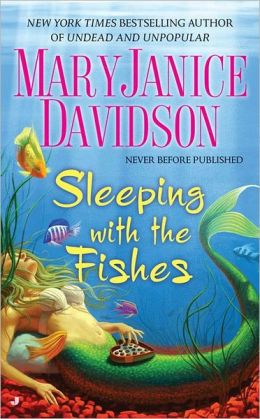
Sleeping with the Fishes (Fred the Mermaid #1) by MaryJanice Davidson

Dr. Fredrika Bimms knows that she's a mermaid and that her dad isn't her biological father.  When her parents decide to drop the news, that the man she calls dad isn't biologically related to her, Fred is more bothered by catching her parents in the middle of sex, than she is by their revelation.  Feeling scared for life, Fred wonders how she will get past seeing what no child ever wants to see.  Little does Fred know that she'll quickly get over the trauma when the handsome Prince Artur of the Black Sea appears, demanding her help as his royal subject to discover the source that is polluting the ocean.  Fast on Artur's heels, is the hot marine biologist Thomas, who has also noticed a problem with the water and the fact that Fred's hair is green and not blue. For the first time, Fred finds that she has the attention of two gorgeous men and doesn't know remotely how to handle it.

Sleeping with the Fishes is mindless fluff and never pretends to be anything else.  It can easily be read in one afternoon on the patio with a piña colada for company.  That said, even with few expectations, Sleeping with the Fishes is outright puerile and at times irritating.  There's really no plot to speak of.  For the majority of the book, Fred just stomps around angry and confused by the attentions of Thomas and Artur.  We learn about her penchant for striking out physically when irritated or feeling threatened.  At 5'11, Fred is incredibly strong thanks to being a human/mermaid hybrid.  She's stunningly beautiful, though naturally doesn't even acknowledge it.  Other than her grumpy disposition, she has no real characterisation to speak of.  It's impossible to like or dislike Fred because I know hardly anything about her.  

In between Fred's grumping, we get the search for the person who's polluting the water.  This really could have gone somewhere and given Sleeping with the Fishes a real plot; however, Davidson really didn't invest in it at all.  The connection made between Fred and the polluter is tenuous at best and his reasons for polluting are absolutely ridiculous.  If that were not enough, Fred quickly puts two and two together to ascertain the antagonist's identity and the case is wrapped up with everyone headed their own directions.  I didn't expect the great American novel but what the hell?  The ending is so abrupt that it left me asking, "is this all?"

I assume that because the story is so light in terms of plot, Davidson tried to interject humour. Unfortunately, none of the humour is particularly amusing.  Fred is a mermaid, who has an allergy to seafood and gets seasick in a boat.  Yes, it's awkward but it is not enough to make me giggle Where Davidson really failed however is having Fred's Bff Jonas be confused as a gay for the sake of shits and giggles.  People naturally think that Jonas is gay because he likes shopping, can pick a good pair of shoes, takes care of his skin, cares about how he looks etc., and ets., I assume you get the picture.  It's all based on a stereotype of what a gay man is supposedly like. Jonas's sexuality is the brief stumbling block between him and the woman he has had a crush on for six years.

Tuesday, November 5, 2013

Once Upon a Time, Season 3, Episode 6: Ariel


We open with a flashback this time, Snow White, in her pre-soggy-salad days running away from the Queen’s guards and, rather than be taken prisoner, jumping off a cliff into the sea. Presumably the fall knocks her unconscious (or she’s really bad at swimming) because she sinks like a stone until she is rescued by a mermaid, Ariel.

So it’s all YOUR fault, Ariel!

Return to the present day in Neverland and Regina is teaching Emma how to use magic! At laaaaast! Including why concentration is important; unfortunately Regina’s advice is to use her anger to focus and Emma shrinks away from the darkness of that. They argue and Emma produces fire, Regina smugly presents her “I told you so” smile. Of course, David hates the whole idea but Mary Margaret of the Wet Lettuce surprisingly thinks Emma needs how to learn how to use her magic rather than fumbling around and hoping.

Hook tells Mary Margaret and David what Pan told him – that Neal is still alive (Pan’s little test to see if hook would tell Emma and sink his little crush).  Mary Margaret looks up and sees a bent branch and a trail – she takes this as definite proof Neal is alive and almost runs off all on her own. David stops her. Mary Margaret, you just turned David into the smart one. David. What does this say about you? They all agree not to tell Emma to protect her delicate emotional fee-fees (David) and to not give Pan what he wants (Hook). Mary Margaret is initially resistant but agrees to keep the secret to protect Emma and they’ll all go off and rescue Neal without her. Oh dear.

Flashback to the enchanted forest Ariel tells Snow White her story – she’s on the run to someone – her loved one, Eric, she has never ever spoken to but had insta-fishy-lust on seeing his face. Snow White calls it love at first sight and doesn’t think it’s foolish (I do). Anyway, she’s off to her prince’s ball in the name of Ursula the sea goddess and she does that by changing her tail into legs (and a filmy skirt, because the kiddies may be watching). Apparently Ursula also gives her 12 hours of legs for this particular date (I think because she likes the idea of mermaids who can’t keep track of time floundering around helplessly in dry land). Snow White asks why she just doesn’t get an extension which shows a bizarre lack of knowledge of deities in general, but apparently Ursula hasn’t been seen for a few thousand years. Oh and Eric doesn’t know she’s a mermaid but Snow White will help her find her true love (and by “true love” we mean the guy Ariel is creepily stalking who she’s never spoken to before).

Back in Neverland, Emma and Regina notice that the others are packing to leave; they try to lie which lasts oh 3 seconds which is 1 second less than Mary Margaret can keep a secret and she blurts that Neal is alive.

Elsewhere on the island, Gold can’t see the future because time stands still in Neverland and Pan drops in for breakfast and mockery, extra mocking because Neal has the brains of the squid he killed. And apparently Gold can’t kill Pan without killing himself. Lots of poking gold for how, even if he rescues his son and grandson, they’ll never forgive him – after all, Gold hasn’t forgiven his own father. He tells Gold to return to Belle and have a new child (one more intelligent than Neal, perhaps). I’m getting a little tired of Gold angst.

Monday, July 1, 2013

The Mermaid's Madness (Princess Series #2) by Jim C Hines


There is a new threat to the kingdom – the seas around the nation are becoming impassable due to rampaging mermaids and, worse, Queen Bea herself has been injured and lays dying. It falls to Princess Danielle, Snow and Talia to set out again, the only ones who can to try and save Bea’s life – and her very soul – and preserve not just the kingdom but all seafaring nations

But it’s a complex task and finding who the actual villain is proves more complex than previously imagined. It begs the question – even if the villain is the victim, can they afford to be merciful?

And all because the Little Mermaid didn’t get her Happily Ever After


I do like how this series challenges a lot of assumptions about fairytales, a lot of the staples we’ve all grown up on that are, frankly, dubious to say the least. In this book we have a very strong challenge to the whole love-at-first sight trope that so dominates fairytales. Why should that prince you’ve barely met and hardly know turn out to be a nice guy? How can you be so sure of his affections after such a short time knowing him? Or that, occasionally, that guy you fall for turns out to be a brutal, manipulative, arsehole?

So when the Little Mermaid decides to give up her family, her people, everything for the sake of the love of a human she has known for a week – is it any surprise that it ends badly or one applies reality rather than fairytale rules? This story is a tragedy through and through because Lirea is, in many ways, a victim as much as she is a perpetrator. Ultimately, she was a very young woman who fell hard for the wrong man and was badly used by people who were older and wiser than her who sought to exploit her for their own ends. I like how this is even applied to Danielle’s own story – Talia pointing out just how lucky she was that Armand was a good man since they married after knowing each other for so little time. Danielle is presented as having made a very naïve, very silly decision that, luckily, worked out; this is even more stark when you consider that out of Snow White, Sleeping Beauty and The Little Mermaid, Cinderella is the only one who managed her Happily Ever After.

This book does a very good job of preserving that nuance, partly through the lens of Danielle’s near infinite compassion and the pleas of Lirea’s family, but also through the much harsher and more cynical gazes of Snow and Talia who recognise the real bad guy. At the same time, this doesn’t require anyone to be a saint or ruin the story with people being just so damn nice that you have to wipe the sugar off your tablet screen. While there’s sympathy for Lirea, there’s equally not much forgetting that she has killed people, she is threatening the nation and she has hurt Queen Bea. Compassion and acknowledgement of her victimhood does not translate into automatic forgiveness – certainly not from Talia, nor does it stop the 3 princesses from doing what they consider necessary to save Queen Bea. And if that means everyone doesn’t get a happy ending – well, so be it; not everyone’s promised one.

Even the behind-it-all villain is presented with a level of nuance. Ultimately her actions stem from the widely held belief that mermaids are lesser people; a belief they took to heart and sought a way to save themselves and their people from. No-one is just a villain, and even bad people have people who care about them.

I like Danielle as a character, I think she has grown a lot since the first book and in interesting ways. She was very naïve and apolitical and lost back then and has learned from her experiences. But here learning doesn’t mean becoming a super-jaded cynic as we so often see as a stand in for learning. She’s still good, she’s still ultimately caring – but she’s also gained a level of competence and understanding to leaven that goodness and caring. She brings compassion to the political agenda – confronting princes and kings with the fact that the disposable “red shirts” dying around them are people with families as well, appealing to common sense, to compassion, to mutual good while still being ready to lay down the law and put her foot down if necessary. And I really like how Talia makes her see not only the disadvantages of growing up poor and not understanding political matters, but also the advantage of not being a coddled princess and not having the expectation that everything should serve her, everything should suit her and that nothing bad can possibly happen to her.

Monday, October 1, 2012

Review: Lies Beneath by Ann Greenwood Brown


Calder is a merman, a predator who drags humans to their deaths so he can feed off their positive emotions to fill the voice inside every merperson. But this time he and his sisters are not targeting a random human – they have set their sights on John Hancock, a man promised to them by his father and a debt that has long been owed

Of course, even though he’s not finally within their reach, getting him to the water is a different matter entirely, especially since he has listened to his family history and is wary of the lake. It falls on Calder to try and find a way to the man, through his daughter Lily if necessary.

But getting into Lily’s affections isn’t easy, especially as she comes to suspect something is different about Calder and stories of lake monsters abound. And then there’s the trap of his own emotions, caring for his prey even though killing John Hancock would not only be revenge, but his chance at freedom from his sisters.


This novel is primarily about a romance and, I have to say, it didn’t appeal to me at all because it had several tropes I strongly dislike. But I will start with on element that was almost done right. Calder starts by being stalkery in the extreme. He follows Lily around, he tries to charm her, he appears at her house at truly bewildering hours - before anyone is awake (except Lily because that girl never sleeps) and generally is a creepy creepy stalker guy. And Lily is put off because of that – for a while anyway. She doesn’t even let his rescuing her convince her that she must instantly open her heart to the stalker. Yet… she does end up with him so the stalking does pay off, and for the level of stalking her reaction is still a little low. Someone’s hanging around your garden around dawn and regularly camping in your hammock? A little creeped out is a pretty minor response.

Firstly, it rushed in too quick and too soon. It seems that Calder arrives in town, sees Lily and is pretty soon smitten. It’s not love at first sight, but it’s close. And when you think Lily is the daughter of his big bad enemy John Hancock and a tool to getting at him, I don’t really see him being all open and looking for love. Yes, I know it’s a trope in romance and YA, but it still loses me to see people declaring eternal-love-I’ll-totally-betray-my-family-for-you after a brief acquaintance.

But secondly, and mostly, it’s how Lily reacts to him. Not just the reluctance-turns-to-love trope, but how, when she discovers he’s a merman and he finally admits it they have conversations that go a little like this:

Calder: I’m a merman, a dangerous predator
Lily: yay, merman! Let me quote pretentious poetry!
Calder: Actually, we kill people, I’m a murderer.
Lily: But you don’t mean it and we can be happy together. Let me make you happy.
Calder: We. Are. Predators. WE KILL PEOPLE! They are DEAD
Lily: Under the sea, under the sea, darling it’s better down where it’s wetter, take it from me!

Monday, September 17, 2012

Review of Tempest Rising by Tracy Deebs Book One in the Tempest Series


Tempest has a boyfriend who really adores her, a family that supports and loves and her and has the ability to spend her free time doing what she loves most - surfing.  At almost 17 years of age the world should be filled with adventure for her but instead her seventeenth birthday represents a date with destiny that she would dearly love to avoid. On her 17th birthday Tempest will have the choice of becoming a mermaid and following in the footsteps of her mother, who abandoned her family six years ago, or stay on land and live out her life.

Though her father has told her repeatedly that there were complicated reasons why her mother left and that he bears her no ill will, Tempest is filled with feelings of extreme anger. She does not see becoming a mermaid as an incredible gift but an excuse to abandon one's family.  No matter her desire to stay human, the sea constantly calls her and there are times when she is sure that the intent is nefarious.  In the sea a selkie named Kona waits for her filled with nothing but love for her and on land there is the steady and every so human Mark.  So not only is Tempest drawn between land and sea but to men who care for her.

Tempest Rising in not an inclusive story whatsoever or even remotely progressive.  Tempest worries about how her brothers will be treated when the come of age as mermen because the mer society is matriarchal and apparently males of other species give mermen a hard time over that.  The women are supposedly revered but from the conversation between Kony as his brothers it appears that their appeal is not their power or skill but the fact that they are attractive.  The characters largely read as decidedly White with exception of Kona who could potentially be a of pacific Asian descent but this is a guess based loosely on his description. There are no GLBT characters and no disabled people.  It always amazes me when authors prove they're imaginative enough to create a world different from our own, but somehow cannot take the leap far enough to make their stories inclusive.