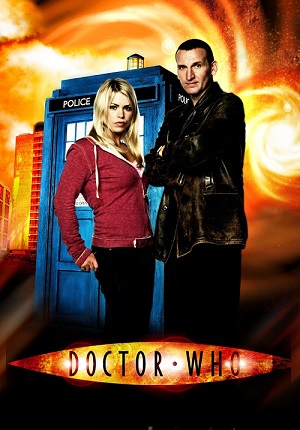
After a 16 year hiatus and one terrible terrible movie,
Doctor Who returned to the air The Doctor (9th incarnation) was played by Christopher Eccleston and his companion Rose Tyler by Billie Piper. From the beginning, the two are well matched and quickly develop a fun friendly banter. The Doctor may be Rose's guide but she keeps him grounded. Rose meets the doctor during an alien invasion and when he offers her the chance to travel with him, she accepts after some reservation.
In their first adventure together, the Doctor takes Rose to see the end of earth. I understand that they had to explain how the Doctor and Rose came to travel together for new fans of the series; however, it wasn't until the second episode that I truly felt like I began to get a sense of who these people are. Like Rose, we are new to everything that we are being exposed to and it's easy to see this alien world through her eyes. The reality is that one day our sun is going to super nova and no one alive today will be there to witness it. The Doctor tells Rose that all the humans have scattered out across the universe.
The End of the World encourages viewers to imagine what might be, even as the Doctor attempts to bring an end to the Lady Cassandra's evil plans.
Speaking of the Lady Cassandra, "moisturize me, moisturize me!" I love her vain and conniving ways. It is however problematic that in discussion with Rose, Cassandra calls earth the place where she grew up as a little boy. This means that this twisted remnant of humanity is trans*. Had lady Cassandra been cisgender, altering her body into something completely unnatural wouldn't have made me raise a single eyebrow. The treatment of Lady Cassandra heavily implies that only cisgender bodies are natural and that the path taken to achieve body gender alignment in the end leads to something that isn't quite human, despite the fact that Cassandra relishes her status as the last so-called pure human. The very awfulness of Cassandra's body is realised the moment Rose stands beside her. Rose, the cisgender woman, in this context is normal and Casandra, the trans* woman, is a freak and in complete denial of this. If Cassandra's 708 surgeries are a commentary on societies absolute fascination with youth that's one thing but if it's a commentary on SRS, then it is most certainly transphobic.
The only character of colour to make an appearance in
The End of the World is Jabe, and she plays the role of a tree. The Doctor offers air from his lungs to Jabe when he cannot find a gift for the exchange. Jabe is the one to discover who the Doctor is and offer her condolences because he is the last of his kind. They share a moment and the Doctor's eyes water. It's short lived because it's not long before Jabe is sacrificing herself, so that the Doctor can once again save the world. She is yet another dead body in the Doctor's wake. The 9th Doctor is still very much processing that he is the last of his kind and the weight of what he has done.
Travelling with The Doctor, means that Cassandra et al are but the first of the aliens that Rose will meet. I really do wish we had not met the Slitheen family. These aliens are bent upon destroying the earth and because of bad gas exchange they are constantly farting. I know that
Doctor Who was originally intended to be a children's show but farting aliens? Really? It was just so puerile at times that the three episodes involving the Slitheens did not capture my full attention, even if I was amused by the Doctor's date with Margaret Slitheen. Talk about a terrible first date.
In the
Daleks, we meet the Doctor's enduring enemy for the first time. The Dalek, just like the Doctor, is the last of its kind and without any commands, it follows it's prime directive (yes, I know that's a
Star Trek reference shut up!) to EXTERMINATE. It gets DNA from Rose and begins to terrorize the underground bunker where it has been held captive. Rose at first sympathises with the Dalek's loneliness, until it shows her why the Doctor had been so adamant that it must destroyed. No other creature rises the ire of the Doctor like the Daleks and it is quickly evident in the way the Doctor immediately calls for its destruction. With other alien antagonists the Doctor at least tries to reason and negotiate as can be seen in
The Unquiet Dead for example and this is quite different than his approach to the Daleks. When dealing with the Slitheens, the Doctor is quick to reject a gun but when offered a gun by Adam when facing the Dalek, The Doctor readily accepts.