Showing posts with label Karen Chance. Show all posts

Wednesday, January 13, 2016

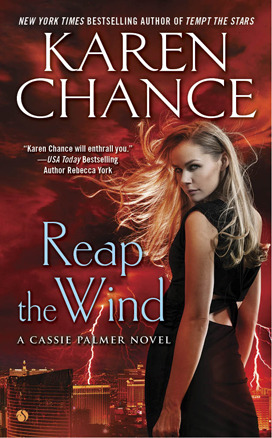
Reap the Wind (Cassandra Palmer #7) by Karen Chance

It's been two years since the publication of Tempt the Stars, in which we saw Cassandra Palmer, Pythia and chief seer of the supernatural world, once again lose the war mage Pritkin, after working so hard to get him back.  This time, Cassie has to travel further back in time than she ever has before in order to save Pritkin's soul.  This one task on its own would be difficult enough but as Pythia, Cassie has to deal with her court, and her supposed allies, who seem more interested in controlling her than helping her prepare for the war ahead. Still new to her power, Cassie is just holding on by the seat of her pants, hoping that somehow in her time travel and bumbling that her luck will continue to hold out long enough for her to help prepare the supernatural world to face their biggest threat - Aries.

It took a long time for Cassie to accept the fact that she is indeed the Pythia and now that others in the supernatural world have accepted her title, the battle is on to see who will control her.  Cassie has known the vampire Mircea since childhood.  Unlike her guardian Tony, he always seemed to treat her kindly and now that Cassie is a woman, there's a bond between them that is undeniable.  They have made a promise to be Senator and Pythia but also to be Cassie and Mircea.  It's a good plan in theory but with so much at stake, it is impossible for Mircea to avoid using his influence to get what he wants. When Mircea asks for a master vampire army to defeat the fae, Cassie knows that if she gives into this demand which Mircea tried to frame as a request, she will spend the rest of her time as Pythia capitulating.  As much as it bothers Cassie, she says, "no", and she means it.

The circle, the Pythia's traditional guardians and protectors having accepted Cassie can still not abide her independence.  To that end the freeze Cassie's assets making it impossible to support her new court, withhold information and set about trying to force Cassie to remain in one location and be the none active Pythia they expect who only uses her power as they see fit.

In many ways, Reap the Wind is about Cassie not only learning more about her powers but understanding the politics behind the position of Pythia.  Sure, Cassie has been told about all the responsibilities the Pythia has and their historic roles but she hasn't really learned how to do her job because she never received training.  It would be easy to just become a pawn of the vampires because she was after all raised by the them or the council because they were always heavily involved with the Pythias but Cassie learns that despite all of this history and the pomp and circumstance, for this to work, she's going to have to do it her own way.

For the longest time, Cassie has been made to feel inferior because she was a human in a vampire world.  When she became Pythia, despite being the seat of power, many sought to control her because of her lack of training.  Reap the Wind is about more than Cassie accepting her role of Pythia, it's about her gaining some much needed confidence in her abilities. Yes, Cassie rushes head long into things and doesn't really stop to form a plan (which is absolutely a problem) but somehow, despite the odds, Cassie has always emerged victorious.  Though many around Cassie would like to believe that this is all blind luck which certainly cannot last, Cassie has finally accepted that her victories are just that, victories and for her to win. skill had to have been involved.

Monday, March 9, 2015

Fury's Kiss (Dorina Basarab #3) by Karen Chance


While the war rages on and the American Vampire Senate looks to fill its empty seats, Dorina is still part of the squad looking to track down the smugglers using portals to arm the Dark Mages with deadly weaponry and creatures to tip the balance of the war

The investigation turns deadly when several vampire agents are destroyed leaving only Dorina as a survivor with a hole in her memory. To find out what happened, she will have to deal with vampires, fae, fallen angels – and more plots than she could ever have imagined.

But while all this is going on Dorina has another battle – with herself. Old barriers in her mind are coming down and everything she believed about her dhampire nature is being challenged – presenting new threats and new possibilities


There is a lot about this book I love

I love the development of what Dorina is, of the very nature of the dhampires and how this relates to vampire culture. The whole sense that vampires are deeply social and hierarchical and that Dorina’s vampire side feels all of that but is then isolated from the hierarchy by vampiric hatred of dhampires and her human side’s own weakness. It’s a wonderful little twist and manages to greatly expand what Dorina is without the sense of retconning or changing the established world setting at all. It also led to more excellent exploration of Dorina’s character and history as well as vampire culture. There’s also the ever-complicated relationship between Dorina and her father which is also wonderfully expanded on and explored in this book.

I also really liked Ray in this book. We had a lot more of his history as someone who is half-Portuguese and half-Indonesian and his history of being rather stuck between two cultures (including an interesting insight that previous Asian vampiric masters had used him, in centuries past, to be their guide to Europe but missing that European blood doesn’t give knowledge of language or custom). He really grew as a character in this book beyond his standard role as somewhat inept comic relief. He’s survivor and a chancer. A vampire who will never be a major power nor has any real close family ties to keep him safe - he’s always found his niche by being clever and being daring. He takes risks, he’s willing to try things no-one else would consider (sometimes for very good reason) he’s imaginative and creative and comes up with a lot of crafty answers and work arounds because of it. He becomes an asset and we can see him as an asset without having to greatly increase his power.

The plot itself is amazingly complicated (which I have some problems with which I will get to) which draws on every element of this vast world – and it is vast. I think every faction and player that has been introduced in the last two books all plays a hand in this book – the fae, the vampires, the mages and some new ones we’ve never heard of before. It all adds up to an incredibly complicated master plan which fits so well in this rich and wide world that is laid out for us

The pacing of the book is break neck (which, again, is not without its problems). Dorina runs from action to action, scene to scene at an incredible rate with no time to catch your breath before the next concept or battle or revelation lands on you. This doesn’t pause or get bogged down, though it can certainly exhaust you as you struggle to keep up with the battles or absorb yet another chunk of world building, all of it thrown at you with little chance to process.

The main problem I have with this book is that it feels long. It is somewhat long, that’s certainly true, but it’s the feeling of its length that is the problem. That sense as you’re reading that this book has already gone on for a very long time and isn’t it about time it started to get wrapped up?

Monday, December 8, 2014

Death's Mistress (Dorina Basarab #2) by Karen Chance


Dorina is doing more and more missions for her father, Mircea, senator for the North American vampire council. Of course, being a vampire, her father, and extremely ancient he keeps far too many secrets – including the true nature of her latest task and the powerful artefact at the heart of it
A task that also drags in Louis-Cesare, who has his own political machinations caught between two senates
And then there’s Dorina’s best friend Claire – bringing a whole lot of lethal fae politics and her fae child with her.
This world has so much happening in it and it all comes into play in this book. The mages, the fae and the vampires all play varying role (focusing on the vampires but there’s a huge fae involvement). We have lots of political machinations from the world that has been completely upset by a huge ongoing war. I really like that each of the supernatural beings presented has a sense of culture – and not just a sense of culture but a sense of multiple cultures and factions rather than them just being homogenous groups.
I also love the sense that there is a lot going on beyond what Dorina is aware of – that great feeling that the world continues without her and doesn’t focus on her just because she is the protagonist. A lot of worlds seem to disappear when the protagonist is not involved, but not here.
The war makes for an excellent backdrop for the series because it gives such a perfect motivation for Dorina to be involved. The consumption of resources and attention by the war – coupled with the disruption by it – gives us a perfect reason why Dorina needs to be involved in things she’d normally be kept from. It also makes for an excellent world building exposition without making Dorina ignorant – she’s clearly capable and skilled (and, excellently, has some tricks that even the ancient master vampires don’t have), but the new situation means things need to be explained to her (and us). Similarly, explaining how the war has changed things also elegantly explains to us how the status quo normally operates. It works, it works really well considering just how much there is to grasp.
My complaint with all of this is that there is just so much going on. This rune is so valuable that half of the supernatural world want it which means there are a lot of players, a lot of possibles, a lot of factions that is all kind of overwhelming. Some I can see as important foreshadowing for the future and world building like Ming-de and the Chinese delegation, but Ganimus felt like a step too far and I’m not sure if the mage involvement and their event was particularly necessary either. I’m not saying any one of these elements was badly done or boring – certainly not – but there’s just so much going on not just in this book, but in this huge, varied and multi-layered world there needs to be triage, especially for readers who haven’t read other series set in the same world. Sometimes I felt like I should have been taking notes or keeping a flowchart or something.

Monday, October 27, 2014

Midnight's Daughter (Dorina Basarab #1) by Karen Chance


Dorina Basarab is worried about her room-mate, Claire. She’s missing and that’s not like her – worse, she is hearing some very disturbing rumours about what has happened to her. Not only is Claire a friend, but her powers are able to calm Dorina’s Dhampire rage.

Mircea, Dorina’s vampire father, has the resources to find Claire – but to use them he wants something in return; he wants Dorina to hunt down her escaped fugitive uncle. Vlad. Dracula. Who is every bit as terrifying as his legend would suggest.

Working with the reluctant and equally outcast Louis-Cesare, Dorina has to find and defeat a vampire who is legendary for his cunning and evil – but there’s a war raging between the supernaturals of North America and even the fae are involves with their own shady machinations.


We have a very rich world here – with so much going on and being involved in the plot. There’s Dorina and her family, the Basarabs. Yes, Dracula, but more than just a redrawing of Stoker, this is far more about the family from Wallachia. In fact, Dracula’s brothers, Mircea and Radu, play far more of a role in this book than Vlad himself. There’s a lot of complex and involved family dynamics there that are really interesting to explore.

On top of the vampires and dhampires we have fae of several stripes, light and dark, different courts, different factions, different creatures, royal politics and all kinds of shenanigans.

Then there’s a war on between several of the factions that affects Dory, including the Vampire Senate. Even though Dorina doesn’t directly involve herself with the war, the fact it takes resources and creates new factions to be wary of is a constant background to the story – it’s pervasive and even when it’s not overwhelming it’s always there. We never have to really see the war to feel the scale of it and its effect on their society. It all comes together to be a really well written, rich world I enjoy.

Dorina and her side-kick/fairly obvious love interest Louis-Cesare are moderately decent characters. I find them both extremely typical of the genre. Dorina is the kick-ass Urban Fantasy female protagonist, she has woo-woo that is rare, she’s a dangerous fighter but there are definitely darker and more dangerous things out there. She has anger issues, a whole lot of anger issues. Louis-Cesare is a super sexy French vampire who has arrogance issues and a tragic, tortured past. They’re not bad characters, but they’re genre templates, we’ve seen them before and we will certainly see them again. There’s a lot of them raging at each other that gets in the way of the plot, but the inevitable sexual tension doesn’t – both are pretty focused on the mission and most of their conflict comes from them struggling over who is in charge. They do stay on mission –but have drastically different ideas over how to do that

Friday, August 15, 2014

On the Prowl. Anthology by Patricia Briggs, Eileen Wilks, Karen Chance and Sunny


Alpha & Omega by Patricia Briggs


This short story is the prequel to the Alpha & Omega series that I have read. I found it quite useful to bring a little more detail to the background of the Alpha & Omega series while, at the same time, striking the ideal balance of not actually being essential to reading that series. It doesn’t add more to Anna’s history than I already knew but does provide a greater context to how her abusive past happened (especially given the inviolate nature of Omegas in the series) and how she and Charles met.

Even though I have read this series and the Mercy Thompson Series I also think this book did an excellent job of being both a stand-alone novel and giving us enough information about the world to be both workable and intriguing. Whether you had or hadn’t read the series, it was still a good story with elements for both readers.

While I’m not a big fan of the whole Alpha-male-werewolf-rawr trope but I think this story did a good job of looking at some of the consequences of this – how easy it would be for these “dominant” wolves to be abusive and for their victims to fear them all due to the ease of abuse written into their culture. Sure there’s a heavily element of the abusive werewolves doing-it-wrong, but at the same time it’s clear why their victims wouldn’t see much difference and would be wary of dominants.

We do have a lot of insta-love and insta-sexiness going on with Charles’s woo-woo mating bond kicking in. This causes a lot of over sexiness, a lot of domineering sexiness and, frankly, a lot of really unpleasant sexual pressure that is only exacerbated by Anna being a rape victim

We have some POC in this story – Charles is a Native American and drops in a fair amount of his culture and origins. Kara, Anne’s best friend, is Black – but it’s a shame she doesn’t get more presence here or in later books, serving only to be worried and protective of Anna (in a rather powerful way) without much more to her.

Anna sets the tone for future books in this series – while she’s hurting, abused and fearful, she’s also intelligent, brave and resourceful when called for – she’s abused but it’s made clear that doesn’t make her weak.

Unfortunately, this book does revolve around one of the tropes that is central to these series – mental illness is worse than death. Older werewolves in this world are often prone to insanity. This is considered terrifying, very dangerous and, ultimately, these werewolves have to be “put down”. Making mental illness a source of danger (a common, destructive and rarely true trope), a fate worse than death and something incapable of treatment or management.

This story has issues but it’s the one I liked most in the book – and the one I think struck the best balance with the series it was part of


Inhuman by Eileen Wilks

This is a short story set in the same world as the World of the Lupi series that I have read. It is, however, an excellent standalone story – in fact, while it’s set in the same world and the same events that are in the main series shape this one, it’s so separate from the main series that I missed that it was a part of it – in the beginning at least. It’s possible this perception is because I have read the main books and don’t realise how much I’ve assumed or absorbed to make this one work but it was very detached. The events like the magic wave flowing over the world and the increasing magic were mentioned in the beginning and nicely easily understood concepts to establish this world setting without having to get into the detail from the main series

If anything, the World of the Lupi series is too dependent on this book. Nathan and Kai, the protagonists of this story, return to play a major role in Night Season which makes that book feel very rickety unless you have read this short story to explain who Nathan and Kai are.

I think more development of Kai’s abilities and more definition of it would have been helpful – it was a little vague. I think the story itself was also more of an introduction to Kai and Nathan than a plot in and of itself. It does a great job of establishing who they are, how they fit into the world and how they get pulled into whatever shenanigans they will be pulled into – but it doesn’t actually tell much story. There’s a monster, they wait, the monster attacks them. Ok that’s overly simplistic and there’s a lot around the edges – but the edges is more about introduction of the characters and throwing in a hefty amount of “rawr sexy”.

Like the series it’s part of, there’s also a lot of appropriation of real world oppression against the woo-woo groups. We have direct links made to the holocaust and a lot of anti-magic laws that mirror laws and language against oppressed groups

Friday, April 4, 2014

Responding to Author Comments on our Review of Masks by Karen Chance


We have received an email from the author about our review of Masks by Karen Chance.


We don’t usually publish emails we receive but this email indicated that she tried to comment but could not, presumably due to Intense Debate (we’re not sure why the comments tool isn’t working for all our readers - if anyone else has any problems can you let us know). In addition, we will not edit our review to add the email as suggested, because we don’t agree with the points raised but also because, even if we did, amending our reviews after the fact because an author emailed us is really not something we, or (we think) any review blog should actually be doing. In both cases, however, we feel there’s a clear wish to make these views known publicly on Fangs.


We also feel that the comments made are more generally applicable to comments we have received about a number of reviews and would benefit from being addressed in general


The email in question:


Hey guys, I appreciate the review for Masks. But I had a few comments I wanted to make on it. Unfortunately, the website isn't allowing me to do so. I am therefore sending them in , in the hopes that you will amend them to the review. They're below. Thank you I appreciate you reading the book and doing the review, but I would like to briefly point out a few things.


1) The book is not "erased". There are four major players who are non-white: the consul (Egyptian), the senator (mixed race), Hassani (Iranian) and Marte (Egyptian). On the subject of Marte, Mircea describes her early on as having dark, curly hair and eyes, but doesn't mention her skin tone. But then, why would he have? They are in Venice. Olive skin is normal there. He took her for an Italian at first, because that was how she was presenting herself. There are also many other people from all over the world mentioned in the book: a gondolier is African, the consul and senator are Egyptian (or partly so, in her case), Hassani is Iranian, a hat seller is Spanish, Bezio is Sicilian, Martina is Greek, etc. It was a multifaceted, multicultural bunch that, I think, fairly represented the Venice of its day.

2) LGBT issues weren't mentioned because there was a rash of homophobic hysteria sweeping Italy at the time. I wrote about this on my blog (http://www.karenchance.com/news/category/maskslife-in-renaissance-venice/), specifically in the entry Inspirations VI if you want to read more. But basically, being an out person in Venice of the day was illegal and homosexual people were subject to death--by burning--if caught. I have LGBT characters (including Mircea's brother Radu) in my Dorina Basarab series, but it would not have made sense here. Any LGBT people in Venice at the time would have been keeping very, very quiet about it.

3) Class issues: Can I point out that a person being born poor doesn't make them a good person, any more than it makes them a bad one? There were characters born into poverty who ended up on the "good" side, and other who did not. Just as in life. The book was about the hand we are dealt in life being important, but not all important. We still have to play that hand, and we still make some crucial decisions for ourselves. The characters made their decisions, some good, some not so good. And their fates depended on that every bit as much, if not more, than on the class they started out in.


1) On the Racial Erasure


We have spoken before on the problem of Invisible Inclusion. Unless a character is depicted as otherwise in fiction, they will be read as the most privileged body. Even when they are described otherwise this is often a problem, as we can see from many corners of fandom being shocked when Rue was depicted as Black in the Hunger Games film and when an Asian actor was cast to play Magnus Bane in The Mortal Instruments.


Relying on the readers’ assumptions that a character would be a People Of Colour (POC) is, therefore, highly fraught. We are trying to avoid spoilers here so we will talk around one of the characters in question: the Consul is a person from history - and they do have a POC ancestor. But holding that to be sufficient to make them a POC raises a very dubious and highly prejudicial “one drop rule” argument.

And even if they were - this would require the readers to be aware of the fact to read her as a POC. And ignore that fact that she has been depicted in fiction on numerous occasions - as white. Fictional portrayals of this character - and, indeed, numerous historical POC - are repeatedly depicted as white. Fictional whitewashing was prevalent and even the norm; history is no guarantee of a POC portrayal in fiction.


It is always dubious to assume that an audience will read a character as POC when it has not been expressly stated (especially if descriptors are, at best, ambiguous - like dark, curly hair and brown eyes); time and again we have seen that to expect that from a western audience is simply unrealistic and highly disconnected from societal attitudes. If you describe a character as having brown hair and brown eyes with no further description they will be read as white.


To further stretch this and assume that readers should read a character as a POC because of (a very questionable reading of) history, despite how that character has repeatedly been depicted in fiction without any other markers is to stretch this to breaking.


In my review I used the words “largely erased” to describe Masks. This doesn’t mean that there were no POC in the novel but that they didn’t play any significant roles in the story. A minor character of colour, even when they fit into a privileged role in the story does not mean good inclusion. It simply means they have been promoted to obscurity. These characters don’t drive the plot because the book could clearly exist without them; such is the case with Hassani. To the suggests a group of Europeans constitutes diversity is to completely ignore that diversity means more that multiple Eurocentric ethnicities occupying the same geography.


Good inclusion involves fully fleshed out characters of colour with important storylines. They don’t act as sidekicks and they most certainly are not passing characters like a gondolier. Running afterwards and counting POC without considering them within the context of the story itself is problematic.

Tuesday, September 17, 2013

Tempt the Stars (Cassandra Palmer #6) by Karen Chance

When we last left Cassie two years ago, she was on the verge of death until Pritkin gave her the energy so desperately needed, thus sacrificing his freedom.  I am sure that many fans of this series screamed in frustration at this point, I know I did.  Tempt the Stars doesn't begin quite where Hunt the Moon left off.  It's now been a week since Pritkin disappeared and Cassie is determined to do whatever he has to to bring him back from his fathers clutches - even if she has to go to hell.

Tempts the Stars is filled with all of the elements that fans have come to love about the series.  Cassandra continues to be filled with spunky agency and though at times it is seriously annoying because she jumps headfirst into situations without thinking them through, one cannot help but to route for her. It is only when we consider how little Cassandra knows about the office of Pythia, her mother and even latent powers that one realises that she been left absolutely defenseless despite the power she has. Yes, I know that this is yet another trope in urban fantasy, but Cassie's never say die attitude keeps the story moving without being bogged down in self pity.  It helps that in the end, Cassie accepts who she is and is thankful.

For all of her inept bumbling, Cassie continues to be a strong protagonist.  Chance avoids falling into the trap of simply turning her into a weapon as a way to express strength, which is far too common in urban fantasy today.  Cassie's goal is to save Pritkin which in many ways is a change in gender roles because not only is not waiting to be saved, Cassie is actively trying to save the big strong man. I love that though Cassie has her moments of modesty, she is not above whining about not being able to masturbate in the shower because of sensitive vampire hearing.  

Wednesday, January 4, 2012

Review of Hunt the Moon by Karen Chance Book Five of the Cassandra Palmer Series

Since Cassie inherited the job of Pythia, the chief seer for the supernatural community, the mages, a faction of vampire rebels and the Gods have been trying to kill her.  After finally killing Apollo, you would think that Cassie would finally be free to be installed in her office without having to worry every second about someone trying to kill her, but you would be wrong. In the scant few months that Cassie has been Pythia, she has managed to remove the corrupt leader of the council, expose the treasonous vampires, kill a God and to be within a hair of uniting the vampire councils globally for the first time ever. In the days leading up to her coronation the effort to kill magnifies and she learns that there is no place that she is truly safe. 

For everything that Cassie has been through, she has not learned to think before she leaps. Most of her decisions are ridiculous and it hard to actually support her agency when she battles to remain her freedom for the the vampire council and its senator Mircea, as well as the council of mages.  They all want to control the power of the Pythia and Cassie wants to be respected and have the room to make decisions free of influence.  She hides from her bodyguards and storms into events that she has no place being.  It disappoints me that after five books, Chance's version of a strong empowered female protagonist is filled with the much lamented spunky agency.

In the last book, we got the first real appearance of a character of colour that Chance had invested in.  Unfortunately, in this book Caleb seems to exist to serve White people.  When Cassie is forced to heal the mage Pritkin through sex, revealing that no only he is an incubus, but the infamous Merlin, Caleb keeps his secret on their request, despite the situation that he could potentially put him in with the council, an organization he has sworn to be loyal to until his death.  He is in this book long enough to save Cassie, and keep their secret.  Unlike many of the other characters that we have been introduced to so far, we know very little about him, or his motivations.

Thursday, December 29, 2011

Review of Curse The Dawn by Karen Chance Book Four in the Cassandra Palmer Series

I think that I have a love/hate relationship with this series.  At times, the characters, world and plot are absolutely fascinating, and at others, I struggle not to roll my eyes and toss my ereader across the room.  Curse the Dawn turned to be more of the same. 

At this point, Cassie has been the pythia for one month, but she still has not been crowned, because the circle refuses to acknowledge her right to fulfill this role, though the power clearly chose her.  At every turn, Cassie is being manipulated because if a group does not want her dead, they want her under control because of the strength of the office that she holds. I must say that I like the fact that Cassie is particularly resistant to being used and continues to hold onto her moral beliefs despite the fact that everyone around her continually encourages her to put them aside.  Even when she is under attack, the one thing that Cassie clearly respects is life and she will go to extraordinary lengths to protect it.

I wish that I could say more good about Cassie.  She is clearly devoted to doing what she thinks is right however unfortunately this too often takes the role of spunky agency.  She does not think through her decisions carefully and continually runs head long into trouble that in most cases could be avoided with a little bit of forethought. This makes the fact that Mircea keeps her in the dark about his plans perfectly acceptable.  It is hard to be upset with fact that both Mircea and Pritkin are condescending and paternalistic because at times, Cassie clearly needs to be lead around just to keep her head attached to her neck.  This of course takes away from the whole strong kick ass protagonist thing that Chance has going on.   Having a strong female character should mean that the majority of the time she uses the brain God gave her rather than continually rushing brashly along from one crises to another.

With Pritkin the war mage by her side, Cassie travels through ley lines and battles war mages in an attempt to save the world from the return of Apollo, who wants to reassert his power on the earth, by any means necessary.  At one point in the story, Pritkin and Cassie change bodies, which leads to some of the most hilarious scenes in the book.  How does a woman suddenly transported into a mans body suddenly deal with waking up with an erection that is demanding to be satisfied?  Even though this new male body is filled with strength and the ability to heal, it is still male and things like leg hair just don't feel right.

Wednesday, November 23, 2011

Review of Embrace the Night by Karen Chance Book Three of the Cassandra Palmer Series

I have to admit that this series is really growing on me, though Chance has not given up on her love of bringing dead stars into her stories.  In Embrace the Night we were introduced to Jim Morrison's ghost which last long enough for me to roll my eyes. 

In this story, Chance really enlarged her world which I would have believed impossible to do because she had already used so many super natural beings in the other two books. The world consists of fae, both light and dark, witches, Demons, Incubus, vampires, Ancient Greek Gods, and Merlin from Arthurian legends.  Clearly a lot went on in the story but Chance managed to keep it all straight.  I think that it takes a great imagination to have all of these mythos in one book, without having one group over power another and Chance does this beautifully.

Time shifting plays a huge role in this book, but unlike previous stories, it was extremely easy to follow.  It really added a level of complexity that lead to a brilliant story.  When Cassie was in Paris in the 1700's, the background scenery was so graphically described, that as a reader, it felt as though I was on the journey with her. This book also tied up some time traveling issues that were difficult to follow in the first two books.

Monday, November 21, 2011

Fangs for the Fantasy podcast, episode 42

This week we discuss the latest episodes of the Walking Dead, Grimm and American Horror Story.

We also talked about the most excellent Changeless by Gail Carriger, Embrace the Night by Karen Chance, Waking the Witch by Kelley Armstrong, Kitty Takes Holiday by Carrie Vaughn and Blood Bound by Rachel Vincent

We also discuss why we analyse Urban Fantasy through a social justice lens and what it means when we criticise a book.

Tuesday, October 18, 2011

Review of Claimed by Shadow: Book 2 of the Cassandra Palmer series by Karen Chance

Just about every mystical creature that you could possibly think of, has been mentioned at least once in this story.  This makes for a very large and interesting world. At times however, Chance gets downright ridiculous in her choices.  In the last book, we were introduced to Marlow, Rasputin, Baby face Nelson, Jack the Ripper and the famed artist Raphael as vampires.  It's enough to make one wonder if Chance believes that any historical figure was human.  To some degree, one must suspend belief to read urban fantasy but Chance simply has pushed this too far with her latest editions.  Would you believe that zombie Elvis makes an appearance as an Elvis impersonator in Las Vegas and when he gets accidentally hurt in a battle, he is temporarily replaced by zombie Jimi Hendrix? If that were not enough, Casanova the incubus, inhabits the body of a vampire.  I side eyed my kindle so hard, I damn near hurt myself. It seems that Chance just loves a dash of camp with her urban fantasy.

With the death of the Pythia, Cassie inherits great power, unfortunately she does not have the training to be able to control it and the Circle (Light witches), vamps and fae all want something from her.  Cassie's goal is to find someone to transfer the power to, save her father from an eternity of imprisonment and to avenge the mortal death of her parents. As you can see, there is a lot going on with this world and this is even further complicated by time travel.  As an agent to move things along, time travel is excellent; however, if not treated carefully, the varying timelines can and in this case do make story difficult to follow. 

In a trip to fairy, Cassie is offered the opportunity to complete the transfer of power and claim her rightful tittle as Pythra.  As you may have guessed from my previous review, this involves having intercourse.  We are repeatedly told that Cassie is a virgin, though if she is -- it is name only --having done every sexual act except penile penetration; this definition of virginity is highly heterosexist.  It means that a gay man or woman who has never had sex with someone of the opposite sex, would by Chance's definition, remain a perpetual virgin, regardless of how many times they had sex. This coupled with the fact that there isn't a single gay or lesbian character in the series thus far is highly problematic.  I will give Chance a bone though, for having succubi and incubi change gender at will however, once  they change their gender to ensure that whatever coupling they participate in is heterosexual.  There is only one hint of a same sex relationship involving an incubus and the vampire Dracula and that is thrown in as an aside, but with the ability of the incubi to change genders, there is enough room to question whether this really constitutes a same sex interaction.

Tuesday, October 11, 2011

Review of 'Touch the Dark' by Karen Chance, Book 1 of the Cassandra Palmer series

Though Karen Chance is quite prolific, I had not heard about her until I came across a post on Tumblr raving about her Cassandra Palmer series.  I can't say what exactly spurred me to read one of her books, but  I didn't go into it with great expectations, and so I suppose that there was nothing to let down by.

Touch the Dark, is the first book in the Cassandra Palmer series. Cassandra is a time traveling, clairvoyant, and as you might imagine, time travel lends itself to various timelines.  When a writer chooses to go down this road, the plot must be clear and easy to follow.  At times I had to go back and re read because I lost the thread of the story entirely. To give you an idea of the potential to be confused, take a look at the time line created by Chance, to help the reader follow her story.

I suppose time travel encouraged Chance to introduce historical characters in her fiction.  So far we have met Baby Face Nelson, Jack the Ripper, Vlad the Impaler, The Man in the Iron Mask and Rasputin.  Of all the historical figures mentioned, I think that Rasputin makes the most sense, as he was notably hard to kill; however, it quickly became laughable, as I found myself wondering if Chance planned on making every notable person in history a vampire.

As protagonists go, Cassandra was not prone to spunky agency, and seemed to determine to hold onto what was in her best interest, despite the pressure to choose sides in a war she wanted no part in. However, she is yet another protagonist with dead parents. I simply do not understand why urban fantasy writers cannot allow their main characters to have normal childhoods or parents. In Cassandra's case, her parents were killed when she was four years old, and she was raised by Tony, a vampire mobster - the same vampire who had her parents killed.  Tony keeps Cassandra a virtual prisoner in his home, because he wants to use her talents to his advantage. When she does finally leave him, we learn that her life on the streets was rough, but no great details are given.