Friday, August 16, 2013

Deadline (Newsflesh #2) by Mira Grant


Shaun is not doing well after George’s death. At least she’s still with him – or his grief shattered brain keeps conjuring her up for him – but the fact the boss is hearing voices (and talking back to them) doesn’t reassure anyone else around him.

But the drive to avenge George continues – along with the George driven need to discover the truth. What is really behind the conspiracy that lead to George’s death? A fleeing doctor from the CDC may provide the answers – starting with the CDC’s disturbing habit of killing off researchers who get too close to certain topics and asking the question WHY the CDC’s vast budget actually devotes so few resources to actually curing the zombie plague?

Questions lead to rogue researchers, some stunning data and some truly devastating revelations – both personally, but also for the entire planet.


This book had a very different tone from the previous book and, on the whole, I think that worked appropriately. In the last book things were very different for George and the people around her. She was embarking on the opportunity of a lifetime. They were doing something they passionately believed in, they were increasing their site to unprecedented levels, they were legitimatising their industry. Even through the eyes of these cynical people, there’s a positivity there, a sense of them doing something powerful and meaningful and things getting better – at least until everything starts collapsing. But even then, as the conspiracy is revealed in Feed there is a sense that they’re uncovering it, they’re succeeding.

Now contrast that with Deadline. They’ve uncovered the conspiracy – but it’s still been largely hushed and a very public scapegoat has been thrown to the wolves. They’re freewheeling, they’ve lost people they care desperately about, their leader is having a full blown psychotic break. Yes they’re pre-eminent bloggers now, but the cost has been huge and, for much of the book, they don’t even know what to do and are rather desperate and flailing. Even with the zombie apocalypse, Feed had a sense of, well, not positivity – but competence and confidence. George and co knew what they were doing, where, when and why. Shaun and his fellows do not. They’re lost, desperate and facing off against an enemy that is more dangerous than just about any other force in the country. People have died, people are continuing to die and no-one is grieving in a healthy fashion.

And then there’s Shaun as the narrator. George was a Newsie. She was a Newsie who endeavoured to present the truth with minimal spin and garnish. Her tone is informative and attempts to be objective. Shaun is not. He’s an Irwin. He finds dangerous situations and pokes it. He’s also emotional, depressed, in incredible pain, angry and dealing with mental illness. His tone is angry. His tone is subjective. His tone has an agenda and a mission and isn’t there to info dump for us. When he does info-dump, it’s more about his personal state and emotions than bringing us up to speed on the world.

Dead Like Me, Season 1, Episode 13: Vacation


George is facing family issues again – every year the Las family used to go on holiday and, of course, George used to be sullen and pouty about it because she was far too cool for family holidays. And now, separated from her family preparing to go on the first holiday since her death, she wants to go with them. She wonders if she haunts her family – especially her sister (while hiding in her sister’s cupboard to spy on her). Rube has an excellent insight – haunting is all about envy. George’s envy for the family she no longer has.

That family is, of course, full of lots of bickering between Joy and Clancy. And the phone keeps ringing then ringing off whenever Joy answers it – but there’s someone there when Clancy picks up. Uh-huh. Clancy also seems less than thrilled by the whole thing.

When they arrive at the cabin, Clancy is still not happy – and he’s brought a mobile phone with him. Joy tries hard to make the holiday good for Reggie in the face of Clancy’s indifference; which contrasts sharply with George’s happy flashbacks. Including an awesome in observation from Joy about not needing to work so constantly for stuff that makes them happy when the simple life in the cabin brings them such joy.

The next morning Joy asks Reggie if she’s ok and she says no – Joy admits she isn’t either. Reggie talks about missing George and going somewhere else on holiday next year.

At the Waffle House there are no assignments – the Gravelings are taking the day off (and also enjoying the Waffle House). No-one dies today – and no-one knows why (I’m going to go for “convoluted story twisting so you can force a holiday plot).  But no time off – it’s filing time! Filing time which consumes most of the Waffle House much to Kiffany’s annoyance until Rube orders food for all the piles. And the empty booth full of Gravelings (and, yes, Kiffany has seen enough that the Gravelings don’t phase her).

And George has actually learned things by working in filing and actually has useful things to add – Roxy also has useful things to add “shut up and get on with it.” Especially since the filing system includes the arcane “last thought” storage. (Regrets about pets are more common than regrets about spouses it seems). All around people do many many risky things that don’t make them die for once, while George is still having sad flashbacks of past family holidays. Mason flirts with Daisy, as always and Kiffany hovers around as well, trying to draw Roxy in conversation and further pad this episode.

George leads a rebellion against the manual copying and demands they use actual data entry methods and actual computers – everyone agrees with her and after Roxy puts her foot down, Rube caves and they sneak to Happy Time with the keys George still has.

Top 65 Kick Ass Female Fantasy Characters - Looks Awfully White


After Ellen recently wrote their list of the top 65 Kick Ass Female Fantasy characters.

Whenever we see lists like these, we tend to cringe because almost inevitably the “top X characters” will usually neglect one or more minorities - and this list is no exception. The number of Women Of Colour on it are few - especially for a list this long. There are only 7 WOC on this astonishingly large list of 65 Kick Ass Female Fantasy characters. That’s barely more than 10%

10%.

This doesn’t come close to mirroring population demographics. Once again the whole promoted idea of “uplifting” women or promoting women is again limited to White Women. WOC get no more than a few token mentions, thrown in almost as an afterthought or transparent attempt to head off charges of racism without any real attempt to be racially inclusive. This is more about the author’s wish to protect  themselves from an accusation than it is to ensure full representation and give WOC of their due.

Of course, one element of the lack of inclusion goes back to a point we’ve made about Inclusive conventions as well - part of the problem of erased lists is a genre that still has an incredible paucity of WOC characters. This limited pool will always reduce how many awesome characters there are to identify with.

But this is no excuse for this list -  managing a paltry 7 characters when there are several awesome WOC in the genre (not nearly enough but far more than are represented here) that are truly kick ass and worthy of a place on the list - Bonnie from The Vampire Diaries, Astrid from Fringe, Kate Freelander from Sanctuary, Catherine from Beauty and the Beast, Annie from Being Human (UK), Sally from Being Human (US), Max and Original Cindy from Dark Angel, Anna from V, Detective Rita Veder from Vampire in Brooklyn, Dr. Clementine Chasseur from Hemlock Grove, Nora from Revolution, Mira from Terra Nova, Guinevere from Merlin, Rachel from Alphas - we can go on, these are just a few we brainstormed off the top of our heads. We certainly didn’t love all of these characters, but After Ellen’s own list contains some dubious entries.

To put salt in the wound, none of the WOC are entered in the top 10. That latter element is particularly significant because the majority of these lists are usually “the top 10 X” - it’s only by expanding past the usual 10 that WOC were included on this list at all.

It is an indictment that the list had to be expanded beyond this common 10 to have anything other than an all-white cast.

While this may seem like a simple list, a bit of fun, not to be taken seriously - this is yet again another example of White women being predominantly upheld as representative of all women; they are presented as the default woman and the only woman that matters - non-white women are outliers, exceptions to the rule of womanhood. This list is intended to promote women in the genre but instead promotes white supremacy and, as such, is detrimental to marginalised women

Rachel Skartsen and the Mosaic Church


Recently it was drawn to our attention that there was a brouhaha about Rachel Skarsten - the actor who plays Tamsin on Lost Girl - tweeting her support and membership of the homophobic Mosaic church in LA. Naturally, this caused some comment, especially given the prominent lesbian and bisexual characters in Lost Girl


This is always an awkward topic to talk about and I was in two minds about talking about it at all. However, having decided to, it is one that requires some nuance and length.


Firstly, it’s a discussion that raises the question of whether we’re going to examine all actor’s religious beliefs - especially since Ms. Skarsten’s church, as far as I can see, is no more homophobic than many other large churches like the Catholic church, Anglican church, Baptists, Latter Day Saints - in fact, I would say that the Mosaic church is pretty standard in its homophobia compared to the majority of organised denominational Christian churches. It would not surprise me if a huge number of the actors in shows we love, attended churches that hold objectionable, homophobic views. I would say it’s almost a certainty that many of them do.


On that, it feels rather unfair to single out Rachel Skarsten. Especially since organised Christian churches that don’t hold views that aren’t at least a little homophobic (churches that outright say being gay is not sinful and treat gay parishioners with exactly the same respect, rites and blessings as straight ones) are not actually all that common. This is a deeply depressing state of affairs - and certainly one that mainstream Christianity needs to address; but how much blame should attach to individual Christians for that? Because if we are apportioning blame, there are 1.2 billion Catholics in the world supporting a church whose homophobic rhetoric is, at very least, as homophobic as the Mosaic church. I would rather all supporters and members of homophobic churches take a good, long look at what they’re supporting and endorsing rather than singling out one among many.


Ultimately, as well, how people deal with homophobia from their churches can be a fraught issue. Personally, I cannot understand why someone would seek deity in a place that preaches hatred. I do not see how a place that preaches discrimination can be regarded as a source of deity (and certainly not morality). I do not understand this, I find it dubious. However, at the same time I acknowledge that the church can be a source of immense importance to people - religiously, culturally and from a community standpoint. I find it... distressing that people feel they cannot connect with their faith, their god, their culture or their community without also endorsing and supporting bigotry; I also can’t help but feel that people are saying “the humanity and rights of GBLT people are less important to me than X” (whatever “X” the church provides for them). But these religious choices are extremely powerful and personal. And at least it’s a little better (though very much in the same vein) than people saying that the humanity and rights of GBLT people are less important to me than fried chicken or watching a film. Because that’s just really depressing.


But there are three elements that I feel are worth mentioning in this case - and they apply not just to Rachel Skarsten but as good general points.


Firstly, there is an issue of tweeting the church and endorsing it; attending a church and extolling its virtues are different things. Herein lies one of the problems with both the brevity of twitter and celebrity endorsement - it’s a good idea to check out what you’re endorsing first. I don’t know how aware Rachel Skarsten was of her church’s stance on homophobia - in fact, I did a fair amount of googling and the Mosaic church does put its homophobia as front and centre as many churches do. This is a trap I’ve seen other celebrities fall into - in fact, it wasn’t long ago that Cher tweeted support for a homophobic pastor and faced gentle criticism of the bigotry she was promoting. I have to say, Rachel Skarsten’s response was considerably better than Cher’s rather... excessive rant.

Thursday, August 15, 2013

The Iron King (Iron Fey #1) by Julie Kagawa


Meghan was struggling through her normal life, having to deal with the standard problems of a teenaged girl: the mean girls at school, bullying, getting her work done at school because of the antiquated machine they have at home, hoping to get her driver’s license.

But she keeps seeing things – and she’s not forgetting them. Even harder to forget is her baby brother trying to kill their mother. And growing claws at that.

It’s the first of many revelations – about her heritage, her parentage, about her best friend and that her brother has been kidnapped and replaced. And that faerie is real and lurking all around her – and faerieland is just a closet away

She has the chance to forget and return to a normal life – but her brother is out there and she’s the only one who can save him.


This book had some pretty flawless writing. From page 1 to the very end I can’t really point to anything and say “clumsy” or “awkward” or “over-described” and there’s nearly always something I’ve highlighted, but not a line here.

The pacing is excellent – despite being in several sections from Meghan’s ordinary life at school, to the world of the fae, to the different fae courts – everything moves well and quickly. Each section gets enough attention to truly establish it and characterise it. Each section is fully realised with its characters, the nature of what it is and what it represents and the forces in play – but none of it is over described or cluttered with lots of new information we don’t need. We don’t dwell anywhere or dawdle or rehash the same old lines over and over again. It’s impressive how careful the writing is to manage all this

It’s even more impressive since we’re dealing with the fae and fae worlds that pull in a lot of mythological creatures (both faerie and otherwise). We have an extremely rich world here – not just the two courts of the fey, but the way the fey react with the human world, why they react, their feeding on dreams and glamour and excitement and emotion that gives them their vibrancy and even their essence. The power of human belief – and the damage caused by the banalty of non-belief. And even how that belief feeds into things like monsters under a child’s bed or imaginary friends – the powerful belief of the child empowering and attracting the fey.

These are concepts I’ve come across before – but not often and it’s definitely fun to see a new take on them. But then we have the rise of the Iron Fey, the acknowledgement that human kind hasn’t stopped believing or dreaming – only now instead of dragons and faeries, we’re believing in technological wonders. Wonders built from science and iron and things that are the very antipathy of the fey themselves. The interplay and development between them isn’t only fascinating but it really has both a lot of plot hooks and nuances, especially when we can see that it’s far from a simple case of good fae vs bad fae

Under the Dome, Season 1, Episode 8: Thicker than Water


It’s night and a noise wakes up Big Jim. He instantly reaches for the gun he keeps by his bed and heads downstairs to find… Junior. Jim doesn’t lower the gun, since he kicked Junior out last episode. Jim accuses Junior of stalking Angie – and, in a moment of shocking hypocrisy, he criticises Junior for killing the Dundee boy who hurt Angie. Jim didn’t like him and doesn’t defend him – but doesn’t agree with Junior to be judge, jury and executioner. It’s not Junior’s job to decide who needs to be punished

That’s Jim’s job.

He accuses Junior of not being in his right mind – says he sounds like his mother did “before the end” and disowns him and kicks him out. Junior leaves – but warns Jim never to talk about his mother like that again.

Outside the McAllister house, Barbie digs a deep grave for Alice (Julia remarks on how good his grave digging is – yes, all the better to bury your husband with!)  and they reflect on the new baby at the same time as a death – circle of life time. Inside, Angie isn’t impressed by Joe’s lack of shopping – and being too goody-goody to join in the looting. To the diner for food! They try to bring Norrie but she’s isolating herself with grief and anger

At the diner there’s coffee, Julia – and Jim arrives remarking on Angie letting herself into his diner. She has a good come back about Junior doing the same thing the night before. Jim placates her and agrees to talk to Ollie about getting food delivered to the Diner so she can restock it and open it up – but he also adds that pretty soon they only way they’ll get food is from the ground and they need to be smart. Angie catches the fact Jim is looking for the long haul, expecting the Dome to be around for a while.

At one of the tables, Joe draws the Minidome and the egg within – but hides it from Julia. In the woods, the Minidome glows.

Jim goes to see Ollie, secure in that he now has the propane – but Ollie is happy to grow crops without his modern irrigation systems rather than make a deal with Jim. Oh he won’t starve people – but he won’t share food until the town removes Jim so he can step in his shoes.

At the police station Linda and Barbie walk in on Junior playing with the big guns – which is worrisome. And no she doesn’t trust him after the whole killing thing – and she’d fire him if she weren’t short handed. Glad to see there’s some sense there. He’s on probation. Which is when Jim arrives to say he needs Linda and Barbie – ignoring his son.

Jim wants to use Eminent Domain to claim Ollie’s well. And he wants to use the police to back it up – Barbie is not a fan of this plan. They drive off, Jim still ignoring Junior – and are met by an army of Ollie’s men and Ollie not accepting that Jim’s authority counts as the authority of the town. And he tells Linda that he doesn’t recognise her or anyone else’s authority if they stand with Jim (maybe he doesn’t – but calling Linda “sweetheart” should get him shot anyway) and that he won’t be giving food to the town either. He shoots one of Linda’s deputies in the knee – Linda draws her gun but Barbie gets her to lower it.

And Junior join’s Ollie’s team – and takes Jim’s gun at Ollie’s instruction. Ok – Ollie’s officially the bad guy now – and that’s saying something when you’re opposite Jim.

Back at the police station, Jim says all the farmers back Ollie because they need his well, if they get the well, they win their allegiance and Jim is ready to go back, guns blazing. Linda and Barbie are not fans of Under the Dome: The Civil War. Jim storms up, but Barbie has another idea – there were over reservoirs and wells in town before Ollie’s, but they all dried up when Ollie dug his well. Destroy Ollie’s well and all of these other water sources start flowing again. Apparently. I’m kind of bemused that the town let some guy get away with digging a well that sucked up all the water in the area.]

The Walking Dead Volume 12: Life Among Them


Rick and his group finally approach Washington and learn the devastating news - Eugene was lying. He isn’t a scientist, he can’t save the world and he isn’t leading them to safety.


But they seem to fall on their feet when they are found by Aaron, a scout for Alexandria. Alexandria is a walled community, a safe community, protected from the zombies. It is a place where kids still play, no-one is armed and people even still have pets and parties. It is a utopia in the apocalypse


The group joins Alexandria, but are both suspicious of strangers and face the apparent fragility of a place that seems far too good to be real in this dystopian world.


The last few volumes of The Walking Dead Comics have concentrated on how the zombie apocalypse has changed the survivors. We’ve seen their grief and pain - up to and including suicide. We’ve seen their losses drive them to talk to imagined loved ones. We’ve seen them treat a prison as a utopia. We’ve seen them willing to murder living people for the sake of survival. We’ve seen them survive rapists, torturers and even small wars. And we’ve seen them accept that they are, on some level, monstrous - and need to be monstrous to survive in this world


The group has been through fire and survived - but it has dramatically changed them.


Then we get to Alexandria, the safe zone. In some ways this represents everything they ever hoped to find - a place of safety. A place where they can lead normal lives. A place where they don’t have to be afraid. It was such a dramatic transformation that even they transformed - Rick shaving, showering and getting a police uniform is symbolic of this. “Civilised” Rick was such a dramatic difference, it took him back to Issue 1 and the group didn’t recognise him.

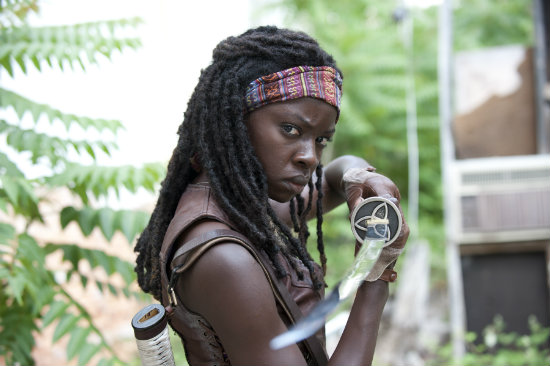
And they don’t fit. As we can see that even “civilised Rick” is marked by his missing hand; the apocalypse has left an indelible mark no matter what veneer of past Rick he wears. We see that they’ve all changed so much that this place doesn’t work well for them. Carl has forgotten how to play - and doesn’t understand kids wasting time trick-or-treating or wearing costumes in a world with zombies to defend against; he even walks around with his own gun when even the adults Alexandria can’t walk around with weapons - his comfort with the weapon horrifies and even angers the Alexandrians. Michonne makes a scene because she can’t relate to women gossiping about such petty issues - and the idea that one woman worries - WORRIES - about cooking food. In a world where Michonne has survived so much, endured so much, she’s presented with a woman who’s worry is if someone likes her food. Douglas even asks them if they mind sharing houses - when they have all been packed into tiny vans and see his “roughing it” as unimaginable luxury.


Alexandria isn’t just safe from the zombies - as the prison was - but the zombies are completely hidden by the wall. In the prison, with the chain link fences, they could see the zombies, they could never ignore the zombies or forget them. The people of Alexandria live in a bubble where they never see or hear the zombies except for the runners looking for supplies. It’s a town of not just safety - but denial.

Wednesday, August 14, 2013

Espirit de Corpse (Reluctant Reaper #3) by Gina X. Grant


Kirsty scythed Conrad – her evil ex-boss who tried to sell her soul to increase the terms of his demonic pact – with Dante’s scythe. All the rules said this was forbidden, but no-one knew why. Until Conrad turned into a demon, escaped from prison and fled to the mortal Coil

Guess that answers that question

Of course, it’s Dante and Kirsty’s job to bring him back since they’re at fault – and quickly. But Conrad has returned to his old company and targeted his daughter and Kirsty’s best friend – Shannon. As if possessing Shannon wasn’t enough, she then gets arrested for murdering Kirsty!

Through all this Kirsty also has to deal with a moody Dante who is Not Happy with Kirsty over the whole scythe thing.


Oh this book. In fact, this series. I can see what it’s trying to do. I can see what it’s trying to achieve. It’s trying to be a very funny, fluffy, light and irreverent story with a slightly ditzy protagonist and lots of zany amusement. Kind of like Mary-Janice Davidson’s Undead series.

But it really isn’t working for me. It’s trying to force all these puns and commentary and it just doesn’t work for me. And everything about the world and story kind of revolves around setting up the next joke or gag so it all kind of doesn’t work for me.

I don’t mind the story in this book – the beginning set up was annoying and the conclusion vexed me, but the middle was pretty interesting. I followed along wondering what they were going to do next, how they were going to rectify things and if they even could, especially from the coil. I was interested and engaged but a little frustrated that they seemed to be more witnesses than participants in the story.

I do give massive points to the awesome judge who set the court room lawyers homework to learn the damn law and banning them from watching courtroom dramas. I cheered that judge. I bow down to this judge. This judge is beyond awesome.

I would really like to see Kirsty involved in a storyline that didn’t come about because of her own mistakes. The second book came from one of her unintentional blunders in the first book and this book is based on her grabbing Dante’s scythe despite knowing there would be (admittedly ill-defined) consequences. If there’s a fourth book in the series, I’d very much like it not to be another episode of “Kirsty D’Arc, scrabbling to clear up her mess. Again.”