Showing posts with label egyptian mythology. Show all posts

Tuesday, February 20, 2018

Stargate Origins, Season 1, Episode 1-3


Ok, full disclosure before I begin this - while I’ve always been sort of intrigued by Stargate and caught several episodes, I came to it late and never really set aside the time to catch up on the sheer size of the whole thing. This leaves me aware of the franchises and the basics of it, I know what a Goa’uld is, who Norse Mythology got added in there and a few of the characters but not much beyond this. I looked on this release as a way to enter the franchise without necessarily needing to know a great deal about it given it’s a prequel; but don’t be surprised if I miss more than a few Easter Eggs along the way - do feel free to draw my attention to them in the comments.

So we have Catherine Langford and her dad Professor Paul Langford who have found the Star Gate at an archaeological dig in Egypt. And they’re all enthusiastic about it until 10 years go past, she grows up and they still don’t know a single damn thing about it. Understandably their funding is getting cut because no-one is going to keep paying for a vague shrug and “I dunno”. You can’t write many papers on that either

Despite that, her father is super Disappointed and Upset that she would actually pursue a career beyond staring bemusedly at an object for 10 more years (nor does he or anyone really acknowledge the impressiveness of a woman getting that kind of recognition. Especially if her prime study has been staring confusedly at an object for 10 years).

We also meet Captain James Beale, a British soldier and impossibly pretty man who is sort of dating/courting/whatever you call it back then her. And his friend Wasif, an Egyptian man and another soldier of the British Empire who is largely dragged around by James and forced to do what Catherine wants because James does in an attempt to impress her rather than rely on his great prettiness.

Catherine and her dad’s scholarly confusion is interrupted by Nazis, which just ruin everyone’s day. Nazi Dr. Brucke, his camerawoman Eva and some collected Nazi extras swoop in with guns and menacing threats and generally speaking accented English but occasionally speaking subtitled German… which really I’m going to need Starget Origins to choose. Either have your characters speak accented English and let us assume they’re speaking German, or have them speak German. Otherwise we have weird times where all these Nazis are speaking English to each other

These Nazis capture everyone and hold them all at gunpoint and try to play the whole civilised monster schtick. Dr. Brucke has done his own research and has basically figured out what the Stargate is, how it works and how to make it work.

Professor Langford’s academia looks rather lacking really.

So, the Nazis force Langford to go with them while leaving a token Nazi behind to guard Catherine since Catherine’s safety is being used to convince Langford to be borderline useful. There is lots of creepy touching her and she bites him and he slaps her and it’s all kind of cliched. Someone needs to say “I likes a girl with spirit.”

They leave her with the weakest of Nazis and she escapes, how surprising.

Tuesday, November 29, 2016

Hidden Blade (Soul Easter Series #1) by Pippa DaCosta


Ace, the nameless one, the Soul Eater, is cursed and enslaved. Banished from Duat, bound to his duty on Earth serving his master and reluctantly linked to a woman who mocks him every day with her presence, he doesn’t have a happy life. The one thing he does want to do is avoid the gods however he can

But when Bastet comes back into his life things get a little more complicated. Not least because she’s his ex-wife


Egyptian gods! Anyone who has been reading Fangs for any length of time knows we love ourselves some good mythology and, surprisingly, the Egyptians are oddly uncommon in the genre, I’ve found. Which is a shame because I’d love to dive into an Egyptian story

And here we have the Egyptian gods in a modern world setting along with a fun, action packed story. And I do really like the plot, the action is extremely well paced but it doesn’t consume the book to the point where it feels like there is no plot as can sometimes happen. I like the characters and their interactions, their complexities and temptations, their histories and difficulties. They work really well together and with the world they’re involved in.

But I find myself somewhat disappointed by that huge potential not especially being examined. What excited me about this was Egyptian gods in the modern world – that would have been exciting and interesting and deep and we could bring in lots of excellent mythology. But… we didn’t really see the Egyptian gods. Oh, Osiris and Isis are there – but they’re just mighty powerful evil people. You could have changed their names to be anything or anyone, they could be powerful mages, fallen angels, pretty much anything which is kind of depressing. There was no sense to me of them being actually Osiris or Isis. They were just the big powerful antagonists the culture, the history, the resonance behind what they are is missing

On top of that, I really dislike how Isis is portrayed – conniving and manipulative? I could accept that even if it is beneath Isis (the paragon wife and mother, the mother goddess, goddess of artisans and maidens and so much more) – but to have her sexually shamed – to have Osiris happily . To demonise her both through her sexuality (and her bisexuality for extra unpleasant tropiness) and using that sexuality as a classic marker of evil/depravity/immorality/corruption would be generally gross with any female antagonist – but to decide to do this with the actual lore around Isis and what she could have been just seems to add totally wasted opportunity on top of an utterly tired trope.

Tuesday, May 20, 2014

Penny Dreadful, Season 1, Episode 2: Seance


In a dark, terrifying and foggy night, a sex worker takes a lunch break, nervous and afraid with the news of a body ripped up from last episode – when the lamp lighter disappears and something attacks her. Blood spatters

Ethan wakes up, somewhat worse for wear, under a pier. There appear to be cuts and blood on his hand. He staggers to an inn to order a hair of the dog. Where’s joined by a fun Irish woman called Brona who happily drinks some of his whiskey. She came over to London to look for work – and saw more and more jobs taken over by the machines of the Industrial Revolution. She’s a sex worker, thanks him for the breakfast and is off to do work machines can’t do – yet.

Frankenstein teaches his new creation to eat, marvelling over him and randomly selecting a name for him from Shakespeare – Proteus. But he has to go out and make money – convincing Proteus to stay and wait; leaving him scared and alone.

He’s calling on Sir Malcolm and Vanessa – Vanessa carefully locks away her writing when Malcolm calls her. He also tells her to unbutton the top of her dress – instructions that don’t phase her. (And Frankenstein’s eyes do blink down to her exposed… neck. Well it is a very high necked Victorian dress).

They take him down to the basement where the vampire lurks, stripped of all flesh, hieroglyphic covered exoskeleton exposed. While Frankenstein studies the body, he talks about his (unsurprising) fascination with Egyptian religion and Vanessa is surprised to discover he has Romantic Poetry in his bag. For all his obsession with science, it is the “ephemeral” that makes life worth living. Vanessa seizes upon it, reciting a poem about man transforming nature. Because she’s cunning like that and later tells Malcolm the doctor has a secret.

Sir Malcolm and Sembene go to see the police about the gruesome murder, and after a token effort to keep the investigation private, he reveals everything. Body parts and organs are missing, but they were not drained of blood – he rules out the Ripper since the Ripper targeted sex workers and neither mother nor her 7 year old daughter were. Malcolm insists on being called into the next crime scene – and he’s sure there will be one.

Brona goes to a very very expensive address to meet with a Dorian Gray. For the purpose of taking risqué pictures – and he seems even more interested in proceedings when he discovers she has consumption and is coughing blood. She warns him against kissing her, for fear he may catch it, and he licks her lip. They have sex while the photographer takes pictures and Dorian gets a special thrill from having sex with a “dying creature”. Which is the least sexy pillow talk, ever.

Ethan gets a message from home – his dad instructs him to return to America since his legal problems have been “taken care of”. This apparently includes paying a federal marshal.

Sunday, March 16, 2014

Grimm, Season 3, Episode 15: Once We Were Gods


“You shall not become corrupt,
You shall not become putrid,
You shall not become worms.”


Well that sounds faintly ominous.

Some builders excavate a hidden room that wasn’t supposed to be there and call in a university person to have a look at the large box they’ve found. Inside is a sarcophagus with an Anubis head. She seems very very happy about this. And the mummy inside.

The discovery is reported on the news and 2 men watching are really angry by the grave robbery. They break into the university, leaving graffiti – and making a noise. A guard arrives and shoots one of them when he woges (jackal wesen?) and leaps on them. He dies and his friend shoots the other guard.

Wu is still in the mental hospital. A meeting of the Grimm scoobie gang has Hank trying to convince everyone that it really is time they tell Wu the truth – especially since he’s been there and was rather unstable when he first caught of a glimpse of Wesen without knowing the truth. But no-one else is convinced – they think Hank has the reassurance of trusting Nick, Juliette can also rely on Nick. Especially since the Aswang is apparently much much scarier than most: Rosalie and Monroe want to see how Wu responds to treatment. For the mental illness he doesn’t actually have. If he doesn’t “get better” they will have to tell him.

To drive home how wrong they are, Wu is in therapy describing what he saw and the nice therapy lady asks how it could have been real if Nick and Hank were there and didn’t see it? Nick and Hank visit him – he seems well but mentions he’s on meds. Reunion is interrupted by a call for the murder at the university

There they look at everything notice the sarcophagus was open, here clear signs of wesen-ness and meet the professor – Vera Gates. She examines the mummy and they see its head is shaped like Anubis’s jackal head under the bandages. The graffiti the men left is hieroglyphs that say “I protect the dead.”

At the police station they tell Renard about the men who broke into the museum, one Canadian and the living man, Karl, Swiss/US citizen who has a record for breaking into museums protesting the “desecration of the dead.” They also tell him about the Anubis mummy – and that Karl may be wesen. Cutting to Karl it’s clear he has someone pulling his strings.

Time to gather the gang and speak to Rosalie and Monroe who agree that you could mummify a Wesen in full woge, though it’s not easy or pleasant. And apparently Egyptian gods often were Wesen, so Anubis as a Wesen doesn’t surprise them. A living Anubis trying to grab the sarcophagus is also not unknown – there’s an organisation called the Beati Paoli that seeks to preserve and protect Wesen culture. They’re extreme and neither Monroe nor Rosalie likes them – but equally they both find the idea of displaying a mummified Anubis in full Woge to be grotesque, sacrilegious and immoral. Yes they feel quite strongly about it.

While Hank, Juliette and Nick hit the Grimm Trailer, Rosalie and Monroe wait for their wedding planner – Rosalie opts against informing the Wesen Council because they don’t want to get involved and it was on the news anyway. In the Trailer they find this ancestor actually left a film (Juliette, seeing the Grimm, vetoes Nick growing a beard) and Wesen on camera who woge are visible to Nick but not Hank and Juliette (nifty bit of world building). Reading they find the pharaohs mummified Anubis with them because they believed it ensured full godhood – but the difficulty of mummifying a wesen in woge meant thousands were killed rather horribly to make it happen. Which is all the more reason why modern Anubis are not amused by these bodies being put on display – and want to give the mummies a proper burial.

Tuesday, February 25, 2014

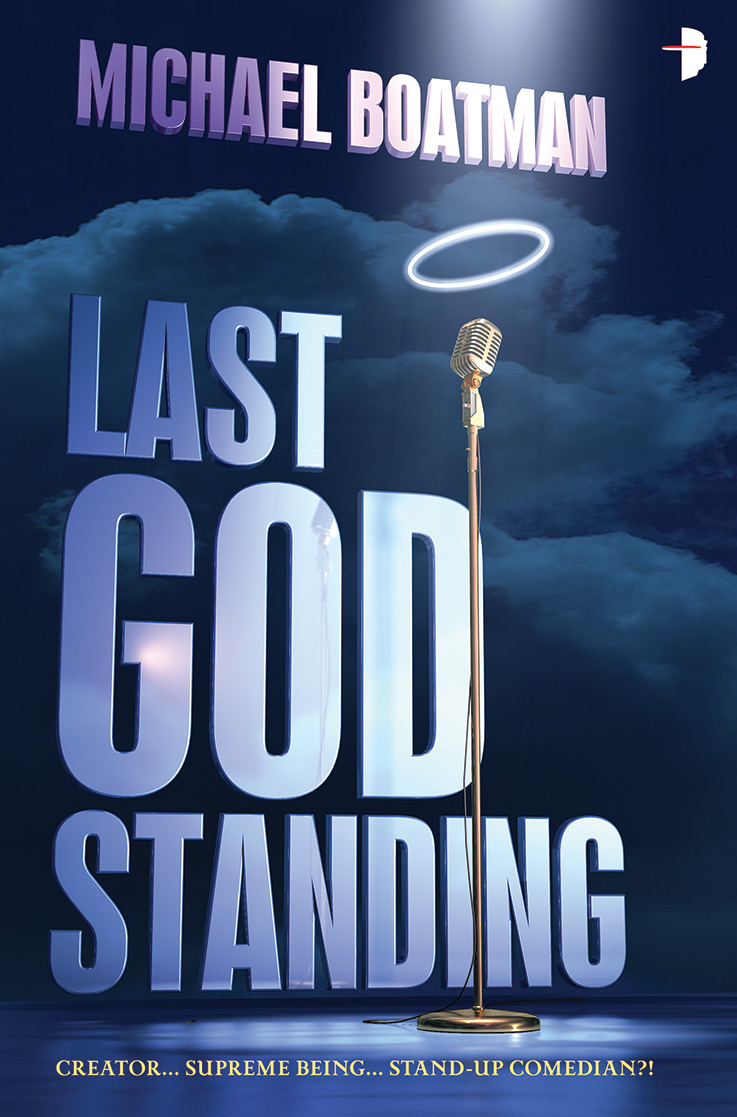
Last God Standing by Michael Boatman

After presiding over humanity for over 2000 years, God has decided to abdicate and live as a human. No, this isn't like when Jesus was born of a virgin; this time his only motive is to simply let humanity get on with it. With Yahweh out of the way, humanity's now lesser deities like Zeus want to step into his shoes and become powerful again.  The battle lines are drawn and now God, stuck in the body of Lando Calrissian (yes, that Lando Calrissian from Star Wars) Darnell Cooper has a war on his hands that he might no longer have the ability to fight.

Last God Standing has a very interesting concept. With all of the horrors in recent history it is hard for some to believe that there is an all knowing being up in the sky directing the hot mess we currently live in.  From the concentration camps, to natural disasters, global warming, environmental decay and income inequality, even the most optimistic amongst us has to believe that humanity is in trouble.  As far as a premise goes, Michael Boatman picked a winner.  Unfortunately, that is the last good thing I can say about Last God Standing.

At times, Last God Standing made absolutely no sense whatsoever.  The entire plot was incredibly rushed and even with that, I found myself struggling to get to the end.  At about the 1/3 I sincerely considered DNFing this book for it's sheer incomprehensibility.  The characters had absolutely no development and felt like cartoons rather than representatives of real people.  Last God Standing is little more than a long winded joke, which when finally coming to end, has no damn punch line.  My deepest regret is that I will never retrieve the hours I invested reading this story hoping that it would at some point live up to its premise.

Not only is Last God Standing poorly written, it is offensive on almost every level you can think of.  It quickly became a written guide to homophobia with f@g appearing constantly without any indication that such hate speech is problematic. When the word gay was not being used as a pejorative, it was operationalized as the punchline of many jokes. Last God Standing heavily implied that real men most certainly were not gay or effeminate. In one passage, Herb refers to gay as a "lifestyle", something that irresponsible men of colour are free to engage in like the "White Man's children," now that African-Americans have made some civil rights gains.  For almost the entirety of this novel, there were no GLBT characters, that is until "Barbara declared herself a "Happy Lesbian," sold her taverns and moved to the Pacific Northwest with her therapist to open a rehabilitation facility."  Boatman filled his novel with homophobia and no GLBT characters until page 300, as though this could somehow redeem the problematic language he engaged in throughout the book.  Just no. No. No. With passages like the following, there can be no doubt that Boatman means his homophobia to pass as comedy.

Thursday, July 4, 2013

Gunmetal Magic (Kate Daniels #5.5/Kate Daniels World 1) by Ilona Andrews


Andrea’s life recently went through an upheaval; kicked out of the Order of Merciful Aid for being a Bouda, a werehyena, she’s trying to get her life back on track working with Kate in their private detective business – cleaning up the magical messes for people who can’t afford to pay the rates the Mercenary Guild charges, nor wish the Order’s unsubtle approach.

But being known as a Bouda means she now has to find her own place within the werehyenas of the pack – being an outsider is not an option. But she has terrible memories of her childhood among another Bouda pack and feels little loyalty or connection to those who would be her people.

Then there’s Raphael. They broke up when she disappeared to try and hold her place in the Order. And he’s bitter and angry and getting revenge. And she’s bitter and angry and willing to dish back. And they’re both still madly in lust with each other – it’s ugly, very very ugly. Especially when the carpet is deployed. Normal people would avoid each other – but as part of her duty to the pack she has to solve a murder of several pack members working for… Raphael.

That murder leads onto a trail of something far worse – something that goes back to Ancient Egypt and could end up destroying the entire city


This is an odd book in that it runs parallel to Magic Gift. The events in both books pretty much happen side by side which is something I haven’t seen often before, especially since they cover pretty much separate events.

There are several things I love about this. Firstly, I love that it shows that the side characters do have a life of their own. Andrea, Dr. Doolittle, Ascanio et al are not just waiting in a plot box, twiddling their thumbs until Kate and Curran need them. They have their own lives, their own activities; things are happening that are important that do not centre around the protagonists. The protagonists are not the only actors in this world and not the people around which everything else simply must orbit.

Another element I loved was that the plot was epic. While Kate and Curran are off doing something relatively small (important certainly, but not world shattering), Andrea is facing off against forces that could devastate Atlanta and more. There’s no assumption that they must get Kate and Curran and when they do get involved it’s just one step along the line, Andrea remains the main actor; she’s still the protagonist. I like that someone else can save the day, the world, other than Kate Daniels, it allows Andrea et al to be truly full characters on par with Kate herself.

Besides the epic, it has the same style, the same perfectly balanced pacing, the same excellent level of description, musing and emotional growth, all with enough to give us full impact and experience without descending (at least not too often) into overdramatic monologues. The dialogue is real, the characters are real, the banter is amusing and it all just comes together extremely well.

This book also has some excellent recapping. Normally I hate recapping with the fiery passion of a thousand suns – it inevitably causes info dumps and the story to be derailed while the author tries to retell the story they’ve already told in a few paragraphs. It doesn’t work. In this it did, part of it is because the world here is so complex that a revisiting of it really worked well – even more so than in Magic Gift. It truly solidified what happened to the city and the world when the magic hit – and further expanded on that by touching on what happened way back in the veils of history before the technology hit – back when magic ruled and gods and monsters roamed the night. The explanation of deity advances the world extremely well in addition to providing plot hooks not just for Andrea’s story, but also information that gives some very juicy possibilities with Kate and Currans.

I just love this world – it’s innovative, original, full of everything you can imagine and far far more. And the author has clearly got a really solid grounding in world mythology and/or spends their lives chained to research books because there’s so much excellent information there. The work that has gone into this series is truly incredible and the realness and fullness of it really shows. Because it’s not just the big things that have been developed – every shapeshifter group has developed its own culture. We have things like the Library of Alexandria trying to replace the lost knowledge with the tech fading. Even side characters, like Roman the dark and evil magician priest who does as his told because his parents nag him (he can recite his mother’s story of the 40 hours she spent in labour with him). The full implications of this radically different world have been considered so it all works well together

Thursday, June 20, 2013

One Silent Night (Dark Hunter Series #10, Dark Hunter World #17) by Sherrilyn Kenyon


Stryker, for reasons that don’t make sense to anyone, has decided he is finally going to bring down Acheron and Nick once and for all – by unleashing the very essence of War. A deity only the combined might of several pantheons – pantheons that are no longer complete – managed to defeat and imprison before.

Things do not go as planned.

Not least of which is the rise of old powers – powers older and greater than even War himself rising to make his mission difficult. And Artemis, rather annoyed with Stryker, sends her own assassin – Zephyra, the woman he wished to marry when he was 14, the woman he has spent 11,000 years missing, the woman he abandoned and a woman who most certainly wants him dead.

Almost completely certainly. Almost


This book failed terribly for me. Utterly and awfully – and it did it in many ways that are almost too long to list so I shall stick to the most annoying of them.

More than anything else, there is one fact that breaks this story for me. It’s a number: 11,000 years.

See, in the Dark hunter series just about everyone is older than god – and this has only become more pronounced as the series has possessed. At this stage mere 2,000 year old people are positive children! No, it’s 10 millennia or nothing!

The problem is absolutely no-one acts like it. In fact, most of them would be pressed to act like they’ve hit their 20s. Now I know there’s some backing to this in that the series is heavily based on Greek Mythology and there are few deities more inclined to childish, petulant overreactions than the Olympians (except, maybe, the Norse) but there’s a limit. It’s a problem that has been growing through the series and it really is the straw breaks the camel’s back on this one. Nick, in his mid-20s, acts no less mature than beings that have been around for literally longer than recorded human history (and he acts like a whiny child far too often).

So we come to the two main characters Stryker and Zephyra (which has to be shortened to Phyra for no damn reason than women needing to have a cutsey pet name to denote them as love interest). When they were 14 (yes uckies, but they rely on the history of the time to justify it) they were engaged to be married, briefly. But Stryker’s daddy said no (Apollo) and to marry the woman he chose. Stryker agreed because he eternally sought daddy’s approval and abandoned the pregnant Zephyra who was hellciously pissed.

That’s the history – fine. And from that we know that a) Stryker regrets leaving Zephyra, b) Styker has daddy issues (oh boy does he) and c) Zephyra hates Styker with the fiery passion of a thousand sons. Fine, I can sign off on all of that – if they were, say, still in their 20s. But they’re no, they’re 11,000 years old. 11,000. Eleven millennia. One hundred and ten centuries.

Zephyra has maintained her vast, all consuming hatred for her ex dumping her for 11,000 years. This is beyond restraining order territory. If you found someone still bitter and seeking the death of their ex 20 years after the break up you’d consider them to be a disturbed and frightening person. Yes he dumped her. Yes he was cruel. Yes it was tragic – but it was 11,000 years ago. Move on already. I can’t dredge up the slightest sympathy for someone who has managed to cling to burning hatred and sexual tension for 11,000 years

Much the same applies to Stryker “daddy likes my sisters more than me and said mean things!” Stryker, you are 11,000 years old. 11,000 years. By all means hate Apollo for the curse he has put on his people – but to run around looking for a pseudo-parental figure, apparently the source of his angst with both Acheron and Appolymi is ludicrous. I don’t care how mean your daddy was, when you are 11,000 years old it’s time to put on your big boy trousers and look beyond parental validation.

And the patronising way they treat their daughter is utterly ridiculous. That would be the same daughter they had aged 14 – meaning she is also 11,000 years old. At that age being 14 years older than someone hardly grants you even the slightest hint of parental authority – it’s ludicrous, it’s farcical and just adds to how much these characters fail to act anything remotely like their incredibly vast ages.

The second biggest break in the story for me is this series eternal power creep. When it began we had a wide world with one big, overwhelmingly terrifying horror lurking in the base – Appolymi, the Atlantean goddess of destruction who would cause an apocalypse if she was ever released. This was the big bad everything was terrified of. Then there was Acheron, her son, the Deus Ex Machinae who kind of drops in to unleash his awesome powers whenever a story needs resolving. Ok, I can work with that, both have limits by Acheron’s morality and Appolymi being stuck in hell. Then there were the Cthonians. And Savitar. And probably Jaden. And now there’s War, the Sephiroth and the Malachai.

The book is LITTERED with ridiculously over-powered stronger-than-all-the-gods characters. It doesn’t make the book more epic – because the writing doesn’t support the epic – there are no grand epic confrontations, there are no grand displays of epic powers, there is no real tension written in the book, no great scenes telling us what epic powers are about to clash – it’s just clogged with super powerful beings. The fight scenes were clumsy and distinctly unimpressive and it was pretty impressive that we had all of these uber-beings dancing around but there was no attempt to actually write them with any kind of interesting uber-powers. And the beings who HAVE had that epic established – Appolymi – now has bodyguards! Which really makes me question the previous books in the series when she was the thing to fear above all else.

Related to that we have moments were it seemed they were going to work on the epic – Zeus and all the Olympians gathering to stop War, an appearance by Hades and Ares and the Egyptian goddess Ma’at. We even had a moment where several of them, along with Artemis, were willing to go into battle and we never even saw it. You don’t even have to work to make these characters epic! They come pre-epicced! They have entire mythologies and belief systems behind them to make them epic.

Wednesday, May 8, 2013

The Grimoire of the Lamb (The Iron Druid Chronicles, #0.4)

Okay to start this review, I feel it necessary to give full disclosure that I am totally a Kevin Hearne fanpoodle.  This means that this review will probably just consist of the obligatory fanpoodling that happens when one of a readers favourite author released a new book.  Lucky for you, The Grimoire of the Lamb is a novella so that means you won't have to tolerate much of my poodling. 

The Grimoire of the Lamb is set four years before the events of Hounded.  This means that  while we still get Atticus and Oberon having an epic adventure in Egypt, Granuaile is missing.  It all begins when a man from Egypt calls with the hope of purchasing one of Atticus' rare books. Nkosi Elkhashab is desperate to get his hand on the a grimoire, which appears to have nothing but recipes for cooking lamb, but Atticus decides that there has to be more to Elkhashab's desire than ancient culinary delights and does some research. When he learns that the grimoire contains 13 spells, which Elkhashab wants to use to "restore Egypt to its rightful place as supreme among the world," Atticus realises that no matter what happens, Elkhashab must not be allowed to possess it. 

When Elkhashab manages to undo Atticus' magic and escape to Egypt, Atticus and Oberon have no choice but to follow.  Like every other pantheon,  Atticus is not exactly very friendly with the Gods.  Before Atticus can even deal with Elkhashab, he must find a way to make peace with the goddess Bast, whose holy book he stole centuries ago.  

Tuesday, December 18, 2012

Review: Deadly Descendant by Jenna Black, Book 2 of the Nikki Glass Series


 Nikki, descendant of Artemis is awkwardly fitting into Anderson’s house of Liberi, while still trying to maintain some semblance of independent existence – not helped by her work place burning down and having to work for Anderson as well.

A further complication is Emma. After her deeply traumatising experience with the Olympians, she has become increasingly unstable and difficult to be around. Her fights with Anderson rock the house – and her jealousy has focused squarely on Nikki.

There’s a new Liberi in town, one who is hunting innocent civilians with a pack of wild dogs. Even the Olympians want to track him down – not that they care about innocents, but they want him found before he exposes them all to humanity.  Of course, when it comes to tracking someone down there is no better candidate than the descendant of Artemis.

I do really like this world setting - I’m a mythology geek, I always have been. Throw in some ancient deities and you’ve hooked me – and this world definitely hooked me. The descendants of the gods with their arcane abilities, battling against the supremist and cruel Olympians, a full range of different pantheons (even if they do have a Greek focus) are really well done – and I just would like to see more. There are some gems of characters as well – I think Jack, descendent of Loki – always playing his own game, never really sure what he’s up to, but always having so much fun is definitely one of my favourites.

The plot itself was largely solid and decently paced – expanding the world well without inundating us in unnecessary world building. We have a mystery that Nikki has to solve, murders to stop – her motivations are detailed, her thought processes reasonable without too much in the way of monologue and the investigation proceeds in a reasonably well paced way. Some of it is short cutted by her Artemis power that makes her a gifted hunter, but it doesn’t make it merely a matter of “ding lookit my magic”, she does actually have to do some work. In fact, I’ve seen detectives in other novels who have made far greater, illogical leaps to convoluted solutions than ever Nikki has. I don’t think the plot was especially complicated – there were twists but they weren’t unexpected or major – but nor was it totally linear because there w If there’s any fault with the plot it’s that some character development wouldn’t have gone amiss for some of the side characters who are little more than names. A little day in the life of Nikki before the plot launched wouldn’t have been a bad thing. As it is, we’ve never had chance to establish a “baseline” for how the Olympians live – or even what half of them do all day. We have some really nice hints (like Maggie’s romance novel war) and some odd diversions (does it matter if someone’s drinking tea or coffee?) so I really do hope it could come in a future book.

I did feel Emma’s antagonist was excessive, unexplained (and, no, “she’s crazy,” isn’t an explanation) and spotted by Nikki before there was any reason to believe it was going to happen. Since a large part of Nikki’s motivations rests upon Emma’s malice, I think it added a weakness to the plot (and I don‘t understand why it’s necessary to have a protagonist lie to her allies so she can go solo in a dangerous situation). Except for that, her motivations, her conflicts and her actions make sense and continue to develop her presence in the house. I like that she hasn’t instantly decided “this is my home, these are my family” she is taking time to adapt, to fit in – and is still feeling very much the outsider in the home. I do wish she’d interacted more with the characters she had formed some kind of connection with – like Maggie – but it did emphasise just how much the house was not her home.

I’m torn about the female characters in this book. Like before, there’s still a considerably lower number of women than men but the problem is compounded by the nature of the women who take centre stage. In this book Steph and Maggie are both largely absent (though, again, we swipe at the men’s silly dislike of having Maggie carry things despite her super strength) which is a shame because they’re both good, interesting characters. Instead we have Phoebe (evil evil Olympian oracle who Nikki declares her hatred of within seconds of meeting) and Emma (evil evil woman who Nikki declares her hatred of within seconds of her first appearance).  The problem with the way Emma was written is that she was, in some ways, written the wrong way round. Nikki expresses how horrible Emma is, how evil and malicious and nasty (and frequently adds the word “bitch”) BEFORE Emma – who, we have to remember, has been tortured, raped and traumatised for the last 10 years – really shows us any behaviour to justify the depth of Nikki’s contempt. I’m left feeling that Nikki is a rather horrible person that doesn’t really go away even when Emma does develop into the hateful, jealous unstable enemy. And just the way Emma was written bothers me – she was tortured for 10 years, she was raped, she died repeatedly and came back, a harrowing experience, but there’s so little sympathy for her. She’s an enemy from almost the opening of the book – at best a nuisance, at worst a malicious, evil force.

Monday, August 20, 2012

Review: American Gods by Neil Gaiman


 Over the centuries, gods have come to America. From the Norse with Viking explorers, from West Africa with the Slave trade, from the British Isles with immigrants, from Eastern Europe and India and a thousand other places and – of course, from the Native Americans themselves. Gods have arisen, sustained by belief, worship and sacrifice, and they have fallen. Fallen as they lost belief and fallen still further as their very names are forgotten.

But Wednesday is not putting up with falling into obscurity, nor is he allowing the new gods of media and technology to easily brush him and his fellows aside. Employing Shadow, a newly released convict just trying to put his life together after serving his time, Wednesday is determined to rally the old gods lurking in the shadowy corners of the US into a force to fight back.

But it’s not all easy – the new gods are fighting against obsolescence themselves in a country that doesn’t welcome deities – and they’ll kill if they have to. And then there’s Shadow’s ex-wife. Ex because she’s dead, not because he divorced her, who is still hanging around. And, as Shadow plunges deeper into this world of gods and Ifrit and leprechauns, as he learns more about how the world really is, he also finds that Wednesday is far more cunning than he expected.


This is perhaps the most original concept I’ve come across in a long time. The different deities of all kinds, fighting for survival, fighting against new interlopers and even the way deities have had to learn and adapt over the years to integrate into human society. I loved the style of this book, the slow reveal as more and more elements are added to the whole, the slow revelation of what is happening and the powerful depth the world was given. At every turn new layers are added to the world, extra facets and extra depth. All the different ways the old gods reached the US, all the different ways they were worshipped and sacrificed to and how they ultimately ended up as gods in the US. It was a really well built, slowly developed world.

I also had – as a great lover of mythology – lots of fun picking out the gods and recognising them before it became clear who was what. It was fun – and it showed that a truly massive amount of research has gone into this book. The number of different traditions, the number of deities, including some pretty obscure ones, and the amount of knowledge of each one shows a massive amount of reading and familiarity which really impressed me. It gave the world a depth and a richness that far exceeded my expectations, which were already pretty high.

Thursday, June 28, 2012

Review: The Darkening Dream by Andy Gavin


Sarah is a brilliant student in Salem, Massachusetts in 1913. She has a very promising life ahead of her with her brilliant mind, albeit she’s less than pleased with her family trying to set her up with nice Jewish boys, especially when Alex, a new and intriguing boy moves to the area.

Of more concern is Nazir – an ancient and powerful vampire that has also arrived. Working with a local Warlock for an even darker power, they seek an ancient, holy artefact. Vampires, warlocks, demons and even vengeful Egyptian gods are all gathered to seize the prize.

And Sarah is the one called upon to stop them. But she has good friends and a surprisingly powerful family history and with faith, magic and determination she refuses to step aside – whether that battle takes her into fetid vampire lairs, cobbling together half understood spells to save the lives of young children or stepping through angelic portals to fight among angels.


I love the world that is created here. While none of it is unique in itself – the elements of demons and magic and vampires together makes for a very rich combination. It also harkens back to the original core of vampires as a monster in horror stories rather than the current, romantic depictions.

Nasir isn’t just a bad guy, he is out and out evil, complete with terrifying bat form and bug-eating servants, he is Dracula as Dracula was, an insidious threat to be feared and fought rather than a romantic character to embrace.

The world also draws on a of divine imagery with heaven, hell, archangels and the power of faith which instantly sets the story up with an epic feel. It has a strong sense of being much more than a fight for a few people or just one object, but with massive forces in the balance.

And part of that is because the world is very well built. Magic doesn’t involve just saying a few words and waving your hands, there is ritual and rules. Some of them very complex and requiring an almost scientific knowledge. It’s great to see a well thought out world that has magic with systems rather than shiny hand waving. And, of course, this is built on a considerable foundation of research that is always impressive to see – I feel that the author has done a lot of reading on Judeo-Christian theology and mythology and the fullness of it is really there in the text.

As to the romance element – I didn’t dislike it but nor did I particularly like it. I think it was unnecessary – a deep friendship would have served as well - but it didn’t derail the plot. Perhaps it did help destroy the sense of time and place, but, frankly, that was already hanging on by a thread.

Thankfully the story was really well paced and switched point of views smoothly enough between Parris, Nazir, Alex and Sarah that the romance, while adding nothing, couldn’t detract from the story either. The action and tension is well maintained throughout, the downtime explained and never drags and there are no moments where I’m left wishing they characters would move faster – nor are there any moments where I felt lost or rushed, except at the end.

At the end of the book we have a twist – it’s a well foreshadowed twist that is really well done – it can be predicted but only if you’ve been paying attention as the clues were there but not overt lampshading. It adds an extra nuance to the end of the story (which works really well into the book’s cliffhanger ending) and promises more depth to follow. Yet, at the same time, we’d just had the big, epic confrontation and this felt a little tacked on the end. Perhaps it should have left off with a hint and moved this part to the next book. Having the big show down and then action afterwards feels vaguely like winning a big sports match, sitting down with a cup of tea and having someone drag you up again to go to the gym.

Thursday, June 7, 2012

Blood Ties, Season 1, Episode 10: Necrodrome


Let’s start with more fun flirting between Henry and Vicki always a good beginning. Especially since they’re tracking down a nice, mundane cheating husband which is so often the bread and butter work of a private detective. Not sure why Vicki has brought Henry along, but it’s become the norm now.

And the case of the week – we’re in an odd funeral home were 2 odd men are doing some very odd things to a dead body. Even more oddly, an odd figure in an odd mask puts something on the corpse’s mouth which makes said body, oddly, move around. How very odd.

Mr. Olienov, runs a funeral home in which he has to explain to a woman why her nearest and dearest’s body is not actually around for her to bury. She’s rather upset, as one can imagine as corpses are not normally mislaid. He has hired Vicki to find the body (a man called Diesel – a boxing champion) at the recommendation of the awesome Dr. Mohadevan, the pathologist. Because she knows Vicki can handle the freaky cases – including the security camera which shows a strange masked man’s oddness and the moving corpse which would be hard to show to the police.

Time to show the video to Henry and some more intense flirting – he is good at it, I’ll give him that. Yes yes he is. Anyway Henry, seeing a corpse get up next to a man in an Egyptian mask declares it to be Egyptian Necromancy. Well, he’s a font of knowledge this guy. Go back to flirting Henry. Vicki concludes that the man must have known his way around the funeral home since he avoided the cameras, picked the right doors etc

Time to speak to someone who knows Olienov – the awesome pathologist Dr. Mohadevan! And as she does, she makes the fantastic and amazing sound mundane. And how a resurrection (or Easter Weekend) is just a very annoying thing to happen in a funeral home. She’s very passé about it, in her work they see so many things that are strange (as we’ve seen in past episodes). Henry as one of the undead also gets a little tetchy about the use of the words “reanimated” and “resurrected” interchangeably. Vampires are resurrected – they have life and free will. The reanimated are puppets in the hands of their controllers.

At the funeral home again Vicki meets the son of Mr. Olienov who hits a solid 100 on the creepy scale. She goes to interview Diesel’s wife, Darlene, who fills Vicki in on his glowing boxing career and how it ended with an overly harsh penalty of a 10 year ban for betting on himself. Which leaves Vicki the oh-so-fun task of explaining the supernatural to Celluci again. He doesn’t play sceptic at least, but he does play “too busy to care”.  Am I supposed to like this character again?

Back to Henry for more flirting and more exposition of Egyptian belief in the afterlife, which is nicely dropped in and shows some decent research. I do appreciate that about this series, they do try to include some research into mythology.

Move on to the baddies at the Necrodrome. Yes a fighting ring where reanimated dead are made to fight each other – until one, well, dies.

Monday, April 9, 2012

Dresden Files, Season 1, Episode 2: The Boone Identity


This episode Harry has a client who wants him to communicate with the dead – which is far from his favourite thing but far be it from him to be picky. The client keeps feel his daughter’s presence, but Harry feels nothing. The girl was killed in a robbery at her father’s antique store – when a man killed her, stole an artefact then died stealing someone’s car to try and escape.

The ghost doesn’t take kindly to Harry not believing and treats him to a flash back of the events of her death.

Of course, speaking of annoying ghosts, we have to flip to Bob while Harry and Bob discuss exactly what the ghost was trying to show Harry and why, while Harry cooks dinner (I actually quite like to see protagonists do mundane things like cook – so many of them seem to live on air and none of them ever ever ever need to go to the bathroom).

But the ghost won’t move on so Harry is going to follow it up – so he goes to bug Murphy, his handy-dandy police contact, to get the files on the robbery (which involves an unnecessary side-trip to info-dump flirty lady) to find that the person who shot Boon (the thief) during the carjacking gone wrong was a very rich Mr. Miller. Info-dump lady also has the ancient Egyptian tablet – the lock of Anubis – that has been shattered.

Harry goes to visit Miller as a representative of his client to talk more about Boon’s death – and finding a statue of Anubis in his home. Of course, Bob is very very good at pointing out that this is hardly a massive coincidence, but his doubts are treated as unreasonable as opposed to, well, perfectly reasonable. I have to divert a little here to question the idea that so many Urban Fantasy writers think this kind of knowledge is soooo rare. Anubis is not exactly an obscure deity, someone having an Anubis statue should not instantly link them to any kind of Ancient Egyptian paraphernalia any more than a woman wearing Ankh jewellery is secretly an Egyptian Sorceress.

Still, we make the leap and decide that this points to a link between Miller and Boon, just in time for Murphy to turn up to ream Dresden out for harassing Miller – and thankfully Murphy also treats his Egyptian art link as highly dubious.

Of course Harry ignores this warning and goes to check up further – and finds that his client was selling the Lock of Anubis online – and finds that a prisoner bid on the item while it was for sale. A Professor Sabin, a professor ancient Egyptian mythology who mummified a kid alive (why… why would he do this? I mean, Egyptology 101 makes it clear that mummification is not something practiced on the living… how would obsession with Egyptology lead to this?). The ghost also helpfully nudges them towards Sabin.

So Harry goes off to see Sabin in prison and found that Sabin and Boon were friends who discussed Ancient Egyptian funerary rites and finds that Sabin has an Egyptian tattoo on his neck just as Miller has – and apparently so does Boon. This startling evidence he takes to Murphy who….. treats it with the contempt it deserves.

Of course, Dresden’s wild theories are justified when someone starts shooting at him from a car. Dresden takes it to Murphy – as he should – but then accuses Miller of copycatting Boon because the attacker wore a ski mask and carried a shotgun. Really? This is copycatting? Using a gun and concealing one’s face are not the hallmarks of a copycat. This isn’t an MO – this is drive-by shooting 101.

Then he gets to see the autopsy photos of Boon and sees he doesn’t have the tattoo Sabin mentioned. But looking back through the records they find he had them in prison.

And this leads to Murphy joining Harry to interrogate Miller… why this 180? Because Boone, a known criminal, has been researching Miller, a wealthy man. Uh-huh. She then goes with Harry to confront Miller on their evidence - an interest in Egyptology and similar Egyptian style tattoos. Yes, this is some crack evidence here. Murphy theorises that Boone stole the tablet for Miller and then dropped it – so Miller shot him (in the street in public no less) to punish him.

And then Harry strikes on the idea that Boone’s tattoo wasn’t transferred using the tablet allowing Boone to transfer bodies to Miller (and that he’s planning on moving to a new victim soon). Hey it makes as much sense as Murphy’s theory. And it’s right! So rather than dismissing Harry as being ridiculous, Miller snaps and holds Murphy at gun point – then kill himself and leap to Murphy’s body. Boone/Murphy shoots Harry – but his magical shield bracelet from his mother protects him.

Thankfully earlier in the episode Murphy cut her finger on Dresden’s door – allowing Harry to use it to create a voodoo doll (Voodoo as black magic again, alas this is an over-tired trope to say the least. It’s not like Harry doesn’t have enough options of sympathetic magic in European traditions that he actually draws upon) to attack Murphy’s body. Bob is not impressed by Harry’s use of black magic. Bob presents a great alternative plan but Harry is insistent on his plan. And he needs a banishing spell to get Boon out of Murphy, but Egyptian magic isn’t Bob’s speciality and Harry goes to Sabin instead – as a professor of Egyptology who told Boon about the lock of Anubis to begin with.

Next to flirty info-dump woman to get the lock of Anubis and then uses his voodoo doll to hurt Boone/Murphy and convince him he can reach Boon/Murphy wherever they go, goading him into hunting down Harry and kill him to be free.

Thursday, February 23, 2012

Review: Shadow Fall by Seressia Glass, Book 3 of the Shadow Chaser Series


Kira is faced with a lot of revelations in this book. Balm has presented her with a package full of all the answers to the questions she always asked. Who her parents where, why she has her powers, why she was raised by the Gilead – a Pandora’s Box of answers, if Kira feels she can face them. But some truths are hard even for the hand of Ma’at to face.

Even simpler truths abound – such as exactly what she feels for Khefar, the 4,000 year old Nubian warrior who remains the only man she can touch and who is sworn to destroy her if she falls to shadow. And then there’s her friends – and what they feel about her after her many brushes with shadow magic.

But more than that, she has to face a shifting understanding of the world – of the shadow magic inside her, as a part of her and with both the Lady of Balance and the Lady of Shadow having a claim on her as much as the Light did. And if these questions weren’t hard enough, she suddenly finds her advisors silent – Balm, Ma’at and Anansee. What she does have in their place is the Lady of Shadow – and Set, the Egyptian god of Chaos who is also staking his claim on Kira


Story wise, I’m afraid I wasn’t enthralled. A large section of this book is spend with Kira realising she has Shadow magic in her as well as Light magic and that it isn’t infected into her, it’s actually hers through her ancestry. She has to deal with recurring nightmares of Set, the very avatar of chaos in her own pantheon. And this is huge. I mean, after so long believing all things shadow is evil (and for good reason. In fact, brief tangent, if we’re going to talk about “order” and “chaos” and “balance” it would help if the shadow weren’t presented as entirely and utterly evil) and then realising that it makes up part of her ancestry? Believing she has this evil in her blood? Believing she is going to be inexorably pulled towards this evil – something she fears so much that she asked Khefar to not just kill her but unmake her entirely should she succumb? Yes, this is going to disturb Kira. She is going to spend a lot of time very upset about this, very worried about this and spend a lot of time being, well upset and worried.

So I’m not concerned with it being realistic… but it is a lot of the book spent on this. And while it makes sense that she would be rather overwhelmed by it, I just don’t find it a particularly fascinating read – as the turmoil just keeps going on and in great detail. And it doesn’t help that there isn’t a great deal of other plot to balance it or hold it down. It’s ironic really because Kira continually laments how little time she has but doesn’t seem to actually do an awful lot.

We also have a scene were Kira decides to witness the werehyena challenge for succession. Which she does and it’s interesting, gives an insight into a few things and general fun to read but… it adds nothing to the story. It’s just this orphan scene dropped in there for no apparent reason. There are other similar scenes – like the big tense showdown with the banaranjan on the top of the Gilead building. I’m not saying they’re bad scenes – they’re not, they’re good, they’re interesting they add to the world and I enjoyed reading them – and normally I wouldn’t mention them. But these scenes, added to Kira spending so much of the book in self-analysis and worry and general little attention to the main plot line until the end of the book. The plot line, when it arrived, was epic, powerful and full of great climactic scenes of awesomeness – but it was a bit late coming

I repeat again, these weren’t hard or boring scenes to read. Nor was Kira’s upset unrealistic, out of character or in any way wrong. But I would have preferred more focus on the main plot, reaching the main plot earlier and generally more involvement of the main plot. I still enjoyed reading all of these scenes and thought they were well written and added to this wonderfully rich and complicated world. I love this world, I love the forces of light and shadow, the three ladies of light balance and shadow. I love the ancient Egyptian pantheon, love the different magics and the vast number of different hybrids and not just following the same tropes of vampires and werewolves.